


Ireland gave South Africa’s centres little room to work. At Twickenham on Sunday, Libbok gets the first pass and Sacha Feinberg-Mngomezulu gets a view of the same defence from fullback.
Robert Baloucoune had scored twice on the Irish wing before either Springbok centre had much say in Dublin. South Africa eventually came within three points. Both Bok tries owed their beginnings to the forwards, and neither came from sending a man into space out wide. That is the piece of the 20 – 17 defeat by Ireland that makes Manie Libbok’s return at flyhalf particularly interesting.
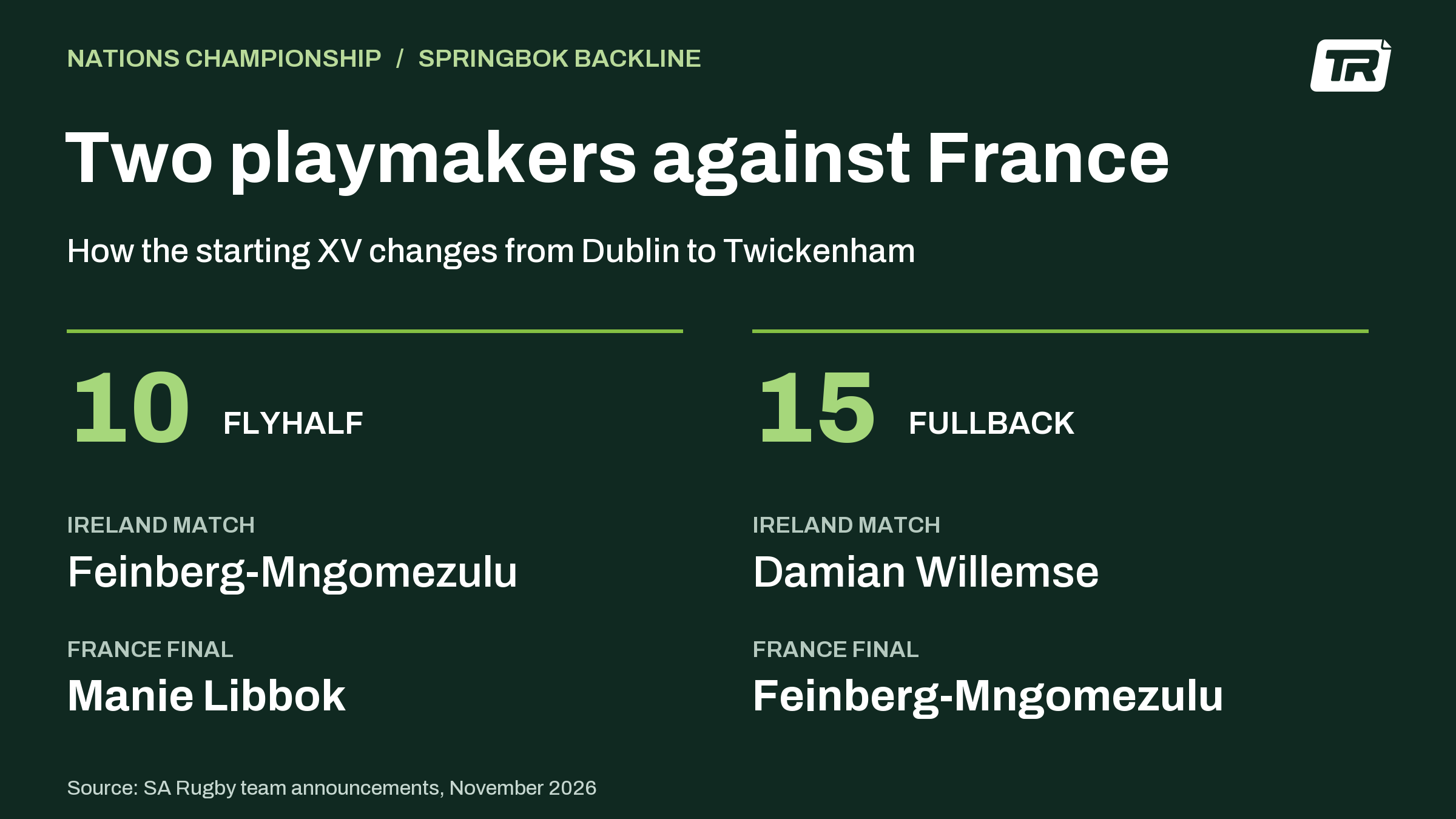
South Africa face France in the first Nations Championship final on Sunday, 29 November. Cobus Reinach will feed Libbok from scrumhalf. Outside them are Damian de Allende and Jesse Kriel, with Sacha Feinberg-Mngomezulu moving from flyhalf to fullback. For the two centres, the important change is who gets to see the French defence first and how much time he leaves them to act. SA Rugby’s final backline puts two men accustomed to making that decision on the field together.
What Ireland took away
The three-point margin mattered enormously in the standings. The losing bonus point drew South Africa level with New Zealand, and points difference put the Boks ahead. Under the competition rules, the highest-ranked southern team meets the highest-ranked northern team after six rounds. South Africa could lose in Dublin and still earn another game against the French side that had beaten them 21 – 19 a week earlier.
On the pitch, the margin told a less flattering story. Ireland rushed up in defence and got the better of the contest under the high ball. For Baloucoune’s opening try, Stuart McCloskey sent a pass over the defence to the right corner. For his second, Mack Hansen found the same wing after Ireland recovered possession. South Africa had a way back through their pack. Morne van den Berg and Malcolm Marx scored, and Feinberg-Mngomezulu converted both tries. After the second conversion, the score stayed at 20 – 17 for the last 20 minutes.
On Sports Report, Jam Jam saw two sides to that performance. Ireland deserved credit for recognising a weakness in the Bok backfield and kicking at it. In possession, he wanted South Africa to give their centres more opportunities. His preference for Libbok turns on a distinction most easily seen from the stands. When the flyhalf spots a gap, does he run for it himself, or can he get a team-mate there before it closes?
What changes at ten and fifteen
There is a practical reason why the coaches could revisit that question this week. Damian Willemse picked up an injury against Ireland. Moving Feinberg-Mngomezulu back to cover him opened the flyhalf position for Libbok. It was one part of a selection with seven changes of personnel and one positional switch. Reading it as a verdict on Feinberg-Mngomezulu’s future at ten would put more weight on one team sheet than it can bear.
Consider the pass De Allende wants to receive. If the defender opposite him is already set and square when the ball arrives, the centre has to win a collision before anyone outside him can advance. If Libbok can draw that defender a step infield before releasing the ball, De Allende can attack a shoulder. Kriel, one pass further out, can keep running instead of stopping to help secure possession. Passing earlier is only half the skill. The defender has to believe Libbok might keep the ball.
At fullback, Feinberg-Mngomezulu can choose where to join that move. He might arrive outside Kriel, or take a second pass from Libbok behind the centres. There is a price to that freedom. When France kick deep, the fullback has to turn, gather and organise the exit. The contest Jam Jam identified in Dublin will decide how often South Africa get to use their extra distributor at all.
Jam Jam’s pick is South Africa by five. There is a more revealing early measure of his reading of the game. Watch Kriel when De Allende takes his first few passes. If Kriel is running onto the ball with a French defender still turning towards him, Libbok will already have given the Boks something they struggled to find in Dublin.