Dawie Roodt’s warning about the economic importance of local government has a stark counterpart in the public accounts. Restoring services requires funding, but the case for protecting residents cannot become an excuse for protecting those responsible for failure.
In July, South Africa’s Treasury confronted a choice that exposes the municipal crisis more clearly than any election slogan. It could keep withholding money from councils with serious financial governance failures, or release funding to protect basic services. Finance Minister Enoch Godongwana announced that the remaining withheld transfers would be released from 31 July. He explicitly said the decision did not mean the affected municipalities had met the requirements.
The money would move because residents could not safely be made to bear the immediate consequences of institutional failure. That was a defensible concern. It also exposed the danger facing every attempt at municipal reform: when the public cannot afford a council to fail, those running it may escape the consequences of failure.
This is the difficult ground beneath economist Dawie Roodt’s argument that local authorities sit at the centre of economic life. Speaking to 702 in August, the Efficient Group’s chief economist put it plainly: “without electricity, without water, without the pavement, you cannot have an economy”.
The practical implication is clear. A firm cannot turn a national growth forecast into production if its premises lack water or dependable distribution infrastructure. For a household, municipal performance determines whether paying an account buys a working service or merely sustains a claim against an unreliable institution.

What the audit figures actually say
The latest consolidated municipal audit report, covering 2024/25, records 39 clean audits among 257 municipalities. Another 117 received unqualified opinions with findings; 86 were qualified, five adverse, eight disclaimed and two outstanding at the report’s cut-off.
Those categories matter. An unqualified opinion means the financial statements are fairly presented in material respects. A clean audit additionally requires no material findings on the reported performance information and compliance matters examined. Combining every council without a clean audit into a single category would conceal substantial differences in what auditors found.
Of the 257 municipalities, 156 received unqualified opinions, including the clean audits. A qualified opinion is a different, specific finding. The evidence therefore warrants precision alongside criticism.
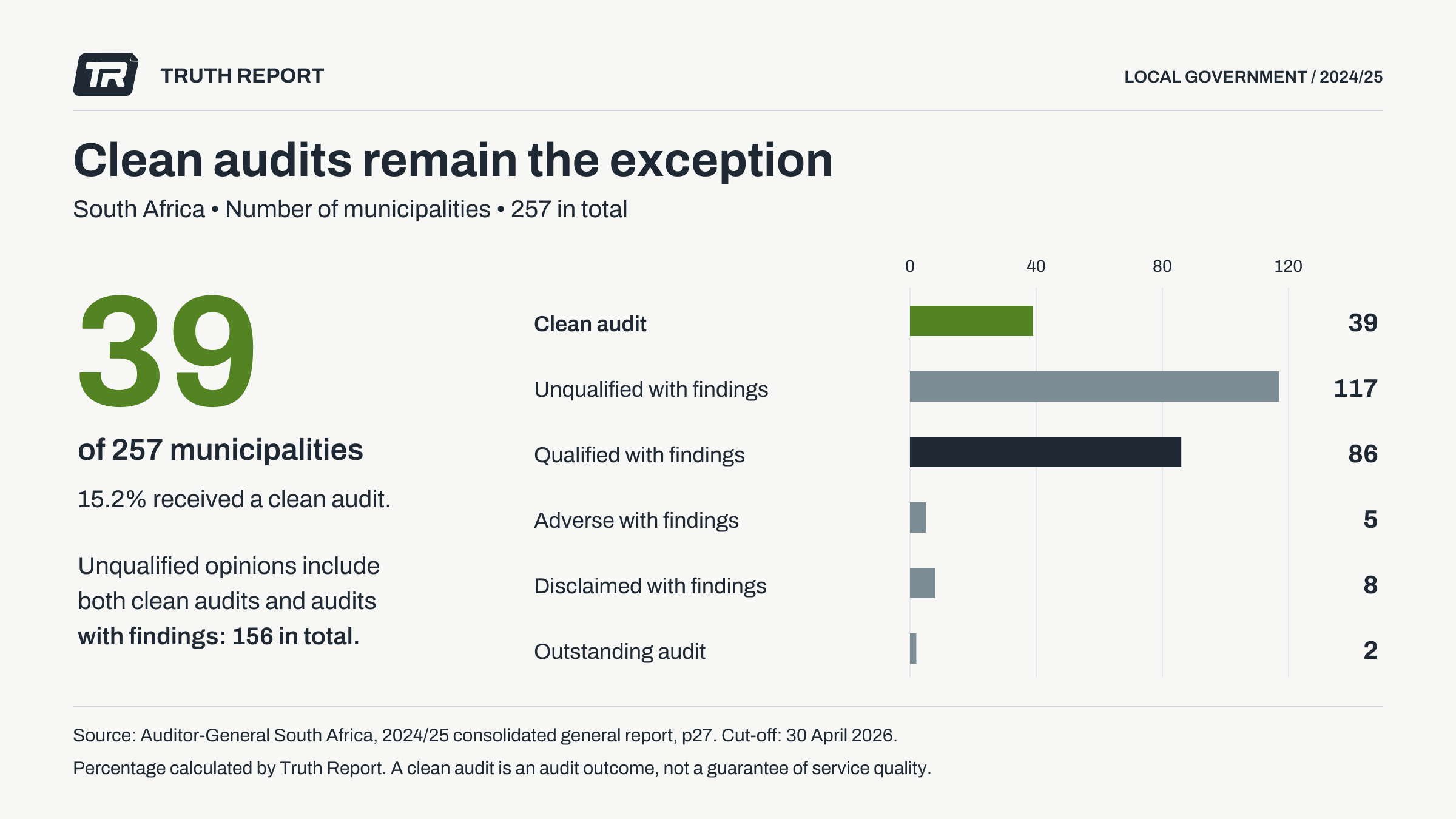
Total: 257 municipalities. Reporting period: 2024/25. Cut-off: 30 April 2026.
The stakes extend well beyond bookkeeping. The Auditor-General’s June release reports that none of the eight metros achieved a clean audit in 2024/25. It also records non-compliant wastewater discharges at 22 of the 35 treatment works inspected. That inspection finding concerns those facilities; it is not a national census of every sewage works.
An audit opinion cannot by itself tell a resident whether tomorrow’s tap will run. These findings nevertheless show why financial controls, infrastructure management and service delivery must be assessed together. A municipality that cannot account reliably for assets, procurement or repairs makes it harder to establish what needs fixing, what has been paid for and who should answer for an undelivered job.
Support is part of the constitutional design
The most serious challenge to a simple prescription of letting councils collapse is that national funding is part of how local government is meant to work.
Section 227 of the Constitution entitles local government to an equitable share of nationally raised revenue so that it can provide basic services and carry out its functions. The same provision says national government has no obligation to compensate a municipality that fails to raise revenue commensurate with its fiscal capacity and tax base.
Both principles belong in the argument. A poor revenue base creates a legitimate need for redistribution. Weak collection from those who can pay raises a different question. Routine transfers, additional support and emergency relief should be judged against their purposes and conditions, rather than treated as interchangeable evidence of either generosity or waste.
The funding pressure remains current. In his 21 October budget policy statement, Godongwana announced an additional R21.8 billion for the local government equitable share to cover higher bulk costs of free basic water, sanitation, electricity and refuse removal. An allocation is a commitment of resources. Its value to residents still depends on competent execution.
There is also credible evidence that support and oversight can work. The Auditor-General reported that 98% of municipalities submitted financial statements on time in 2024/25, while unqualified opinions reached 61%. Her office credited enhanced national and provincial support and oversight for improvements. Institutional repair is possible, even within an overall record of limited progress.
Where protection must become enforcement
Treasury’s July decision illustrates the risk of postponing consequences. Godongwana described continuing weaknesses in investigations and financial governance, while setting reporting requirements and further milestones for October and November. Those announced conditions provide a test of enforcement; their announcement alone does not establish that councils have complied.
The useful questions now are concrete. Which investigations have concluded? What losses have been recovered? Which officials have faced properly conducted disciplinary proceedings? Where money has been released to sustain services, what evidence shows that those services were protected?
The Constitution provides mechanisms beyond waiting for another election. Section 139 allows provincial intervention when a municipality cannot or does not fulfil an executive obligation. In a qualifying financial crisis, it requires a recovery plan and specified intervention; national government must step in where the province fails to perform the relevant duties. These powers have conditions and oversight requirements. Their purpose includes restoring the ability to meet obligations.
Money and competence remain connected. The OECD’s 2025 economic survey identifies municipal resource shortages and argues for funding reform, skilled staff and better infrastructure investment. It also warns that reliance on electricity revenues to finance other services can weaken investment in distribution networks. A diagnosis confined to the identity of the governing party cannot explain every financial constraint or substitute for an operational recovery plan.
Roodt’s central economic point deserves to survive the political argument: local services make economic activity possible. But the policy test must reach further. Residents need functioning services while responsibility is established and enforced. Withholding money indefinitely risks harming the people it is meant to serve; releasing it without demonstrable correction risks preserving the conditions that caused the crisis.
The reckoning should be visible in repaired infrastructure, credible accounts and completed accountability processes. The next municipal administration should be judged by what residents can use, and by whether those entrusted with public money finally have to account for it.Truth Report · South African institutions, public money and accountability.