


Rob Hersov urged Cyril Ramaphosa to move faster on economic reform. Christo Wiese questioned whether he could survive the politics. South Africa’s electricity reforms show what it takes to turn a change in policy into investment.
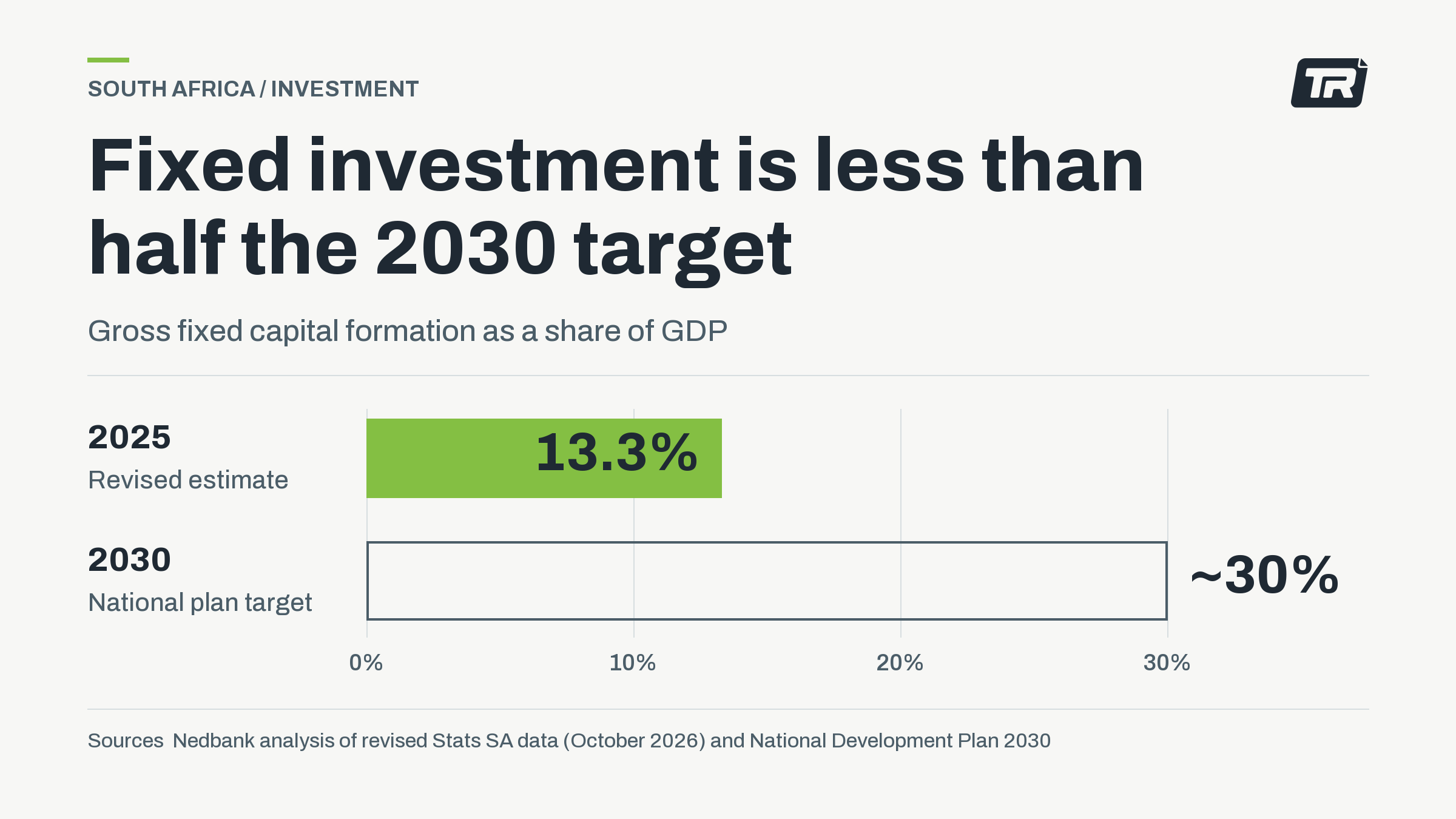
South Africa spent the equivalent of 13.3% of its gross domestic product on fixed investment in 2025, according to Nedbank’s analysis of Statistics South Africa’s revised figures. That is less than half the level envisaged in the National Development Plan for 2030. The measure captures spending on assets such as buildings, infrastructure and machinery. It tells us how much the country is putting into the capacity to produce more.
At the Truth Report Business launch in Stellenbosch on 28 October 2026, investor Rob Hersov urged President Cyril Ramaphosa to ease regulation and open South Africa further to foreign investment. Retailer Christo Wiese argued that a break of the kind Hersov wanted could cost Ramaphosa the presidency. He thought Ramaphosa had room to do better and wanted a system that gave presidents more room to govern.
Both men were asking how to move faster. Before judging their answers, it helps to look at what businesses have committed, what they have built and what still stands in the way.
What the pledges tell us
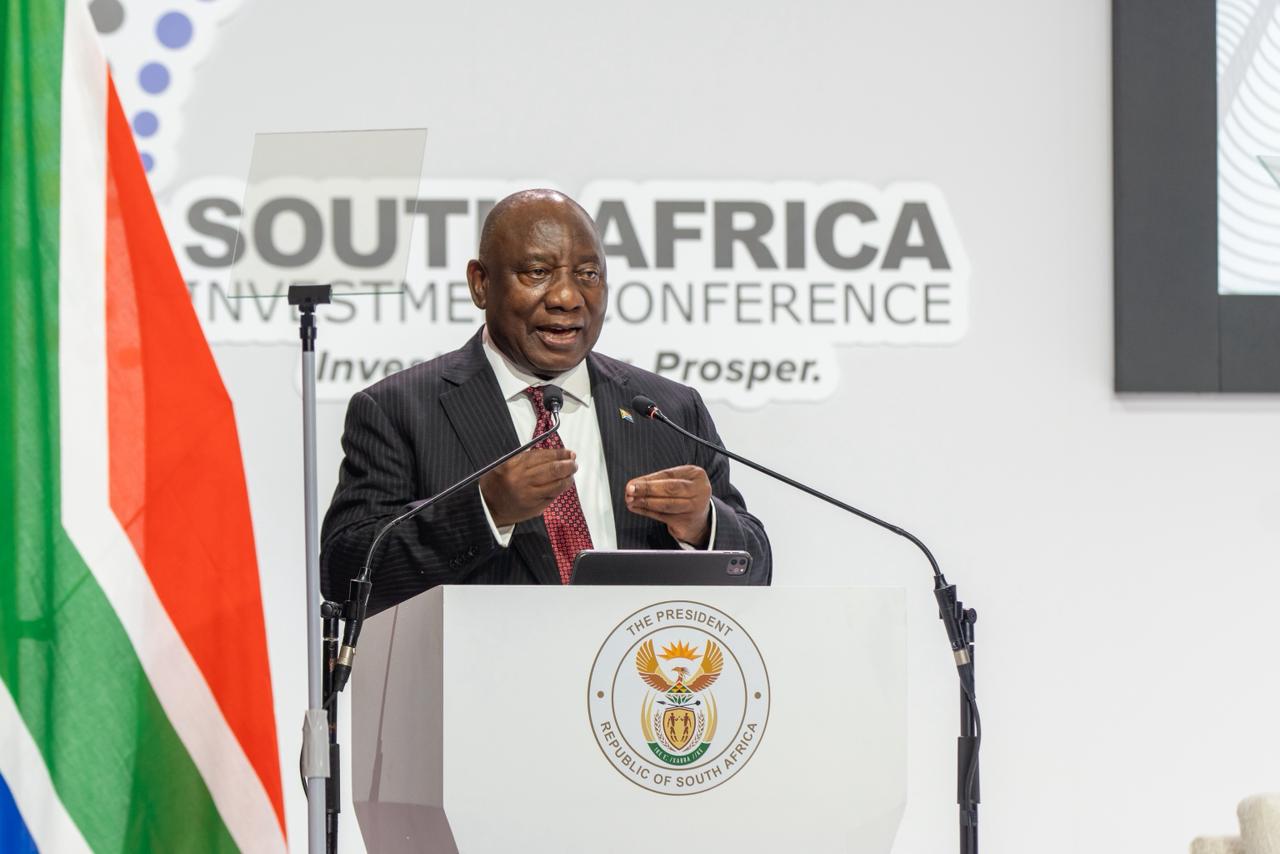
Ramaphosa recognises the investment gap. He told the South Africa Investment Conference in March that the country needed to roughly double fixed investment and sustain it. In May, he told the National Assembly that the conference had secured R890 billion in commitments. About R415 billion came from private companies, with the balance from development finance institutions and multilateral development banks.
Original photograph · CC BY-ND 4.0
A commitment can lead to a factory expansion or a power project years after it is announced. The annual investment figures measure spending as it occurs across the economy. The two figures can therefore move in different directions. In November, the South African Reserve Bank forecast a 0.3% fall in real fixed investment for 2026. That forecast will be tested as the year’s spending is counted.
A reform that made it to the grid
Electricity offers a practical test of Hersov’s argument. In 2021, the government raised the licensing exemption for qualifying generation projects from 1 to 100 megawatts. It removed the size threshold in December 2022. Projects still needed to meet registration and grid connection requirements where applicable.
The government’s Operation Vulindlela reform programme reported 5.4 gigawatts of private generation capacity connected to the grid and a further 19.3 gigawatts in the pipeline in its second-quarter 2026/27 report. The first measures capacity already connected. The second covers prospective projects at various stages of development. A developer can benefit from the licensing change and still need a network connection, financing and a buyer before a project can operate.
The same report shows why opening a market takes regulatory work. A competitive wholesale power market needs rules for trading and for the use of the network. The government and the energy regulator were still working through those rules, while the national transmission company had fallen behind on building high-voltage lines. A generator can have permission to build and still have to wait for room on the grid.
The politics of keeping a reform in place
Wiese’s concern about Ramaphosa’s political support has a basis in the rules. The African National Congress’s National Executive Committee can recall party representatives. A recall can press a president to resign. If he stays, section 102 of the Constitution requires a majority of the National Assembly for a successful motion of no confidence. The ANC won 159 of 400 seats in 2024. Ramaphosa was re-elected president with 283 votes from MPs. Other parties had a say in keeping him in office and would have a say if the ANC tried to remove him through a no-confidence vote.
Hersov pointed to Sweden’s early-1990s recovery as an example of decisive change. The Swedish central bank’s account records a crisis package agreed by the government and its Social Democratic opposition in 1992, followed by the decision to let the krona float after attempts to defend its value failed. It also identifies earlier deregulation and rising debt as contributors to the banking crisis. The International Monetary Fund’s assessment found that exports drove a rebound in 1994 and 1995, while employment fell in 1996 and 1997. South Africa has had a floating rand since 1998. The Swedish precedent speaks most directly to the value of political agreement and the time it takes for an economic recovery to reach workers.
Hersov’s urgency is justified by the size of the investment gap. Wiese’s warning matters because businesses commit money over years and depend on rules that will hold after a leadership contest. For a firm that wants to expand, the difference shows up in whether it can secure power, pay for new equipment and hire people to run it. Those are the decisions that will move the investment figures.