


Crime, unemployment and weak accountability give his challenge its force. The public record also shows how constitutional rights can be used against the failures he condemns.
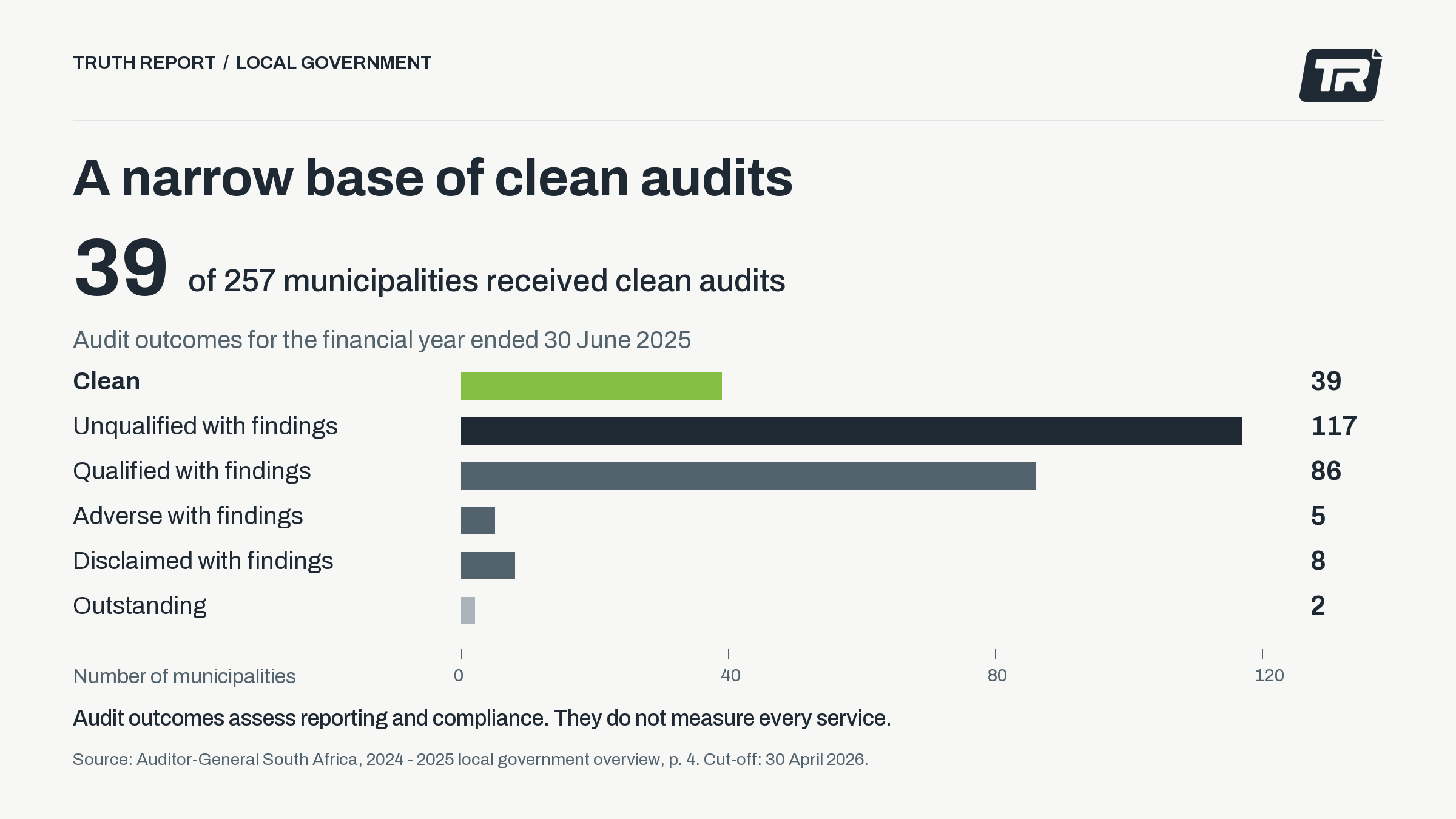
Only 39 of South Africa’s 257 municipalities received clean audits for the financial year ending June 2025. That finding comes from the Auditor-General, an institution whose authority is established by the Constitution. The same constitutional order being accused of protecting failure provides a means of exposing it. The Auditor-General’s national overview records the outcomes as at 30 April 2026.
That tension runs through Mike Gatvol’s challenge to the description of South Africa’s Constitution as the best in the world. He wants its reputation measured against people’s safety, their ability to find work and their prospects of obtaining justice. His argument is that a document celebrated for its protections cannot escape judgment when ordinary people feel unprotected.
It is a serious challenge to constitutional complacency. It also contains a causal claim that needs testing: that the Constitution itself has produced, or permitted, the conditions he describes. Evidence of failure establishes the need for accountability. Identifying the rule, decision or institution responsible requires a further step.
Safety is a constitutional demand
Gatvol’s strongest concern is the distance between formal protection and everyday fear. He argues that safeguards for accused people have helped create a system that fails victims.
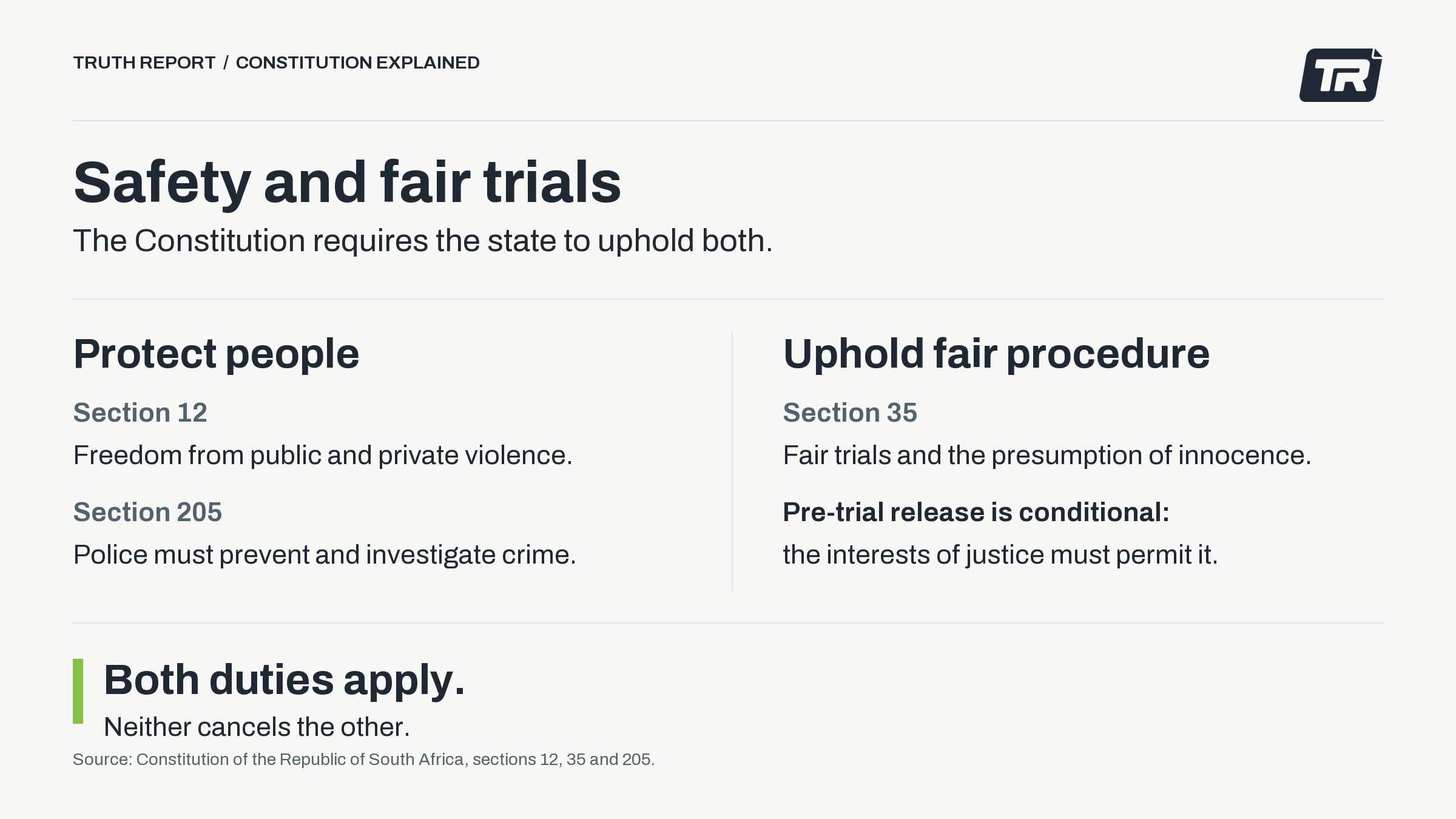
The constitutional text makes demands on both sides. Section 12 protects people against violence from public and private sources. Section 35 protects fair-trial rights and makes release from detention conditional on the interests of justice, subject to reasonable conditions. These protections operate together, rather than granting an unconditional entitlement to bail.
The police have a separate, explicit mandate. Section 205 requires them to prevent, combat and investigate crime, protect people and property, and enforce the law. A failure to investigate a violent offence therefore raises a question about the fulfilment of a constitutional duty.
The crime record also needs precision. At the August 2026 release of the first-quarter figures, police reported 5,427 murders between April and June, down from 5,770 in the corresponding period a year earlier. The decline matters, as does the continuing scale of the violence. Neither observation supports treating all crime categories as a single, uniformly worsening measure.
Acting Police Minister Firoz Cachalia acknowledged continuing investigative and operational weaknesses while reporting declines in several serious offences. His account is the government’s assessment, rather than independent proof that its interventions caused those declines.
For a victim waiting for an investigation, the useful questions are specific: what work remains undone, who is responsible and what would secure a properly prepared case? Blaming a fair-trial protection without identifying how it obstructed justice leaves those questions unanswered.
Joblessness measures a failure, but does not explain its cause
Gatvol also judges the constitutional settlement by unemployment. He describes the loss of hope that follows when young people cannot find work, and questions what protection means without the means to build a life.
The scale of that concern is supported by the official record. Statistics South Africa’s third-quarter 2026 survey put official unemployment at 33.7%, with 8.6 million people unemployed. Employment increased during the quarter, but the labour force grew faster. The government news agency’s account of the release also records youth unemployment of 47.3% among those aged 15 to 34 in the labour force. That is different from saying nearly half of all young people are unemployed.
Those figures justify demanding better economic results. They cannot, by themselves, establish that constitutional rights caused unemployment. Gatvol’s argument would become stronger if it identified a particular provision and demonstrated how changing it would expand employment. Otherwise, a devastating measure of social distress is being asked to supply an explanation it does not contain.
Accountability can expose failure without correcting it
The municipal audit record gives substance to Gatvol’s concern about government performance. Alongside the 39 clean audits, the Auditor-General recorded 117 municipalities with unqualified opinions carrying findings, 86 qualified opinions, five adverse opinions, eight disclaimers and two outstanding audits. A clean audit is an assessment of reporting and compliance; it should not be mistaken for a certificate that every service works.
The institution producing those findings is itself part of the constitutional response to abuse. Sections 181 and 188 establish the Auditor-General’s independence and duties to audit public finances and publish reports.
This exposes a harder problem than either uncritical praise or wholesale rejection can resolve. A system may reveal wrongdoing and still fail to secure timely consequences. Publishing a finding does not repair a pipe, recover every lost rand or ensure that an official faces an appropriate sanction. The effectiveness of the response must be judged separately from the existence of the reporting mechanism.
A case where constitutional rights confronted government
There is also a concrete challenge to Gatvol’s broad conclusion that the Constitution does not work for ordinary people. In Minister of Health v Treatment Action Campaign, decided in July 2002, the Constitutional Court ordered government to remove restrictions on providing nevirapine beyond designated research and training sites to reduce mother-to-child HIV transmission. Its order addressed medically indicated use and the supporting testing and counselling facilities.
Here, constitutional rights enabled a challenge to government policy on behalf of people dependent on public health care. The judgment demonstrates that the Constitution can be an instrument for requiring action against harmful restrictions. It does not establish that every person can readily obtain a remedy, or that a court order automatically produces effective delivery.
Gatvol is right to demand that constitutional promises be tested against lived conditions. His criticism loses force when those conditions are treated as sufficient proof that the protections themselves are the cause.
The practical test is whether a person can obtain safety, fair treatment and an effective remedy when the state fails. Defending the Constitution requires making those protections usable. Proposing to change it requires showing exactly which rule would change, who would be better protected and how the result would be enforced.


