The DA mayoral candidate puts electricity and jobs at the centre of her campaign. Municipal accounts support the urgency, but investment already arriving on the North Coast complicates any simple story of failure.
KwaDukuza can attract a major international resort and still struggle to account for the electricity moving through its network. That is the tension at the centre of its local election debate: a place with visible economic promise, whose households and businesses need the less photogenic foundations of growth to work.
At Club Med’s official opening in September, the Presidency reported investment of more than R2 billion and 600 permanent direct jobs. In a separate account of municipal performance, the mayor’s fourth-quarter report put electricity losses at R441 million for the year ending June 2026. These are different kinds of money, belonging to different institutions. Together, they describe the gap between attracting a development and running the services on which a wider economy depends
Privi Makhan, the Democratic Alliance’s KwaDukuza mayoral candidate, has made reliable electricity a central campaign promise. With local government elections scheduled for 4 November 2026, the useful test of that promise is practical: what would change in the network, the municipal accounts and the experience of residents?
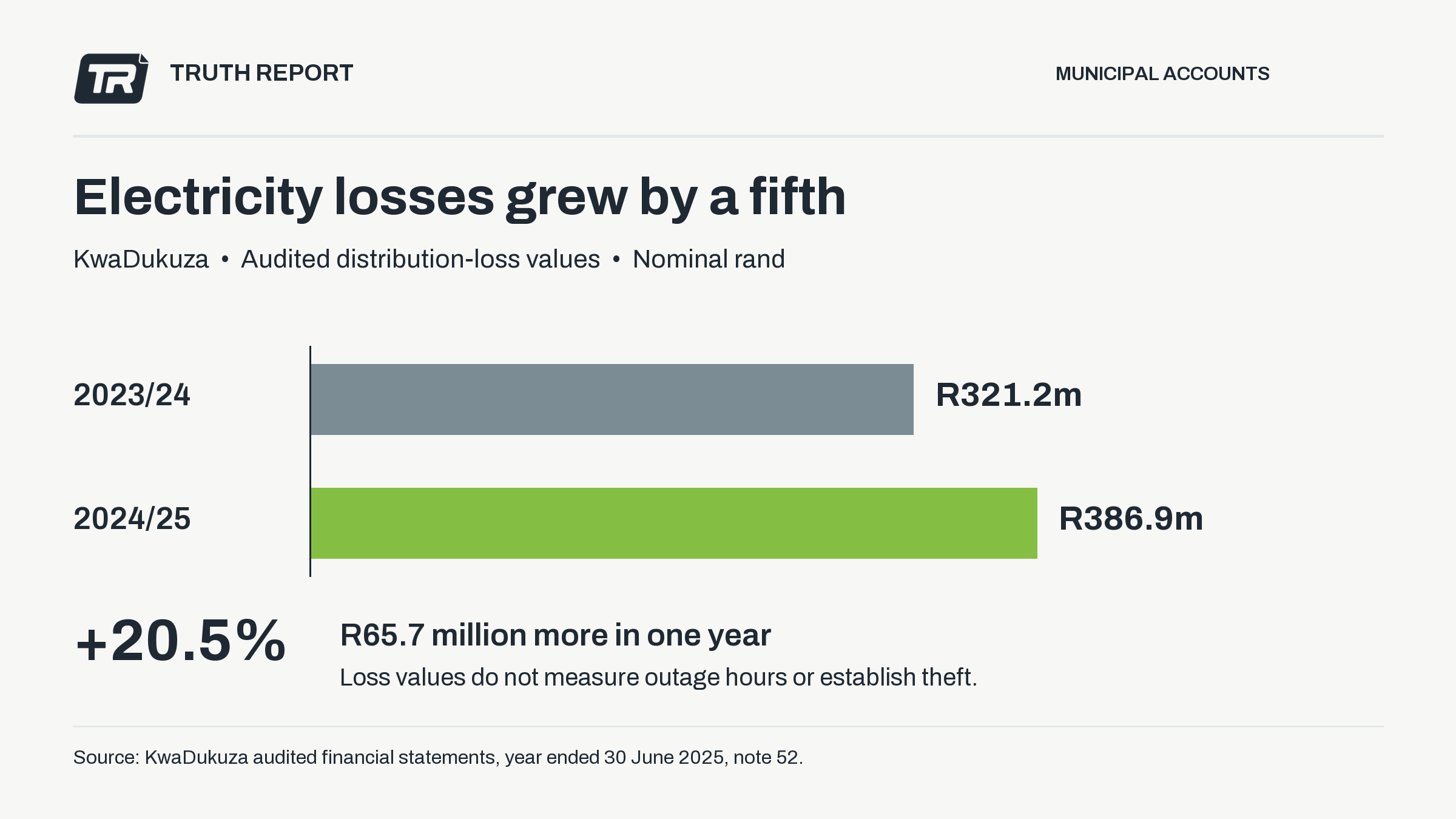
The accounts give that question substance. KwaDukuza’s audited financial statements for 2024/25 record electricity distribution losses of R386.9 million, compared with R321.2 million a year earlier. The same note reports an energy-loss rate of 26.73%, against a national norm it identifies as 6% to 12%. It attributes losses predominantly to transmission and distribution losses and non-technical losses.
That distinction matters. An electricity-loss figure cannot simply be relabelled stolen money. Nor does it measure how many hours a household spent without power. It identifies a financial and operational problem requiring a diagnosis of where energy, measurement and revenue are being lost.
The later mayoral report places the June 2026 energy-loss rate at 25.93%, alongside the higher rand figure. A smaller percentage and a larger monetary loss can coexist. Neither measure, taken alone, tells residents whether their electricity service has improved. The 2026 figures are reported by the mayor’s office; they should not be presented as though they carry the same audited status as the earlier accounts.
Makhan’s published programme proposes smart meters, audits of large power users and ringfencing electricity revenue for the network where law and finances permit. These are commitments that can be tested. A credible administration would publish the starting position, the cost of its interventions and their results over time. Announcing a meter programme is easier than demonstrating fewer losses and faster restoration of supply.
There is already a municipal response to assess. Spokesperson Bridget Shange told East Coast Radio that audits of 493 large power users had recovered more than R24 million in previously unbilled consumption. She also described meter replacements and upgrades intended to improve measurement and billing. That is relevant counterevidence to any suggestion that nothing is being attempted, although the municipality’s account of recovery is not proof that the wider problem has been solved.
Club Med provides a second challenge to a blanket narrative of economic paralysis. The Presidency’s opening statement described 600 permanent direct jobs and a further 1,500 indirect jobs supported through suppliers and related industries. Those categories should remain separate. They do not establish that every position went to a young KwaDukuza resident, and a resort’s employment footprint is not a municipality-wide employment rate.
The investment also sharpens Makhan’s strongest argument. If one major project can create employment and supplier demand, the question is how to make that opportunity available more widely. A smaller enterprise cannot necessarily absorb prolonged interruptions, uncertain approvals or the cost of its own backup systems. Reliable services matter beyond the next flagship announcement.
Makhan told the North Coast Courier that she would prioritise electricity infrastructure, a ten-year infrastructure and spatial plan, updated by-laws and independent power producers. Mayor Siduduzo Gumede, responding to the same newspaper, defended his service-delivery turnaround plan and pointed to support for small businesses, informal traders and township enterprises. Both offer an account of how local government can enable economic activity. Residents need measurable commitments with budgets and deadlines to judge between them.
There is also a boundary to the mayor’s powers. iLembe District Municipality is the water services authority, responsible for ensuring that water infrastructure is developed, operated and maintained. Makhan acknowledges this division in her published campaign programme. A KwaDukuza administration can press for coordination and accountability; promising that a change of local mayor alone will fix the taps would conceal the institutional work required.
This is why the campaign’s value lies in what can survive beyond election day. A published maintenance schedule, an intelligible account of electricity losses and an honest record of completed projects would give residents something firmer than competing declarations of competence. Progress should be visible to a household reporting a fault as well as to an investor submitting a major application.
KwaDukuza’s coastal appeal is already capable of attracting capital. Its next administration will be judged by whether ordinary residents and businesses can rely on the services beneath that promise. The decisive achievement would be a municipality whose daily performance gives more people a fair chance to earn a living.