


SMM puts competence and community participation at the centre of its municipal campaign. Its promise will stand or fall on how it turns local influence into accountable government.
Sasol says it invested more than R54.6 million in road repairs in Metsimaholo between 2021 and 2026. Yet the company also acknowledges that substantial infrastructure needs remain. That combination captures the challenge facing the Service Movement for Metsimaholo: a municipality can have an industrial partner with resources and still need a government capable of maintaining everyday services. Sasol’s May 2026 account describes a repair programme extending to June 2027.
SMM’s answer is to put local competence ahead of political popularity. Its case centres on capable councillors, professional administration, community involvement and an economy strengthened by local enterprise. These are sensible objectives. The harder question is how residents would establish that the people seeking power can deliver them, and how they would hold those people accountable once elected.
The movement’s organisational profile describes a structure connecting voting-district volunteers, ward coordinators, a People’s Council and a board of directors. It presents public reporting and community scorecards as instruments of accountability. Those commitments provide a useful starting point for scrutiny: residents can ask what will be published, how often, and what happens when performance falls short.
Calling an organisation a community movement does not settle the question of political power. The same profile records SMM’s registration as a political party on 5 March 2026. Its civic identity and electoral role can coexist. Once it seeks control of a municipal council, however, it must answer the questions put to every contender: who decides, who benefits, what can be afforded and how can decisions be challenged?
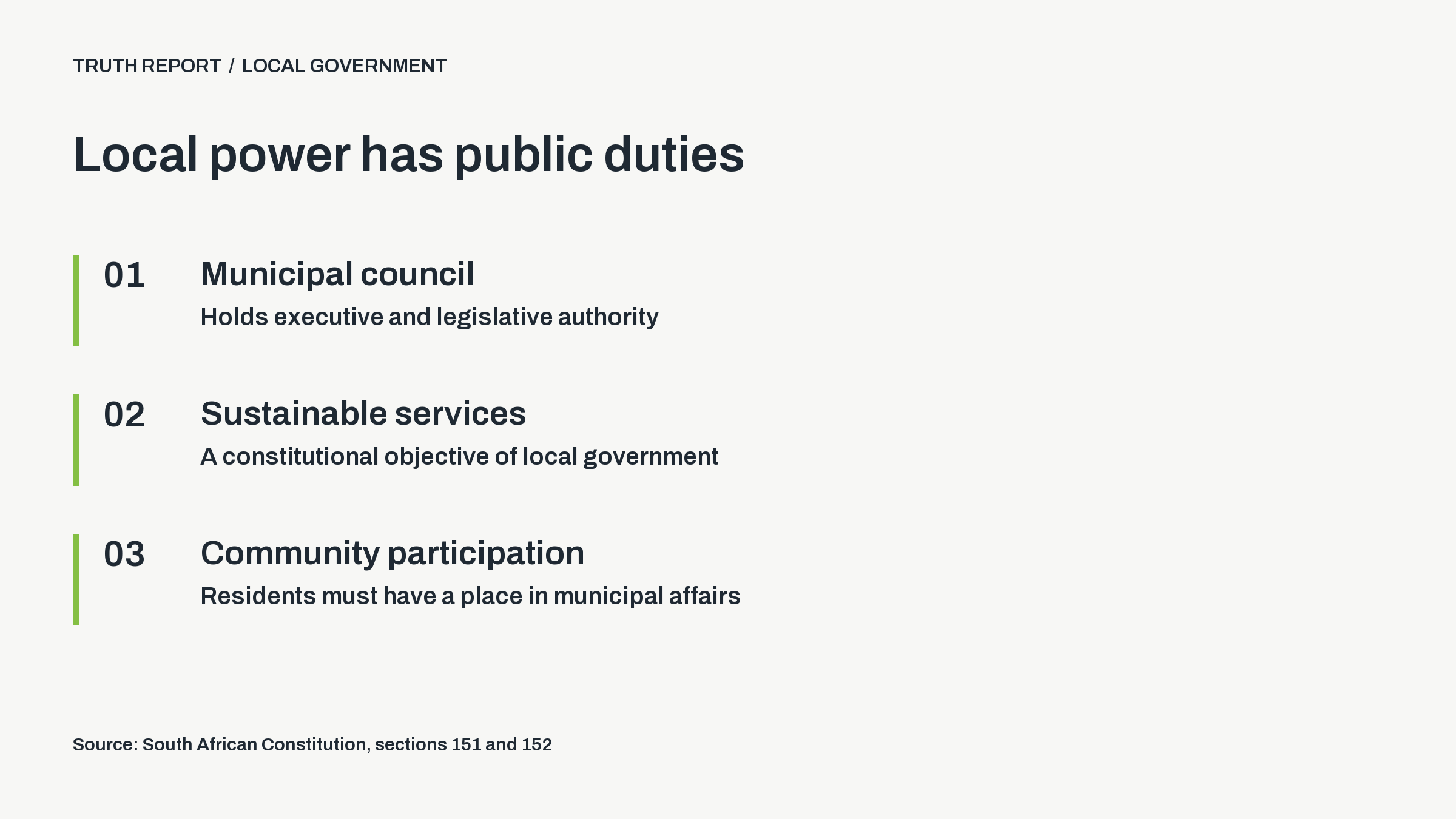
The distinction between the movement and the municipality matters. Under section 151 of the Constitution, municipal executive and legislative authority rests with the municipal council. SMM’s internal structures may organise residents and guide its representatives. They cannot replace the public institutions through which municipal authority is lawfully exercised.
That is also the strongest case for taking its participation agenda seriously. Section 152 expressly includes community involvement among local government’s objectives, alongside accountable government, sustainable services and social and economic development. Participation is part of the constitutional job. It should continue between elections, including when residents disagree with the governing party.
Competence needs evidence. An interview process for candidates can be useful, but its credibility depends on the criteria, the assessors and the consequences of failure. Residents should be able to see the skills required, the relevant experience of selected candidates and the rules for declaring conflicts of interest. A professional administration also needs enough independence to tell elected leaders when a preferred decision is unlawful or unaffordable.
Business cooperation offers another test. Sasol’s existing road programme shows that corporate involvement does not have to wait for a change in political control. According to its May statement, the company had already repaired around 40 kilometres of roads and was replacing or installing streetlights. These are company-reported achievements, rather than an independent assessment of the municipality’s overall condition.
A future partnership should therefore be judged by what it adds: technical expertise, completed work, maintenance arrangements and public reporting. A meeting with an executive cannot by itself establish a funded commitment. Residents need to know which projects have agreements, who pays for them and who remains responsible when equipment fails.
The appeal of buying locally is similarly understandable. Municipal contracts can create opportunities for nearby businesses and workers. But local ownership cannot substitute for reliable work, fair prices or open competition. A procurement programme needs to explain how suppliers qualify, how bids are evaluated, how conflicts are managed and what remedies apply when a contractor fails.
There is a current legal complication too. In September 2026 the Western Cape government reported that the Constitutional Court had declared the Public Procurement Act of 2024 invalid, following a challenge over public participation. Any detailed promise about procurement must be tested against the applicable law and the court’s order, rather than relying on a general claim that the rules have changed.
The financing question is just as practical. Better administration can improve the use of available money, but it cannot make every proposed project affordable at once. Residents deserve a programme that distinguishes urgent repairs from longer-term investment and identifies the revenue, grants or binding partnerships supporting each commitment. A plausible first-year programme should show its costs and explain what will be deferred if income falls short.
There is a fair argument in SMM’s favour: local organisations may recognise problems that distant party structures overlook, and community networks may help identify failures early. The risk is that proximity becomes another basis for favouritism. Publishing decisions, contracts and performance records is how a movement can demonstrate that local accountability extends beyond its own supporters.
The most useful promise SMM can make is therefore a measurable one. Residents should be able to compare repair schedules with completed work, spending with approved budgets, and complaints with recorded responses. They should also be able to challenge a decision without being treated as opponents of the community.
Metsimaholo’s recovery will require residents, businesses and public institutions to work together. The test of a new movement is whether it makes that cooperation more accountable and more durable. Local power earns its legitimacy when people can see both the service delivered and the responsibility for its failure.