


The Survivor winner wants to turn his hometown’s economic potential into better lives. His party already shares responsibility for the city, and the biggest energy promises depend on decisions well beyond the mayor’s office.
Rob Bentele is campaigning to fix a municipality that has already achieved something many South African councils struggle to manage: six consecutive clean audits. Yet earlier this year, residents in Ntuze protested over interrupted water supplies. In uMhlathuze, sound accounts and dissatisfied households belong to the same story. The Auditor-General’s municipal record and local reporting on the water protests establish that tension.
It is the most useful starting point for judging the Democratic Alliance’s mayoral candidate. The question is how he would convert an existing foundation of financial accountability into services residents can depend on, while keeping that foundation intact.
The DA announced Bentele’s candidacy on 27 August, placing community needs, infrastructure and employment at the centre of its pitch. With local government elections set for 4 November 2026, his promise deserves scrutiny at the level at which voters will experience it: a repaired pipe, a functioning streetlight, an application processed without unnecessary delay.
The experience behind the ambition
Bentele has an unusually vivid account of hardship to draw upon. After winning Survivor South Africa in 2019, he told the Sunday Times that he had returned from 39 days in Samoa weighing 16kg less. The same interview described his Zulu mother and Austrian father, and his attachment to Richards Bay.
In his mayoral pitch, he connects the hunger he experienced on the show with the deprivation people endure without a prize or an exit date. He presents food relief as necessary help, but argues that lasting improvement requires economic opportunity and better government. That is a more substantial proposition than celebrity recognition alone.
His political message also rests on trust. In an interview with East Coast Radio, he described politics as a contest of votes, relationships and integrity. Those qualities can help a candidate win support. Municipal leadership adds another requirement: building an administration whose performance remains dependable when the candidate is no longer personally present.
A challenger whose party already governs
There is a complication in the DA’s promise of change. The party is already part of the governing arrangement it wants to lead.
This is acknowledged in its own public record. In March, Bentele’s predecessor as mayoral candidate, Christo Botha, described the DA’s participation in the coalition government. He argued that it had worked to improve services while accepting that much remained to be done. In June, the council elected DA caucus leader Muzi Mtshali as deputy mayor, filling the vacancy left by Botha’s death.
Bentele is entitled to argue that leading a council offers greater influence than participating as a smaller coalition partner. But his party must explain what it has achieved with the influence it already holds, which decisions it could not secure, and how the proposed change in leadership would alter those decisions. A fresh candidate does not erase an institutional record.
The Inkatha Freedom Party offers a different interpretation. At an October rally in Esikhawini, IFP president Velenkosini Hlabisa presented uMhlathuze as an example of a coalition that can work. That is a campaign argument, too. Its strongest independent support lies in the audit record; its limit lies in what residents actually receive.
What the clean audits establish
The Auditor-General’s records show an unqualified opinion with no findings in each financial year from 2019/20 to 2024/25. That sequence deserves recognition rather than dismissal because it is inconvenient to a challenger.
As the Auditor-General explains, a clean audit concerns materially accurate financial statements, credible performance reporting and compliance with key legislation. It does not guarantee that every community need has been met. The distinction matters in a city where the municipality’s communications manager acknowledged ongoing water challenges in February, according to the Zululand Observer’s report on the planned coalition briefing.
The fair test therefore runs in both directions. Incumbents cannot treat clean audits as a complete answer to interrupted services. Challengers cannot use service failures to imply that independently verified financial controls count for nothing.
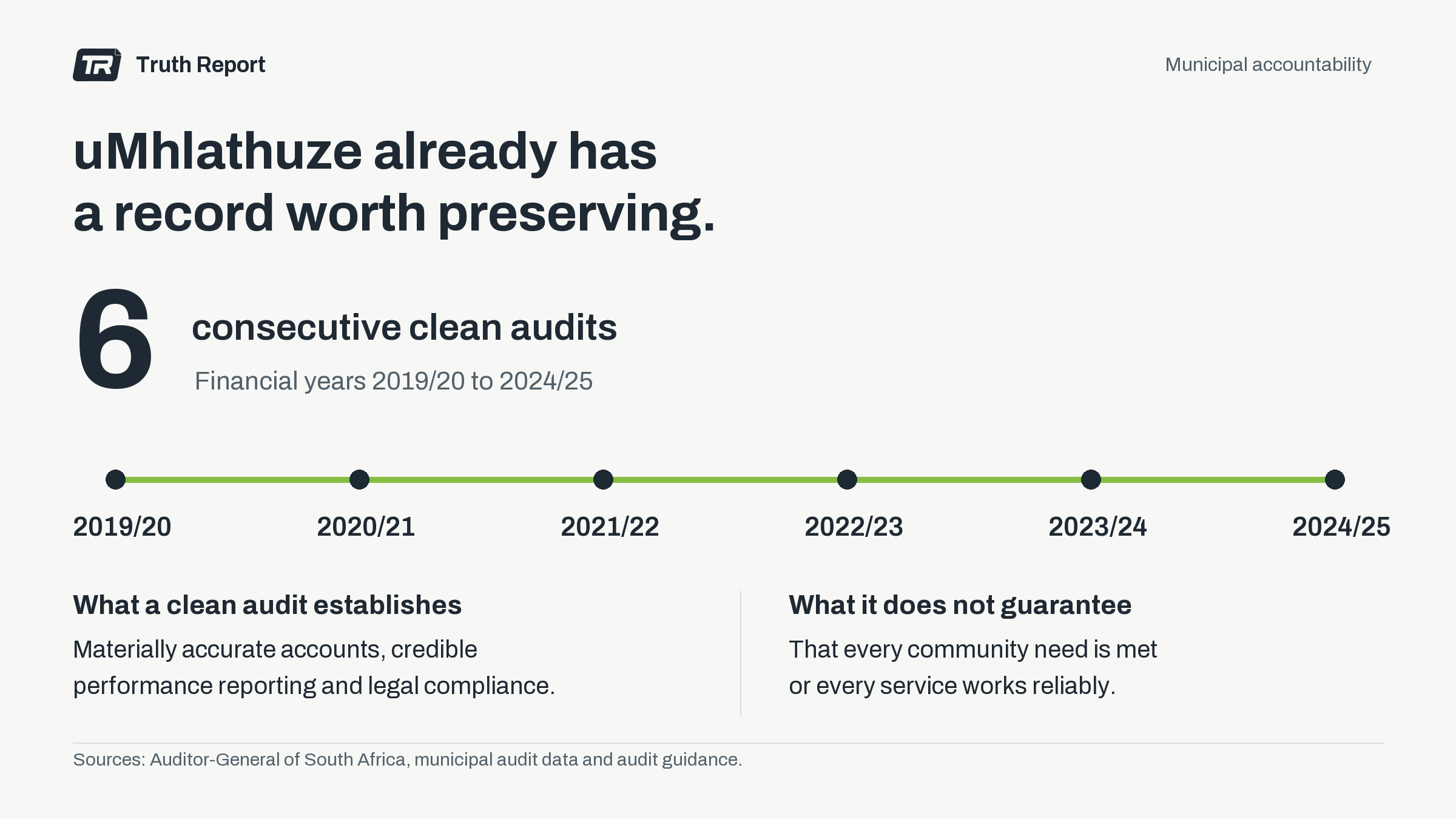
City of uMhlathuze. In each of the financial years 2019/20, 2020/21, 2021/22, 2022/23, 2023/24 and 2024/25, the audit opinion was unqualified with no findings. Six consecutive annual outcomes; this is not a service satisfaction score.
The port is not a mayoral department
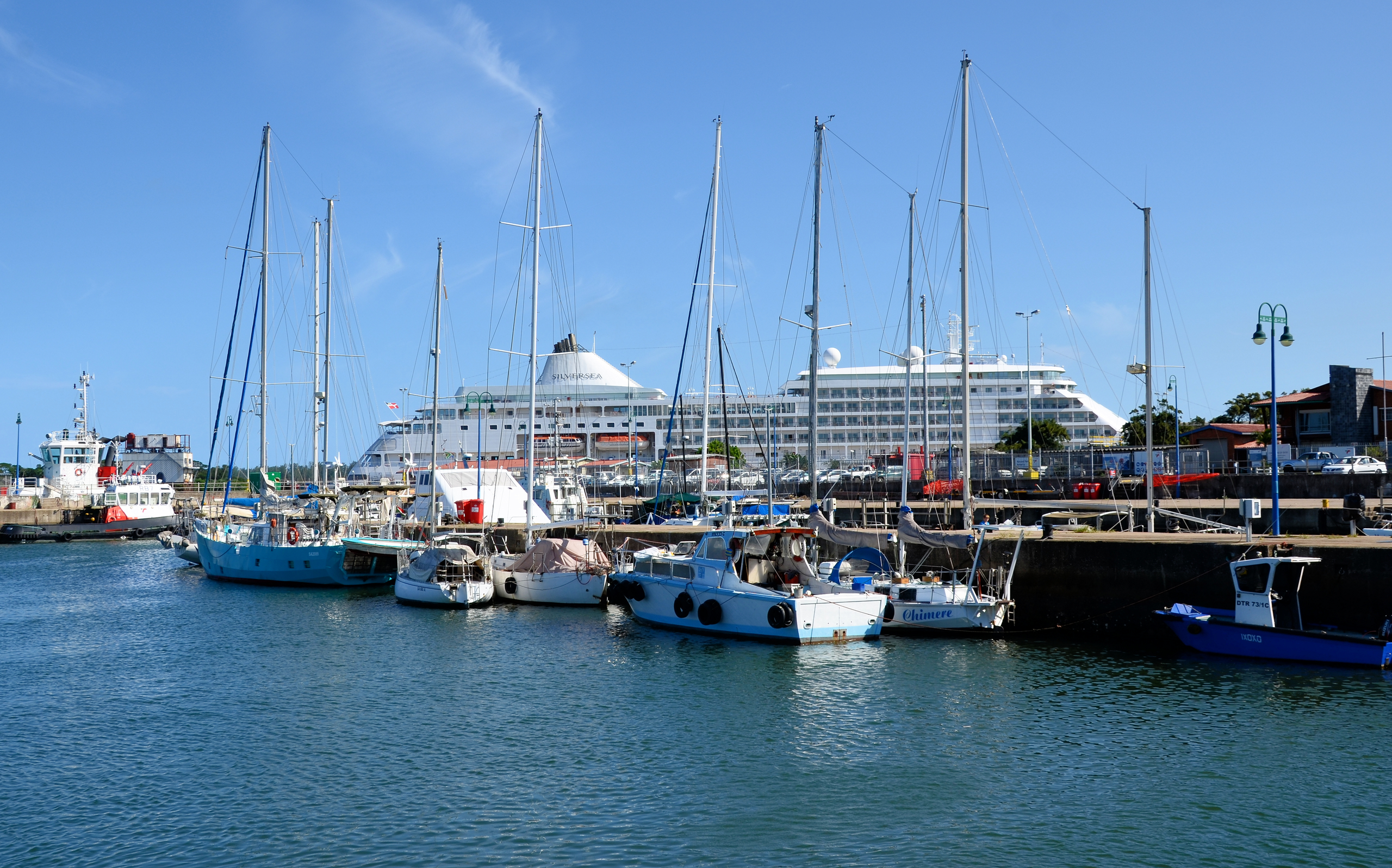
Bentele is right to place the maritime economy near the centre of his argument. But the authority to improve it is divided.
The National Ports Act places ports under the jurisdiction of the National Ports Authority and assigns it responsibilities including port infrastructure, navigation and the regulation of cargo operations. Winning the mayoralty does not transfer those powers to the municipality.
The Constitution vests municipal authority in the council and requires local government to prioritise basic needs and promote social and economic development. The practical implication is that an effective mayor must combine improvements within municipal control with sustained negotiation across institutions.
Bentele’s emphasis on faster building-plan approvals is consequently worth pursuing. To make it an accountable commitment, he should publish the existing backlog, distinguish complete applications from incomplete submissions, set processing targets and report against them. Businesses need predictable administration; residents need assurance that speed will preserve lawful planning and safety requirements.
Gas potential is not yet delivered power
The proposed energy developments give Richards Bay a significant opportunity. They also illustrate the distance between a strategic prospect and an operating asset.
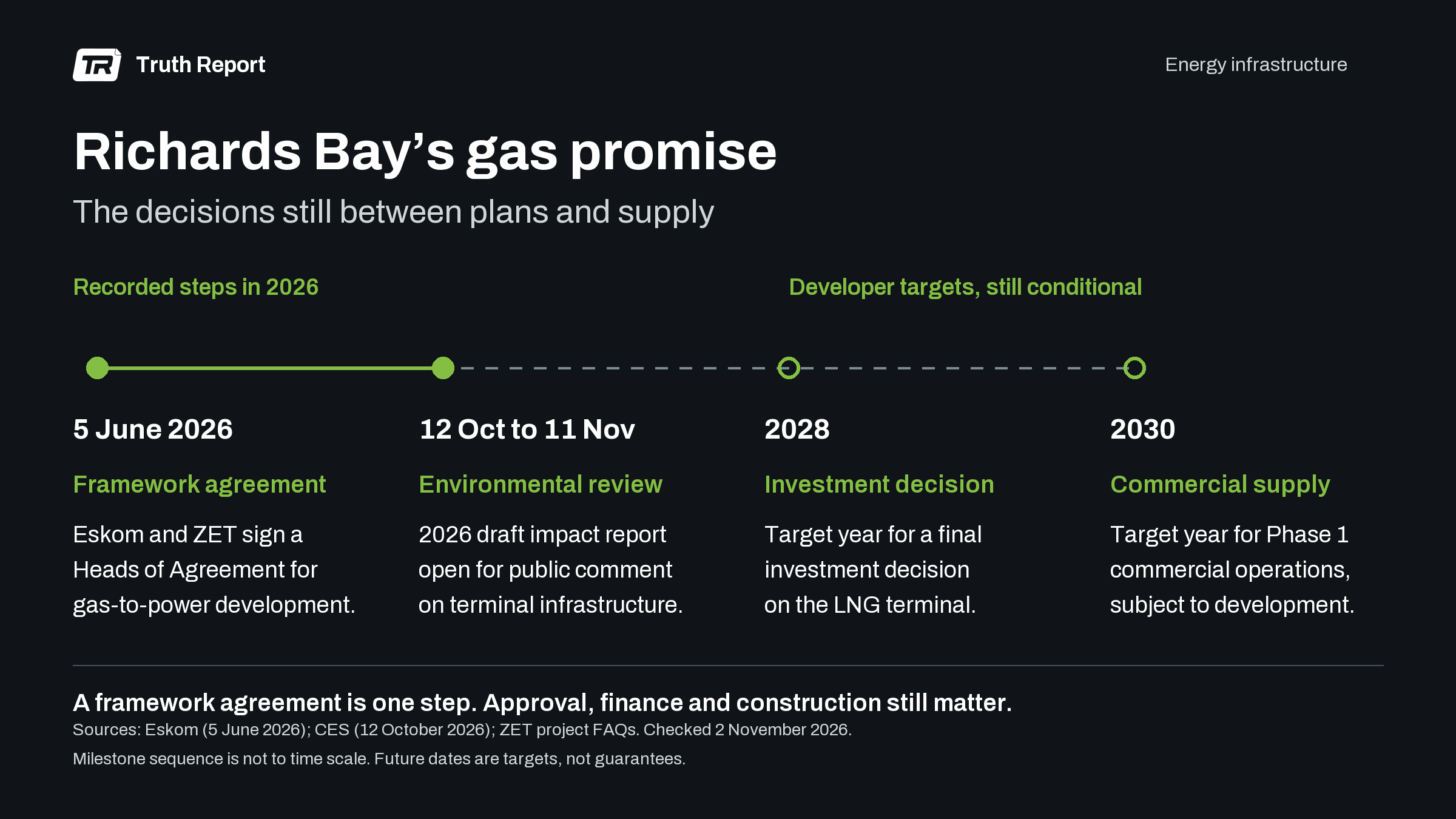
On 5 June 2026, Eskom and Zululand Energy Terminal announced a framework agreement intended to support the planned 3 000MW Richards Bay gas-to-power project. Their statement explicitly identified further regulatory approvals, commercial arrangements and infrastructure development as necessary steps.
The terminal developer’s published project answers target a final investment decision in 2028 and first-phase commercial operations in 2030. These are planning assumptions, not completed milestones. Meanwhile, the environmental assessment practitioner’s October notice places the terminal’s draft environmental impact report on public review from 12 October to 11 November 2026.
These projects could strengthen the local economy. Their development schedules cannot responsibly be presented as a promise that a new mayor can deliver alone. Nor does a proposed power station in the municipal area, by itself, establish a dedicated supply arrangement for the city’s households.
The promise residents can measure
Bentele’s most persuasive proposition is that relief should lead towards a life in which relief is needed less. A municipality that supports enterprise and maintains essential services can contribute to that change. The work is patient, technical and collective.
Voters should ask him for commitments that survive the campaign: public repair targets, clear application deadlines, transparent procurement and regular reporting on progress. They should ask the same of the incumbents.
For uMhlathuze, the standard is demanding but understandable. Preserve the discipline reflected in the accounts. Make it visible in the reliability of everyday services. The credibility of Bentele’s promise will ultimately rest in the distance he can close between the two.Truth Report · Reported analysis