


The party’s Western Cape pitch speaks to housing, exclusion and dignity. Its proposed answer also raises a question for the people it wants to represent: how would they hold a more powerful state to account?
MK’s promise of land justice contains a difficult tension. Its national manifesto proposes replacing constitutional supremacy with parliamentary supremacy, while the existing Constitution gives people enforceable rights against the government that controls land, housing and services. For a household waiting for a home, the question is both what the state should deliver and what recourse remains when it fails.
In his Western Cape election pitch, Siyabonga Booysen puts housing, access to economic opportunity and the geography of exclusion at the centre of MK’s appeal. He presents land justice as a way of protecting communities from displacement and restoring dignity. When pressed about taking property, he also stresses that the party would operate through lawful processes.
Those assurances matter. But a promise to follow the law and a proposal to change the limits on government power deserve separate scrutiny. The most useful test of MK’s offer is whether its institutional programme strengthens the people who must live with its decisions.
Land justice requires clear rights for residents
The party’s 2024 land programme envisages expropriating all land without compensation, placing it under state and traditional leadership custodianship, and establishing guidelines for leases to citizens. That is a substantially different proposition from simply transferring a title deed to a dispossessed family.
Custodianship immediately raises practical questions. Who would decide which household receives a lease? How long would it last? Could it be inherited, transferred or withdrawn? What would protect an occupier from an unfair decision by an official or traditional authority? These questions determine whether a beneficiary gains durable security or remains dependent on whoever administers the land.
The existing property clause has a broader purpose than protecting present owners. Section 25 requires the state to foster equitable access to land, recognises rights to secure tenure or comparable redress, and provides for restitution or equitable redress for qualifying dispossessions after 19 June 1913. It also prohibits arbitrary deprivation and regulates expropriation and compensation.
The historical cutoff is significant for communities whose dispossession predates 1913: that particular restitution provision does not encompass every colonial loss. Acknowledging this limitation is compatible with recognising the reform duties already in the same section. Whether broader reform is needed and whether the state has used its existing powers effectively are distinct questions.
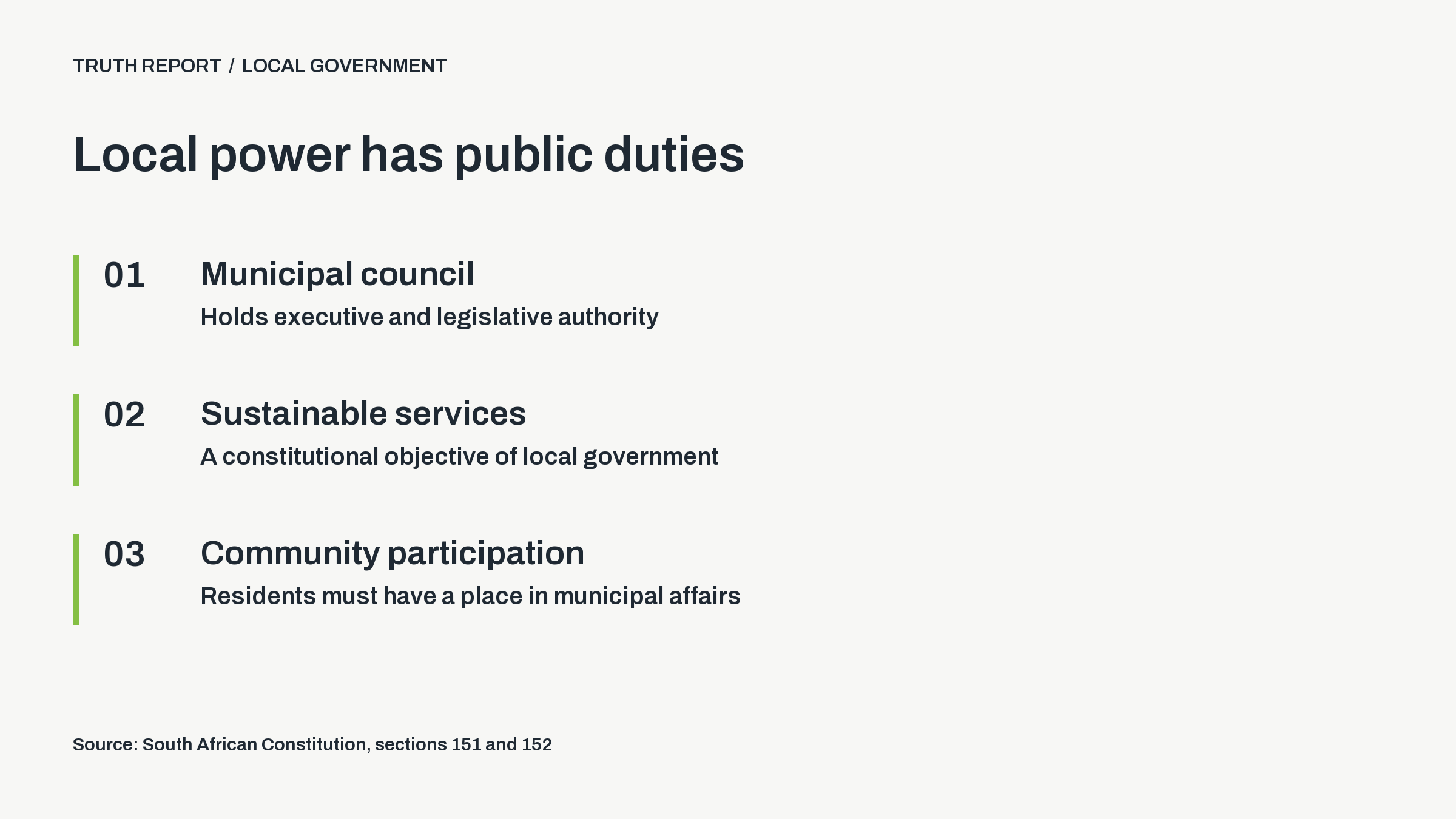
Nor does a municipal election settle the constitutional question. A council governs within powers granted by the Constitution and legislation. Sections 152 and 153 require municipalities to provide sustainable services, promote development and give basic community needs priority in budgeting and planning. A winning party can be judged on those duties without first being given authority to redesign the national constitutional order.
The housing money needs a proper accounting
Booysen’s argument also rests on an accusation that the Western Cape returned a large sum intended for housing rather than developing poorer communities. The underlying financial dispute is real, but the description of money simply being sent back is contested.
In an interpellation dated 13 August 2026, GOOD’s Brett Herron asked why R821.5 million had not been spent, specifying R664.3 million for basic houses and R157.2 million for informal settlement upgrades. Infrastructure Minister Tertuis Simmers rejected the characterisation. His answer distinguished expenditure, approved rollovers, national grant reductions, reallocations and forfeitures. He cited national reductions exceeding R525 million in 2023/24 and another R300 million in 2024/25.
These are competing descriptions of the funding history. The minister’s answer is evidence of the province’s position, rather than an independent reconciliation of every rand in Herron’s question. The record does not justify treating the full R821.5 million as a verified voluntary return, or inferring deliberate neglect from that figure alone.
For residents, the distinction has consequences. A grant cut reduces the resources available; a rollover moves authorised spending into a later year; forfeiture may remove funding after conditions have not been met. Accountability requires a reconciliation by grant, financial year, project and final outcome. Spending percentages also need to be read against the final allocation and the homes or serviced sites actually delivered.
This is a demanding standard for both government and opposition. The province must explain lost or delayed opportunities in terms residents can check. MK must demonstrate that its proposed remedy addresses the actual cause of a stalled project, whether that is funding, land availability, infrastructure, administration or procurement.
The N2 dispute is about whose safety counts
The proposed N2 barrier gives the argument a visible focus. Booysen opposes it as an expression of separation and argues that housing and economic development should take priority. That is a political judgment about the kind of city government should build.
The City’s own description is broader than a wall. In its 29 January 2026 announcement, it identified a R114 million N2 Edge safety project along nine kilometres, including barrier repairs, pedestrian crossings, lighting, access control and other improvements. The mayor argued that commuters from surrounding communities would benefit, alongside other motorists.
That is the strongest answer to the suggestion that the project serves only people passing the settlements: residents also travel on the highway. Equally, a road-safety rationale does not answer every concern about access, separation or spending priorities. Those concerns require a design and a credible account of how people will move through and around it.
The public test should be concrete. What danger is each part of the project intended to reduce? Where will safe crossings be placed? How will access to work, transport and neighbouring communities be protected? What alternatives were compared, and how will success be measured? An announcement of intended benefits cannot establish that those benefits have been achieved.
Housing and immediate safety also operate on different timescales. Residents can reasonably expect protection while longer development programmes proceed. Government should explain how these responsibilities fit together, rather than making communities choose between a safer journey and a better place to live.
Courts are also a means of demanding delivery

The constitutional issue reaches further than property. MK’s 2024 programme proposes a referendum to replace the 1996 Constitution with a parliamentary system, with or without a codified constitution. That proposal goes beyond adjusting a particular clause. Booysen’s emphasis on amendment and lawful process does not, by itself, explain what limits would remain on Parliament afterwards.
Under the present system, courts are independent, their applicable orders bind the state, and they must declare unconstitutional law or conduct invalid. Elected representatives make policy within that framework. Judicial review gives a person affected by an unlawful decision a route to challenge it, including when the governing party enjoys electoral support.
Housing provides a South African example. In Government v Grootboom, decided on 4 October 2000, the Constitutional Court held that the state’s housing programme failed to cater for people in desperate need and required a programme that did. The constitutional protection was being used to demand action from government.
That judgment did not promise an immediate house to every claimant. Section 26 requires reasonable measures, within available resources, towards progressively realising access to adequate housing. The distinction matters: rights impose duties that can be tested, while delivery still requires resources and competent administration.
MK is entitled to argue that these arrangements have produced too little change and that deeper reform is necessary. Its strongest case would explain which existing powers have proved inadequate, what new powers would achieve, and how residents could challenge their misuse. Dissatisfaction with delivery does not answer those questions on its own.
The same standard applies to the DA-led authorities defending their record. A lawful budget or a stated safety objective still has to become a service that improves everyday life. Residents deserve accounts they can follow, projects they can inspect and decisions they can contest.
For the household seeking secure land or a home closer to opportunity, the decisive promise is therefore more specific than land justice. It is a durable right, an accountable decision-maker, a workable delivery plan and somewhere independent to turn when power is abused. Any party asking for greater authority should explain how it will preserve all four.