


An Econometrix study gives substance to the province’s case for a different fiscal deal. Turning its findings into greater autonomy requires answers about national obligations, constitutional authority and who would benefit.
The Western Cape is generating substantially more government revenue than it receives in attributable public spending. That is the central finding of a new fiscal study. It raises a serious question about the existing arrangement, but it does not establish how much better off residents would be under a different one.
Launched in Cape Town on 17 November 2026 by the Cape Independence Advocacy Group and Lex Libertas, the Econometrix report estimates the province’s net contribution at roughly R140 billion in 2024. The two advocacy organisations commissioned the research; Econometrix produced it. Its historical estimates and their political interpretation deserve separate consideration.
The organisers want the findings to drive a shift towards a negotiated fiscal arrangement between the provincial and national governments. For residents concerned about classrooms, hospitals and policing, the practical question is how such a change would improve services, and at what cost.
What the money measures
Across 2015 – 2024, the study attributes an annual average of approximately R365 billion in revenue to the Western Cape and R267 billion in expenditure to the province. The gap is about R98 billion a year, expressed in constant 2025 prices.
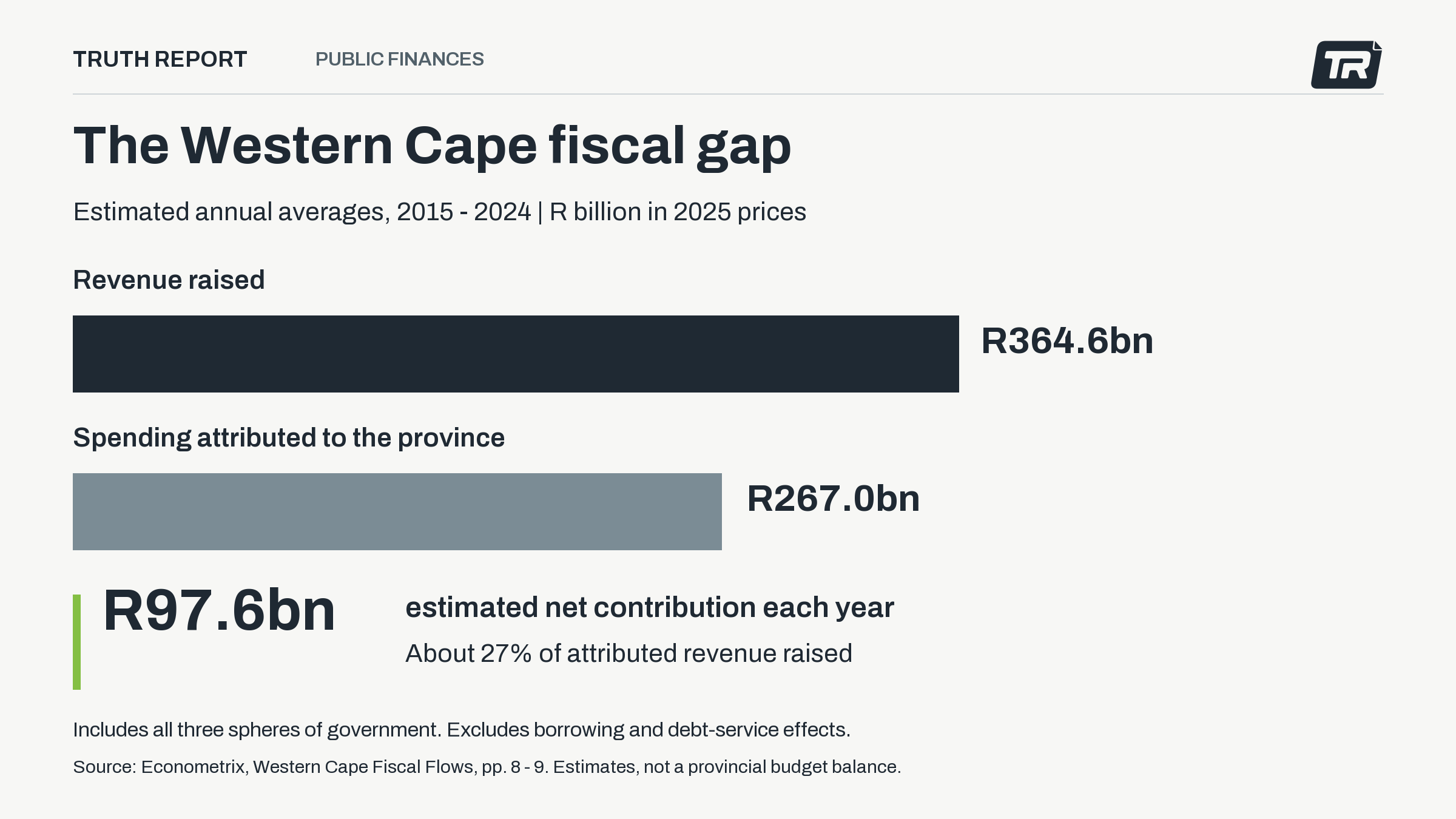
Revenue includes national taxes attributed to residents and businesses, alongside provincial and municipal collections. Expenditure includes services funded through national departments as well as provincial and municipal channels. National borrowing and debt-service effects are excluded from the comparison. The methodology therefore goes considerably beyond comparing tax paid with the provincial budget.
The authors also make an essential distinction: their calculation does not measure the full economic benefit of participation in South Africa. Interprovincial trade, economic spillovers and indirect benefits from national public goods lie outside its scope. Nor does it measure how effectively public money is spent. Those boundaries limit what can be inferred about autonomy from the historical gap.
The household figure needs equal care. The widely cited R74,000 for 2024 is a standardised comparison based on provincial population divided by four. It is neither an observed bill paid by every household nor a promised refund. The report’s household method cannot describe how gains from a future settlement would be distributed among rich and poor residents.
A large contribution, with limits to precision
The estimated annual net contribution roughly doubled in real terms over the decade, from about R70 billion in 2015 to R140 billion in 2024. That widening gap makes the question of how revenue and responsibilities are shared more pressing.
The study places Gauteng and the Western Cape alone in the net-contributor category. The other seven provinces receive more attributed spending than the revenue assigned to them. Gauteng’s average annual contribution is about R226 billion, considerably larger than the Western Cape’s in absolute terms, according to the report’s provincial comparison.
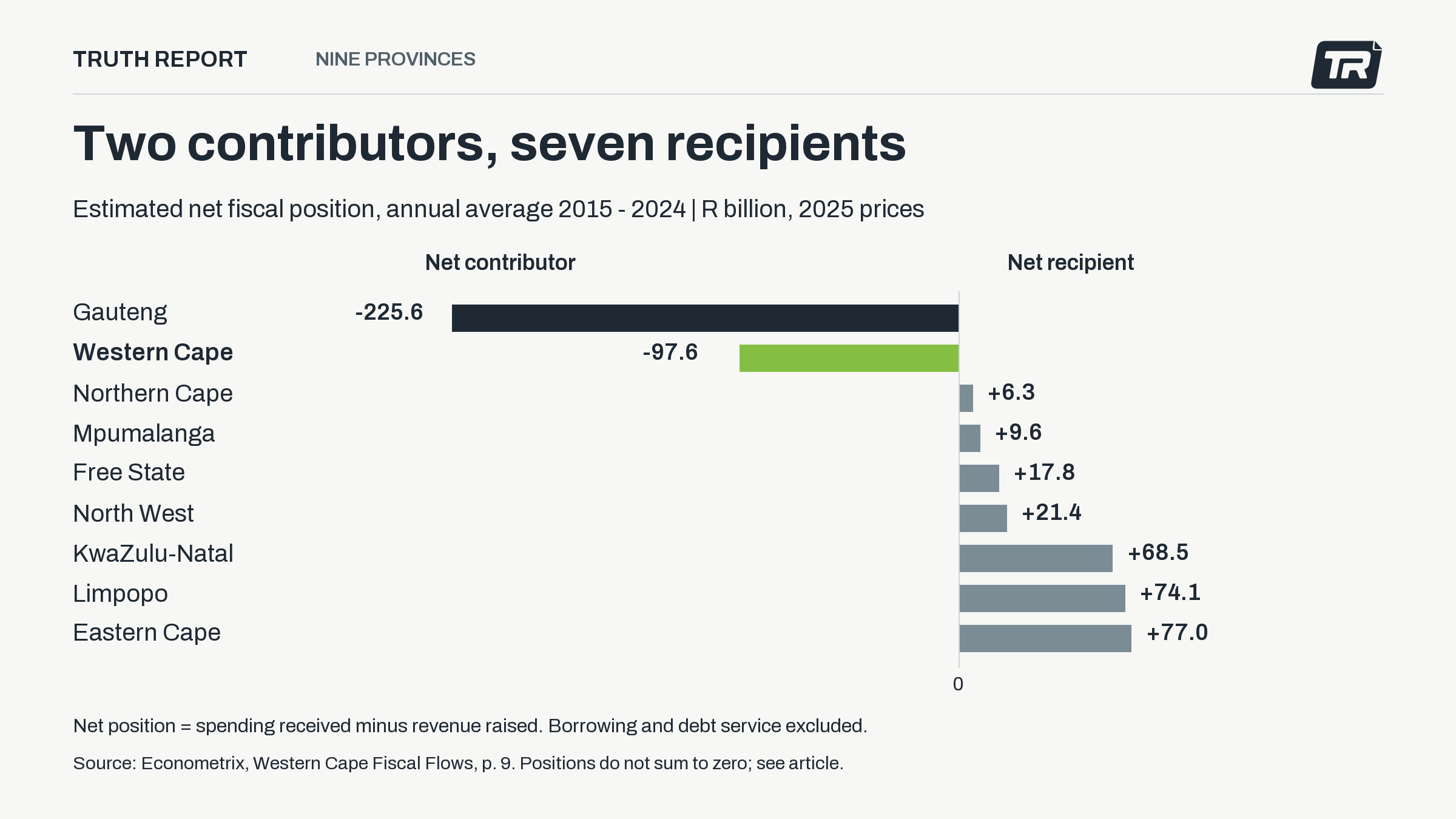
These estimates require judgement because complete provincial records do not exist for every flow. Econometrix attributes company income tax using industry tax data and provincial economic activity. It distributes residual national departmental spending using an equal weighting of provincial GDP and government-services value added. The authors describe their proxies as conservative, while explicitly warning that results are sensitive to attribution assumptions.
The nine provincial balances also do not sum to zero. The report explains that the residual reflects both excluded debt-service costs and separate attribution frameworks for revenue and expenditure. It should not be read as a directly traced payment of the national debt by two provinces.
Why redistribution exists
The strongest case for the existing system starts with citizens’ needs. A province’s capacity to raise revenue and its obligation to provide basic services need not match. Returning money solely according to its geographic origin could leave people in poorer regions with fewer resources for essential services.
That principle is built into section 214 of the Constitution. Revenue division must consider basic services, fiscal capacity, developmental needs, economic disparities, national debt and other obligations. The constitutional test extends beyond where taxes originate.
This does not settle whether present allocations are adequate or well designed. It means that a serious alternative must explain how it would finance shared obligations and protect access to services while improving accountability.
There is a documented service-delivery dispute behind the political argument. In a provincial parliamentary reply, Education Minister David Maynier said national funding covered only 64% of the cost of the 2023 wage increases for his department. He linked the remaining pressure to a decision to reduce the 2025 educator-post basket by approximately 2,400 posts.
A national Basic Education parliamentary reply adds an important qualification: at the time of that response, only the Western Cape had implemented a reduction in its educator-post basket. Funding pressure and the choice of how to absorb it are related, but distinct, questions. The fiscal study does not establish the classroom outcome of an alternative settlement.
A motion and a fiscal settlement
The organisers’ proposed route is politically direct. They argue that a provincial parliamentary motion asserting self-determination could compel reconsideration of the fiscal relationship. Their public statement presents this as a legal argument, drawing on a CIAG paper and a parliamentary legal opinion.
A motion asserting a demand and a completed transfer of fiscal authority are different legal acts. Section 235 recognises the notion of community self-determination within the national constitutional framework and refers to determination by national legislation. It does not itself specify a Western Cape entitlement to retain national taxes.
Meanwhile, sections 214 and 228 govern revenue division and restrict provincial taxation. The organisers’ argument would have to show how their proposed settlement interacts with these provisions. The economic study cannot resolve that legal question.
Lex Libertas executive director Ernst Roets makes a broader case for federalism: constitutionally protected local authority can allow different communities to govern more of their affairs within a shared country. That is a distinct institutional proposition from independence, even where advocates cooperate on decentralisation.
The future depends on the assumptions
The most dramatic future numbers belong to a separate CIAG Fiscal Autonomy Model, rather than the Econometrix historical study. Its benchmark scenario projects expanded unemployment of 7.4% by 2035, against 26.1% under its status quo scenario.
The comparison assumes full revenue retention, an allocation of national debt and a sustained growth premium of four percentage points above baseline. The model explicitly excludes transition costs, currency arrangements and capital flows. It also acknowledges that its labour-market formula probably overstates the fall in unemployment. These are scenarios under stated assumptions, not forecasts.
The report gives reform advocates a substantial fiscal case to advance. It also supplies reasons to demand greater precision from their proposed remedy. The next useful step is a costed settlement showing which taxes, services, debts and redistributive commitments would move, and which households would gain.
Residents need a credible account of how greater authority would become better teaching, safer streets and functioning hospitals. The size of the fiscal gap makes that work more urgent. It does not make the work unnecessary.


