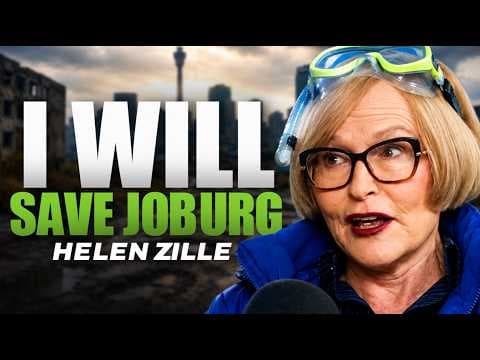
Inside the campaign to save a city many believe is already collapsing
Johannesburg is South Africa’s economic engine, but years of political instability, collapsing infrastructure, corruption allegations, failing utilities and financial mismanagement have pushed the city to the brink. Now Helen Zille has stepped into one of the most volatile political battlegrounds in the country, promising to rescue a city she says is effectively bankrupt. In an explosive interview with Truth Report, Zille laid out her vision for Johannesburg, her warnings about the city’s finances, and why she believes voters are running out of time.

Johannesburg has become a city of contradictions.
It remains Africa’s financial capital and the wealthiest metro economy on the continent, contributing roughly 16 percent of South Africa’s GDP. Yet across the city, residents face rolling water outages, collapsing roads, abandoned buildings, electrical failures, sinkholes, broken traffic lights and growing urban decay.
Entire neighbourhoods now operate on survival instincts.
Communities fix potholes themselves. Residents hire private security because confidence in law enforcement has collapsed. Businesses spend millions on generators, boreholes and backup systems just to continue operating.
This is the backdrop to Helen Zille’s campaign to take over Johannesburg.
And whether one supports her or not, there is no denying that she has managed to dominate the conversation.
From swimming in potholes to ziplining over giant sinkholes, Zille’s social media campaign has become one of the most talked about political campaigns in recent South African memory.
Critics call it political theatre.
Supporters call it effective communication.
Zille calls it strategic.
“For every five serious pieces of content that we put out, one is funny,” she told Truth Report.
“But it’s interesting to me that people only notice the funny ones.”
The City Is Running Out of Money
Beneath the viral videos and social media memes lies a much darker issue.
According to Zille, Johannesburg’s financial situation is far worse than most residents realise.
“The city is bankrupt,” she said bluntly.
That statement is not just campaign rhetoric.
Over the past decade, Johannesburg has suffered repeated governance crises. The city has gone through multiple mayors in rapid succession, coalition collapses, budget disputes and ongoing allegations of corruption and maladministration.
Zille referenced a letter from the Finance Ministry warning about the state of Johannesburg’s finances.
According to her, the city is struggling to meet its financial obligations, its budget is under severe pressure, and key decisions taken by councillors may have breached legal frameworks.
“They have misrepresented the budget,” she claimed.
“If they don’t pull things together, they are going to lose their equitable share under the Division of Revenue Act.”
The implications of that would be devastating.
Johannesburg’s infrastructure is already under enormous strain.
Large sections of the city’s water infrastructure are decades old. Electrical substations continue to fail under pressure. Residents regularly endure prolonged blackouts that last days instead of hours. Water shedding has become increasingly common.
Johannesburg Water has repeatedly warned about aging infrastructure and insufficient maintenance budgets. Eskom debt disputes have also intensified pressure on municipalities across the country.
Zille painted a picture of a city functioning in permanent crisis mode.
“There’s no money to fix anything,” she said.
“So the city lives from hand to mouth. Whatever makes the most noise quickly gets a little bit of money before that money is switched somewhere else.”
Her warning was especially stark when discussing infrastructure collapse.
“For 30 years there has been no proper maintenance. Now everything is breaking down at the same time.”
Viral Politics and the Pothole Mermaid
One of the reasons Zille’s campaign has attracted so much attention is because it refuses to behave like a traditional political campaign.
Instead of polished podium speeches and sterile press conferences, voters are seeing sinkholes, broken roads and collapsing infrastructure turned into viral moments.
The now famous “pothole mermaid” moment became symbolic of that approach.
After swimming in a massive water filled pothole during a campaign visit, social media exploded.
“I think one account called you a pothole mermaid,” Truth Report host Joe Emilio joked during the interview.
“I like that,” Zille responded.
The clips spread rapidly online.
Critics mocked the campaign as unserious.
But politically, the strategy appears calculated.
South African political campaigns increasingly compete in an attention economy dominated by short form content, memes and viral clips. Traditional political messaging often disappears into the noise.
Zille believes humour forces people to pay attention.
“This is the kind of content people notice,” she explained.
The campaign’s defenders argue that the videos achieve something traditional press statements rarely do.
They visually expose the collapse of Johannesburg’s infrastructure.
A massive sinkhole is no longer just a statistic buried in a municipal report. It becomes something viewers can see.
And perhaps more importantly, share.
The Coalition Problem
Johannesburg has become one of the clearest examples of South Africa’s coalition era.
Since the 2021 local government elections, coalition instability has repeatedly paralysed governance in major metros.
Johannesburg alone has cycled through multiple mayors in just a few years.
Motions of no confidence, collapsing coalitions and shifting political alliances have created an atmosphere of permanent uncertainty.
Zille believes voters themselves are partly responsible.
“If the voters split their vote between all sorts of tiny parties, they are guaranteed to have an unstable government,” she argued.
That statement cuts to the centre of a growing national debate.
South Africa’s political fragmentation has intensified dramatically.
In recent elections, smaller parties have multiplied across the political spectrum. While this increases representation, it also creates highly unstable coalition arrangements.
Zille argues that unstable coalitions make it almost impossible to tackle corruption or implement long term reforms.
“We’ve had ten mayors in ten years in Joburg,” she said.
“You can blame politicians, but it’s the consequence of the way the voters voted.”
Whether voters agree with that argument remains to be seen.
But the instability is undeniable.
Johannesburg’s governance crises have damaged investor confidence, slowed decision making and undermined long term planning.
For residents living through daily infrastructure failures, coalition politics increasingly feels disconnected from the realities on the ground.
Hijacked Buildings and the Rule of Law
One of the most explosive parts of the interview centred around hijacked buildings and illegal occupation.
Johannesburg’s inner city has long struggled with abandoned and illegally occupied properties.
Some buildings are controlled by criminal syndicates that allegedly extort rent from desperate residents while basic services collapse inside the structures.
The issue exploded into national attention after the 2023 Usindiso building fire in Marshalltown killed more than 70 people.
That tragedy exposed the dangerous conditions inside many illegally occupied buildings across the city.
Zille argued that South Africa’s current legal framework makes it extremely difficult to address the problem.
She specifically targeted the Prevention of Illegal Eviction Act.
According to Zille, the legislation unintentionally protects criminal syndicates that profit from hijacked buildings.
“The people who benefit are the criminal hijackers,” she said.
She also drew a distinction between xenophobia and immigration enforcement.
“You don’t have to hate foreigners to apply the law,” Zille stated.
“If people want to be in South Africa, they must be here legally.”
The comments are likely to generate controversy.
Immigration has become one of South Africa’s most politically charged issues.
With unemployment hovering around crisis levels and public frustration growing over strained public services, debates around border control and illegal immigration have intensified sharply.
Critics argue that politicians sometimes weaponise migration issues for political gain.
Supporters counter that enforcing immigration law is a normal function of any sovereign state.
Either way, the issue is clearly becoming central to the political conversation ahead of future elections.
Corruption, Decay and the Metro Centre Files
One of the most striking moments in the interview came when Zille described the state of Johannesburg’s Metro Centre.
According to her, critical property and building records are literally rotting inside neglected municipal facilities.
She described files lying in damp, dirty conditions surrounded by vermin.
“These are the records that underpin the economy of the city,” she warned.
In a modern economy, property ownership systems are foundational.
Without reliable records, development slows, disputes increase and administrative systems begin to fail.
Zille argued that the failure to digitise these systems is not simply incompetence.
“I think they do it on purpose,” she claimed.
“When things don’t work, you open many doors for the corruption economy.”
That accusation goes to the heart of one of South Africa’s deepest frustrations.
Many citizens no longer believe dysfunction is accidental.
Years of state capture revelations, procurement scandals and municipal corruption have created widespread distrust in public institutions.
The collapse of administrative systems is increasingly viewed not merely as failure, but as an ecosystem that enables patronage and extraction.
Can Johannesburg Actually Be Fixed?
Perhaps the most important part of the interview was also the least dramatic.
Zille repeatedly warned that even if her party wins Johannesburg, residents should not expect miracles overnight.
“We’ve got a long way to go,” she admitted.
She argued that many of the most important reforms would initially be invisible.
Fixing municipal finances.
Rebuilding technical capacity.
Appointing competent officials.
Restoring maintenance systems.
Stabilising utilities.
None of these produce instant political victories.
And in a country where voters increasingly demand immediate results, that may be politically risky.
Zille believes Johannesburg would require at least two full terms to produce truly visible recovery.
That timeline reflects the scale of the crisis.
Many of Johannesburg’s core infrastructure systems are decades old. Some areas have experienced chronic underinvestment for years.
Fixing a city of this size is not comparable to launching a new political slogan.
It requires institutional reconstruction.
The Bigger National Warning
The Johannesburg battle is not just about one city.
It has become symbolic of South Africa’s broader crossroads.
Can major urban centres still be repaired after years of institutional decline?
Can coalition governments become stable enough to govern effectively?
Can corruption be meaningfully reduced?
Can infrastructure systems be rebuilt before collapse accelerates further?
These questions extend far beyond Johannesburg.
And that is partly why Zille’s campaign has captured so much national attention.
Supporters see her as an experienced administrator stepping into a crisis.
Critics see a veteran politician using spectacle to revive a struggling political brand.
But even critics acknowledge one reality.
Johannesburg’s condition has become impossible to ignore.
The roads, the outages, the broken systems and the growing frustration across communities all point to a city under severe pressure.
The question now is whether voters believe the city can still be rescued.
Or whether the decline has already gone too far.
Quotes From the Interview
“The city is bankrupt.”
“There’s no money to fix anything.”
“You don’t have to hate foreigners to apply the law.”
“For every problem in Joburg, there are people trying to solve it.”
“We can win if all our voters register and vote.”
Final Word
At one point during the interview, Zille described Johannesburg as a place filled with “can do people.”
That may ultimately become the defining question of this election.
Not whether politicians can save Johannesburg.
But whether Johannesburg’s residents still believe the city is worth fighting for.
Because beneath the memes, the pothole stunts and the political battles lies a far more serious reality.
South Africa’s biggest city is under pressure.
And the clock is ticking.