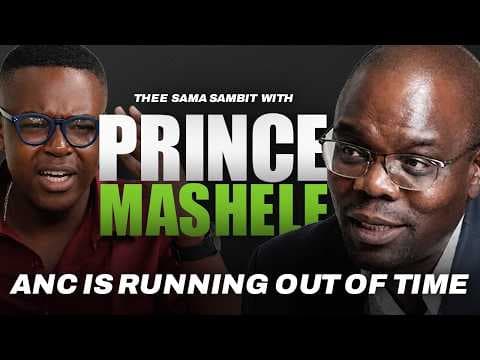
Political analyst Prince Mashele says South Africa is running out of time, and out of competent leadership. In a fiery, unfiltered interview with Truth Report, he tears into the ANC, dismisses the EFF as political theatre, questions the DA’s ability to govern, and warns that without a new generation of leadership, South Africa could become a failed state within a decade.

South African political analyst Prince Mashele has never been known for diplomatic language. But in his latest Truth Report interview, he delivered one of his most brutal assessments yet of South Africa’s political landscape — describing the ANC as “brain dead,” the criminal justice system as “collapsed,” and the country as dangerously dependent on a functioning private sector to survive.
Mashele, executive director of the Centre for Politics and Research, argued that South Africa’s political decay did not begin overnight. According to him, the ANC lost its intellectual backbone years ago. “The ANC historically has been a party of intellectuals,” he said, referencing figures like Pixley ka Isaka Seme and former president Thabo Mbeki. “But after Mbeki, you struggle to find serious thinkers guiding the ANC. Since Zuma took over, the party lost its mind.” His comments come at a critical moment for South Africa, with the ANC’s electoral dominance weakening after the 2024 elections and coalition politics becoming the new reality. For the first time since 1994, the ANC fell below 50% nationally, forcing it into the Government of National Unity (GNU) alongside parties it once fiercely opposed.
“The GNU Will Collapse”
One of the interview’s biggest claims was Mashele’s prediction that the GNU will not survive beyond Cyril Ramaphosa’s presidency. He believes the ANC’s internal factions are already positioning themselves for a post-Ramaphosa era and that a populist backlash inside the party will eventually destroy the coalition arrangement.
“The GNU will fall the moment Cyril Ramaphosa is out of office.”
Mashele predicts that Ramaphosa will not complete his final stretch in office peacefully. He pointed to historical precedent inside the ANC, where former presidents like Thabo Mbeki and Jacob Zuma faced intense internal pressure before leaving office. According to Mashele, Ramaphosa’s support base inside the ANC is weak and transactional rather than ideological.
“Ramaphosa became president by a whisker,” he said. “Those who supported him saw him as an instrument to facilitate their eating.”
The political analyst also dismissed the idea that any major opposition party currently offers a convincing alternative government. While acknowledging the DA’s importance as an opposition force, he argued the party has failed to build a leadership structure capable of governing a deeply divided South Africa.
“South Africa is languishing under a dictatorship of no alternatives.”
Trump, “White Genocide,” and Global Politics
Mashele also weighed in on one of the most internationally controversial narratives surrounding South Africa: claims of “white genocide” amplified by figures close to former US president Donald Trump. He rejected the claims outright, arguing that South Africa’s crime crisis overwhelmingly affects black South Africans living in poorer communities.
“There is no genocide against anyone in South Africa. The majority of people murdered are black.”
South Africa remains one of the world’s most violent countries outside active war zones. Police statistics consistently show murder rates above 70 murders per day nationally, with townships and poorer areas carrying the heaviest burden of violent crime. Mashele argued that the international focus on white farmers ignores the broader collapse of safety across the country.
He further claimed that tensions between the United States and South Africa intensified after the ANC government took Israel to the International Court of Justice over the Gaza conflict — a move that triggered backlash from powerful international lobbying networks. “Donald Trump knows there is no genocide here,” Mashele said. “This is geopolitical punishment.”
Still, he did not spare the ANC from criticism. Throughout the interview, he repeatedly accused the ruling party of corruption, incompetence, and destroying public institutions.
“Without the Private Sector, South Africa Is Already a Failed State”
Perhaps the interview’s most alarming moment came when Mashele described South Africa as a country surviving largely because the private sector continues compensating for state collapse.
“If you take South Africa now and remove the private sector, this country is a failed state.”
He pointed to collapsing public hospitals, failing infrastructure, poor public education outcomes, and a dysfunctional criminal justice system as evidence that the state is struggling to perform its most basic responsibilities. South Africa’s official unemployment rate currently sits above 32%, while youth unemployment remains among the highest in the world — hovering above 45% by expanded definitions.
Mashele argued that educated South Africans increasingly rely on private healthcare, private schools, private security, and private transport systems because they no longer trust the state to provide functioning public services.
His comments on policing were equally severe. Referencing corruption allegations and failures inside SAPS, Mashele claimed the criminal justice system itself has effectively collapsed.
“The police have collapsed. If you collapse that, you collapse the entire justice system.”
The warning reflects growing public frustration around organised crime, political killings, infrastructure theft, and corruption investigations that rarely result in convictions. Recent commissions and investigations have repeatedly exposed deep dysfunction inside law enforcement and intelligence structures.
The EFF, Julius Malema, and Political Theatre
Mashele reserved some of his sharpest criticism for EFF leader Julius Malema, whom he described as politically finished.
“The EFF is shrinking every election,” he claimed. “South Africans have realised this thing is a sham.”
He accused Malema of performing radical politics publicly while privately benefiting from the very capitalist systems he attacks. According to Mashele, much of the EFF’s anti-Western rhetoric is political theatre designed to maintain relevance rather than a genuine ideological project.
While Malema remains one of South Africa’s most influential political figures online and among younger voters, the EFF’s national support has stagnated in recent elections compared to earlier expectations of rapid growth.
A Message to Young South Africans
Beyond the politics, Mashele delivered a direct message to young South Africans struggling with unemployment, hopelessness, and digital distraction. He warned that social media algorithms, political populism, and “tenderpreneur culture” are trapping many young people in cycles of anger and dependency rather than self-development.
“Read, read, read and read books. That’s how I escaped poverty.”
He repeatedly urged young people to pursue education aggressively, warning that no political party or social grant system will save them from economic hardship without skills and independent thinking.
He also criticised what he called South Africa’s obsession with flashy wealth and corrupt role models.
“Don’t admire people driving Lamborghinis bought with stolen money,” he said. “Look for educated professionals doing proper work.”
A Country at a Crossroads
Whether people agree with Prince Mashele or not, his interview reflects a growing anxiety spreading across South Africa’s political spectrum. Trust in institutions is eroding. Economic frustration is rising. Coalition politics has introduced uncertainty into a system that once seemed politically immovable.
South Africa now faces a difficult question: if voters are losing faith in the ANC, but remain unconvinced by the opposition, what comes next?
Mashele believes the answer will not come from existing political structures alone — but from a new generation of capable leaders willing to enter politics before the system deteriorates further.
And if that does not happen?
His warning was blunt.
“In ten years, South Africa will be a failed state.”