


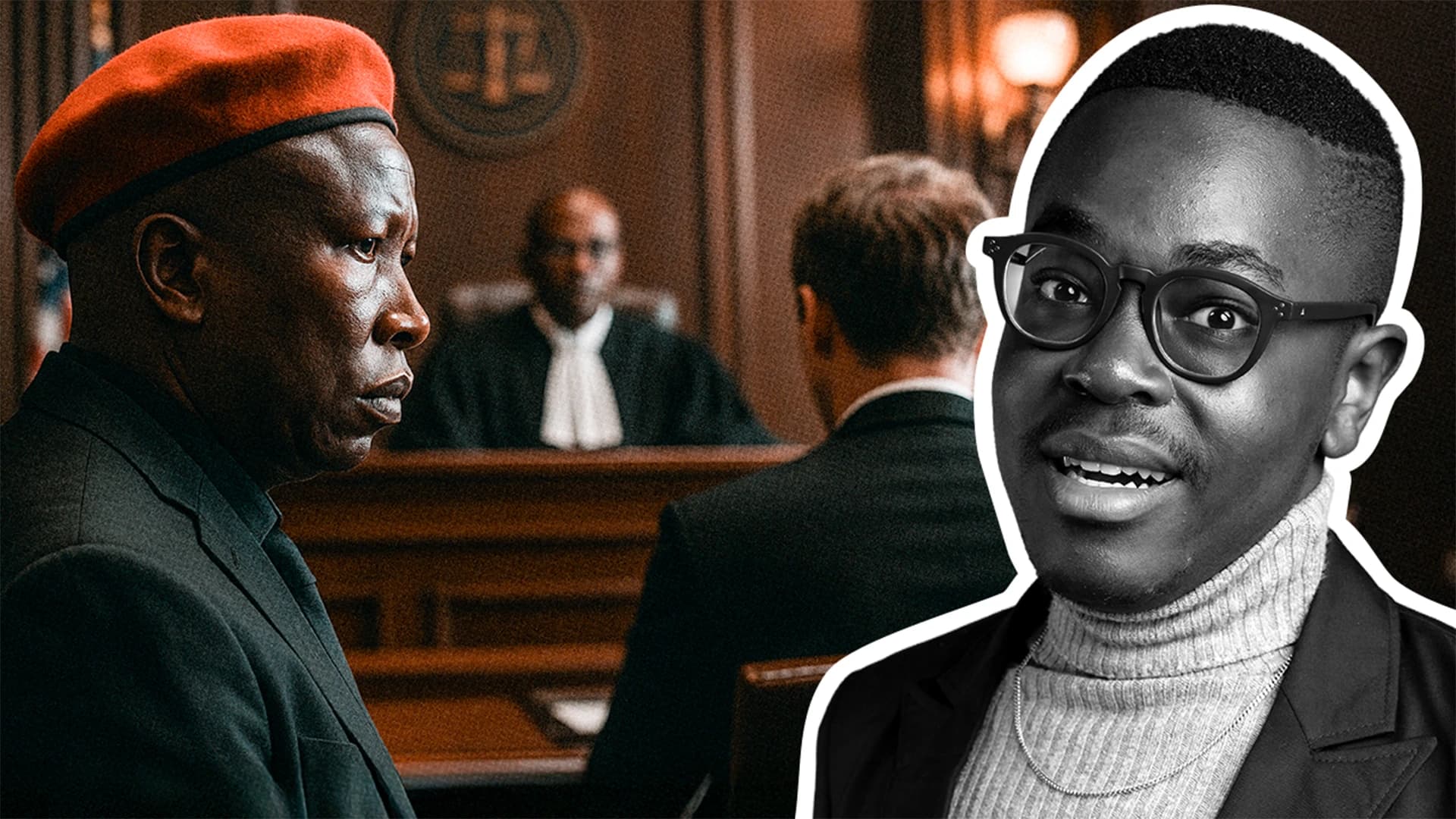
Civil rights organisation AfriForum and the Southern Africa Agri Initiative (Saai) announced last Wednesday that it will escalate its battle against EFF leader Julius Malema’s hate speech to the international stage, seeking targeted sanctions under the US Magnitsky Act and approaching European governments for punitive action.
These organisations have released what a detailed 185-page “charge sheet” against Malema, called The Malema Dossier. The dossier, which will be distributed internationally, presents an account of Malema’s hate speech, his incitement to violence and examples of his statements in support of terrorist organisations and acts. It also contains a report by Advocate Gerrie Nel, Head of AfriForum’s Private Prosecution Unit and his team regarding allegations of corruption against Malema.

Handover in Washington
Werner Human, an AfriForum Board Member, will hand over the Malema Dossier to officials in Washington during his and Solidarity’s upcoming visit to the US. AfriForum said it will also send a delegation to Europe later this year to garner support among decision-makers for targeted sanctions against Malema. Saai and AfriForum will also address the UN Forum for Minority Issues in Geneva and engage in discussions locally with various countries’ embassies regarding the action against Malema.
AfriForum CEO Kallie Kriel and Southern African Agri Initiative Executive Director, Theo De Jager highlight the purpose of the dossier on page one.
“AfriForum and the Southern Africa Agri Initiative (Saai), a family-farming organisation, hereby officially request that the international community, including countries and international institutions, take action to hold Malema accountable for his gross human rights violations,”
“In light of Malema’s calls for the murder of farmers and his encouragement for the unlawful occupation of agricultural land, Saai is intervening as an agricultural organisation, while AfriForum, as a civil rights organisation that safeguards the human rights of South Africans, is making the request.”
Dossier detailed allegations
In support of AfriForum and Saai’s urgent request they said supporting information included in the document alleged:
- Violent rhetoric, hate speech and racist remarks by Julius Malema;
- Malema’s anti-Western statements and support for terrorist organisations
- Corruption: Discussion document to motivate the invoking of the Magnitsky Act on certain individuals by the American authorities
AfriForum and Saai’s decision to fight Julius Malema’s “Kill the Boer/Kill the Farmer” call for violence against Afrikaners and farmers internationally is, according to the organisations, necessitated by the fact that the Constitutional Court has in practice legalised Malema’s incitement to violence through this chant, while President Cyril Ramaphosa has refused to condemn it.
Victory in Equality Court
Speaking at a media briefing in Pretoria, Kriel declared that local legal remedies have been exhausted after years of court battles. However, the organisation recently clinched one victory with the South African Human Rights Commission in the Western Cape Equality Court on 27 August.
“The farmer chant is a violent call for the murder of Afrikaners and the murder of farmers. There can be no doubt about that,” he said.
Kriel said Malema was a suitable candidate for sanctions under the Magnitsky Act that allows the US to take targeted sanctions against individuals who violate human rights, are guilty of serious corruption and who that support terror organisations.
“Julius Malema ticks all these three boxes,” Kriel alleged.
Kriel highlighted the organisation’s frustration which stems from institutional failure at the highest levels. He said Ramaphosa had ignored a letter AfriForum wrote to him in March requesting that he condemn the chant.
“In effect, the Constitutional Court has legalised that somebody can chant somebody else should be killed on an ethnic basis … I have children, and for somebody now coming to try and justify the fact that somebody can chant that my children should be killed, that cannot be justified,” Kriel said.
De Jager, expressed deep frustration with South African courts.
“It has been more than 13 years now that we have been struggling to get this chant “Kill the Farmer, Kill the Boer” flagged as a crime against humanity,” he said.
The organisations said the time was right to escalate the fight to ban the song as there had been recent international recognition of their concerns.
Malema denied entry into UK
The UK government had denied Malema a visa in June citing his “extremism,” specifically his support for Hamas and statements inciting racial violence, deeming his presence “not conducive to the public good.” In addition, two of four conditions the US government has set for the normalisation of diplomatic relations with South Africa regards safety on farms and Malema’s chant. President Donald Trump’s administration has demanded that the ANC as a political party turn their backs on this chant.
AfriForum spokesperson Ernst Van Zyl said the visa rejection letter “directly referred to his statements calling for the slaughter of white people in South Africa.”
Van Zyl shared testimony from AfriForum and the South African Human Rights Commission’s 2022 Western Cape Equality Court case against Malema, which he said revealed his “extremist, hateful, views”. The case, highlighted in the dossier, stemmed from Malema’s statements during a rally, urging supporters to “never be scared to kill” and that “killing is part of a revolutionary act,” targeting white males.
“When Malema was asked under oath whether white people can be victims in South Africa, he very strongly answered: ‘No, not at the current moment, no, no, no, no.’ Referring to past comments of Malema where he said on more than one occasion that “we are not calling for the slaughtering of white people, at least for now,” Advocate (Mark) Oppenheimer asked whether Malema would pledge that he would never call for the slaughtering of white people. Malema shockingly refused,” Van Zyl said.
“When he is asked whether it could be him in the future who makes a call to racial violence he testifies that he may call for the slaughtering of white people in the future. He cannot rule out the possibility.”
“When asked whether he would endorse the use of violence… Malema responded… “when the time comes and the conditions on the ground necessitate that arms must be taken, we will do so without hesitation,”’ Van Zyl said.
‘I’m not moved’
Van Zyl described Malema’s reaction to a traumatised farmer’s testimony about his wife’s murder during the court case. When asked if hearing the farmer’s story would make him stop singing “Kill the Boer,” Malema’s response was “I’m not moved… let me repeat five times I’m not moved.”
Nevertheless, the court ruled on 27 August that Malema was guilty of hate speech for inciting violence during the rally. Judge Mark Sher found his remarks promoted racial hatred and risked inciting large-scale violence. The EFF and Malema were implicated in the judgment and ordered to pay costs. Both have indicated they will appeal the ruling.
AfriForum’s 185 page dossier documents testimony from this case and highlights Malema’s embrace of violence as political strategy.
Perhaps most chilling was Malema’s response when asked about killing. Van Zyl quoted the EFF leader’s words as cited in the dossier: “I’m not scared of killing. A revolutionary is a walking killing machine.”
The dossier documents other inflammatory statements.
More inflammatory statements
During the EFF’s 2013 launch, supporters displayed posters including one reading, “a revolutionary must become a cold killing machine motivated by pure hate.” It highlights Malema’s February 2018 statement: “We are cutting the throat of whiteness.”
Van Zyl also cited Malema’s support for Hamas, quoting the EFF leader as saying in October 2023: “There’s nothing wrong with what Hamas did. When you are oppressed, the only option you have is to fight …the EFF, when it takes power next year, is going to arm Hamas and make sure Hamas has the necessary equipment to fight for its freedom.”
The dossier also documents corruption allegations, including the VBS scandal where South African citizens and taxpayers were defrauded out of nearly R2 billion.
With local remedies exhausted and international attention growing, AfriForum believes it has reached a turning point in its battle against Malema’s rhetoric.
“The recent equality court ruling that found Julius Malema guilty of hate speech simply confirmed what AfriForum and others have been saying for many years …Malema and his EFF party are guilty of inciting racial hatred and race based violence,” Van Zyl said.
He said 2025 has been a “watershed” year regarding Malema’s violent rhetoric being exposed to the global stage.
“The international response to hearing this type of rhetoric has been near unanimous disgust and shock, very strongly in contrast with many political leaders in South Africa who seem unbothered by this type of rhetoric, even entertained and in support of this rhetoric,” Van Zyl said.
“If 2025 has proven one thing is that injustice does not remain hidden forever,” he said.
The organisation has published the dossier on its website and has encouraged global distribution to build pressure for international sanctions against Malema.


