


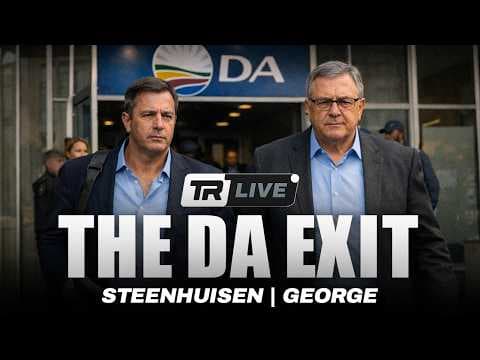
Dion George’s departure from the Democratic Alliance may look like just another political resignation, but to many observers it signals something far more significant unfolding inside South Africa’s official opposition.
His exit comes at a moment when the DA appears to be recalibrating its direction, not just tactically, but ideologically. This has raised questions about whether the party is deliberately shedding parts of its old identity in an effort to broaden its appeal ahead of future elections, or whether internal fractures are beginning to surface as a result of that strategy.
At the centre of the debate is the argument that the DA is entering a new era, one focused on image management, voter targeting, and electoral arithmetic rather than internal cohesion. Supporters of this shift argue it is necessary for growth in a changing political landscape, especially after the 2024 election results forced new coalition realities. Critics, however, see a party drifting toward ambiguity, trying to be everything to everyone while risking the loss of long-standing principles and experienced figures. The concern is that in chasing new voters, the DA may be diluting the very identity that once set it apart from the ANC.
This tension has been amplified by the DA’s role in the Government of National Unity, which has altered how the party governs, compromises, and enforces discipline. Some believe the DA is now engaging in the same “people-pleasing” politics it once condemned, prioritising leadership protection and public optics over internal dissent and principle.
In that sense, Dion George’s exit is symbolic. It forces a bigger, unavoidable question: is the DA evolving into a party capable of winning power, or slowly becoming a party uncertain of what it truly stands for?


