


The debate exposed the distance between a city’s record of investment and the lives that investment is meant to change. Court orders and official financial records offer a firmer test than either party slogans or municipal averages.
Cape Town has an ambitious infrastructure programme. It also has a binding Constitutional Court finding that the City and Western Cape government failed to fulfil particular housing obligations in the central city and Sea Point. Those facts can coexist. Together, they explain why the argument over whether Cape Town works remains so bitter.
In its March 2026 budget announcement, the City set out a R40 billion infrastructure programme over three years. In July, the Constitutional Court’s Adonisi judgment required housing policy to take location seriously, including the need to undo apartheid’s spatial injustice. Financial scale and access to opportunity are different measures of government.
That distinction ran through Truth Report’s debate at the Goal50 educational hub in Heideveld. The Democratic Alliance’s Xanthea Limberg defended the administration’s investment, service delivery and financial management. GOOD’s Brett Herron pressed a different test: whether public investment was closing the distance between communities with established amenities and those still struggling for them.
The disagreement was often obscured by interruptions. Its substance deserves a clearer hearing. A government can show that it is investing without yet demonstrating that the distribution, completion and everyday benefit of that investment meet the needs of its most excluded residents. Equally, persistent deprivation does not establish that investment is absent or worthless.

What the investment figures establish
The City’s March infrastructure announcement included water and sanitation works, electrical infrastructure, the MyCiTi Cape Flats expansion and housing. It also said 75% of infrastructure spending directly benefited lower-income households. This is the administration’s classification of benefit, rather than an independently demonstrated measure of how much inequality has fallen.
A sewer upgrade may serve a large catchment. A transport project may connect several communities. Both can have substantial value without producing identical benefits for every household within reach. A percentage attached to a capital programme needs an explanation of which projects count, which beneficiaries are included and how shared infrastructure is apportioned.
Herron’s demand for identifiable projects and comparable standards therefore raised a legitimate accountability question. It does not follow that the City has done nothing. It follows that a headline allocation cannot, by itself, answer a question about the condition of a particular street, sports field or settlement.
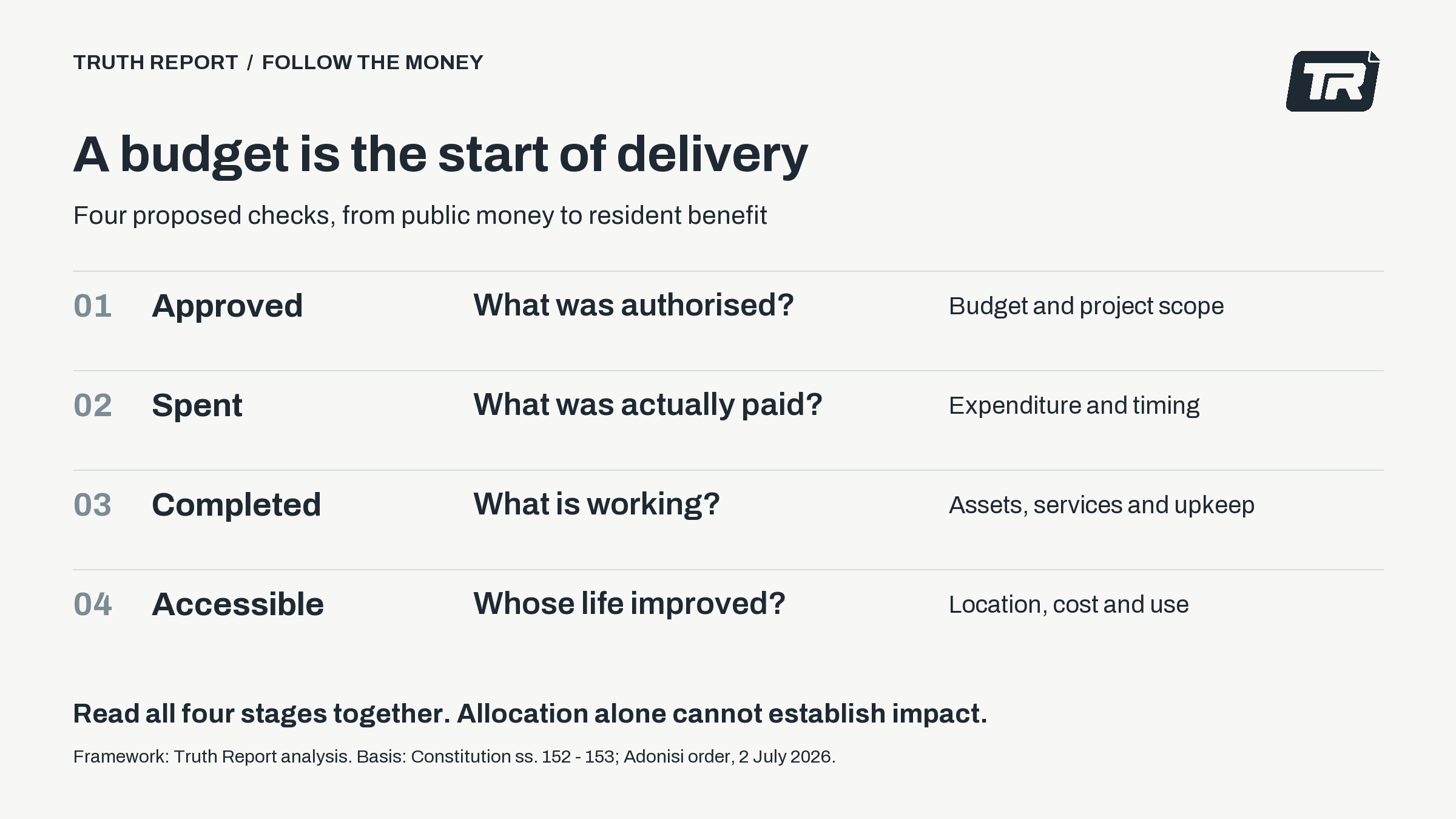
Residents need to be able to follow money through several stages: what was approved, what was spent, what was completed and what improved. These are proposed tests of accountability, not findings that every municipal project has failed them. They would make the City’s successes easier to demonstrate and its shortcomings harder to obscure.
The audit record needs accurate language
Cape Town’s financial position deserves recognition. The Auditor-General’s 2024/25 local government report identified Cape Town and eThekwini as the metros with good financial health indicators. That is meaningful counterevidence to any sweeping portrayal of Cape Town as simply another collapsed municipality.
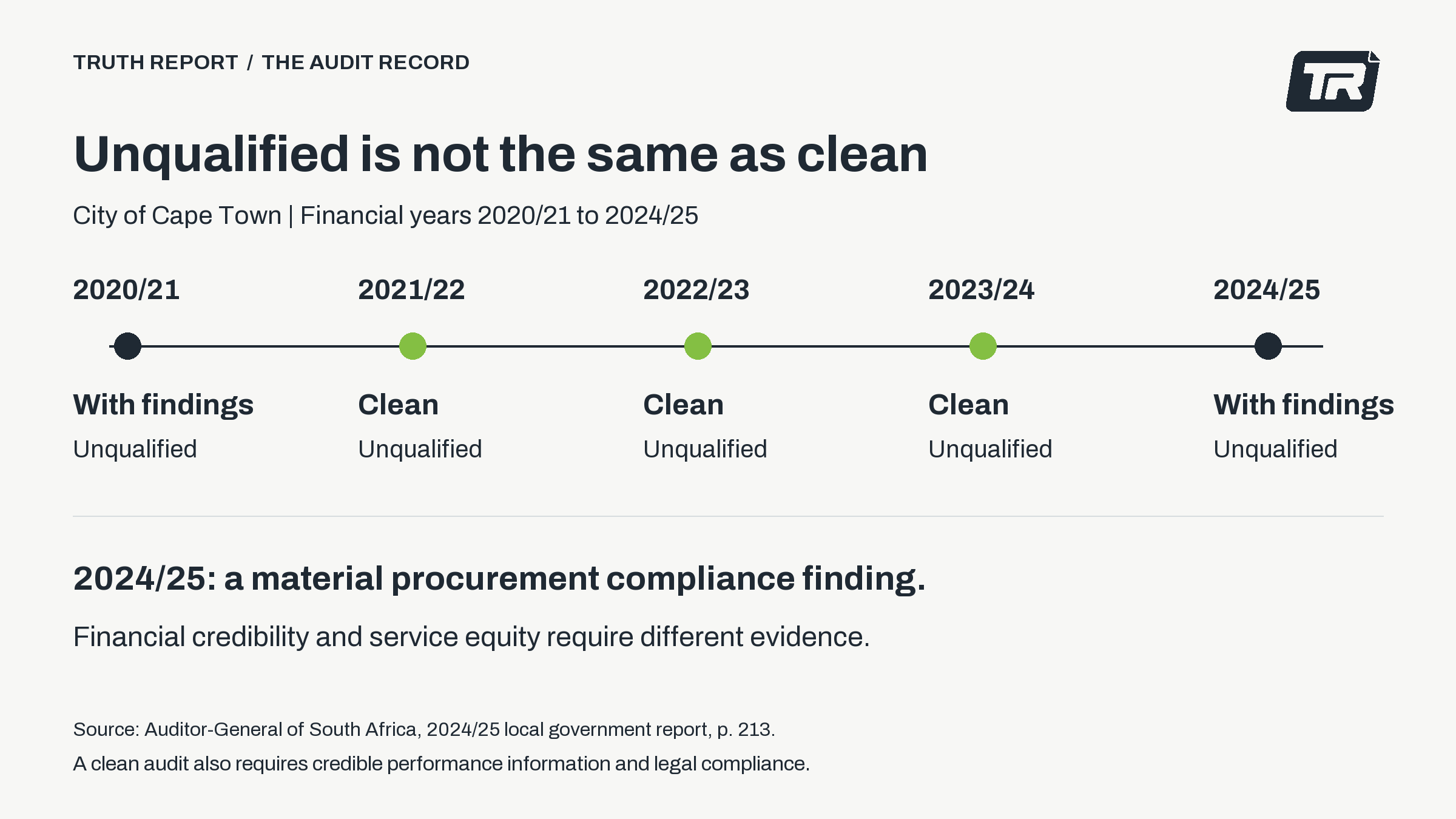
The same report records an unqualified opinion with findings for Cape Town in 2024/25, following clean audits in the preceding three years. It identifies a material procurement compliance finding. An unqualified opinion with findings is not a clean audit.
The Auditor-General’s explanation is useful: a clean audit combines credible financial statements, credible performance information and compliance with applicable legislation. That standard matters. It still does not certify that every neighbourhood enjoys equivalent facilities or that every resident can afford the municipal bill.
Good financial management helps make sustained services possible. Its civic value ultimately depends on the services and opportunities it supports. Neither dismissing audits as meaningless nor treating them as a complete verdict on a city’s fairness serves residents well.
Electricity: the documents narrow the dispute
The sharpest factual disagreement concerned electricity. Herron said the City was challenging Nersa’s 2025/26 tariff decision. Limberg repeatedly denied a court case concerning that year, while acknowledging litigation over earlier tariff decisions.
Nersa’s reasons for its May 2026 tariff decision, paragraphs 8.1 and 8.2, separately discuss the earlier challenge and the 2025/26 dispute. For the latter, the regulator records that it had filed its record and was finalising an answering affidavit. That record supports Herron’s narrower point that a review concerning 2025/26 was recorded. The discrepancy with the debate denial requires an explanation from the City.
That finding should not be stretched into a ruling that a particular household is owed a refund. Nor does it establish Herron’s aggregate overcharging estimate. Those questions require the applicable tariff components, consumption, legal authority and any relevant court orders to be reconciled.
Nersa also approved tariffs for implementation from July 2026. A later approval and a challenge to an earlier determination can coexist. An average annual increase, a comparison with an earlier regulatory baseline and the change on an individual account answer different questions. Calling each of them “the increase” invites confusion.
The City has a substantive position too. It has argued that Nersa failed to consider its cost-of-supply evidence in the earlier tariff dispute. Explaining that position is necessary. So is identifying precisely which decision is being challenged, in which proceedings, and with what consequences for residents.
Housing must change access to the city
The housing argument has a more definite legal foundation. In Adonisi, decided on 2 July 2026, the Constitutional Court held that reasonable measures must include affordable housing in the specified central-city areas and Sea Point. It found that the Province and City had failed to comply in implementing and completing their social housing programmes there. It required reports under oath within three months.
This was a finding about defined obligations and areas. It was not a declaration that every housing development elsewhere in Cape Town was unlawful, or that every public property must become housing. The qualification is essential. So is the finding itself.
For a household, location can change the practical value of a home: the journey to work, access to services and time available for family life. The judgment makes that geography part of the assessment of adequate housing. Counting units or announcing land releases cannot settle the question on its own.
Limberg defended a pipeline of affordable housing and transport investment. Those are relevant responses. They should be assessed through completed homes, affordability, location and functioning connections to opportunity. A proposed project and an occupied home belong at different points in the delivery account.
Safety has more than one responsible institution
The debate also risked turning policing and community development into competing explanations for violence. The Constitution assigns preventing and investigating crime to the national police service. It also provides for municipal police services within a national legislative framework. These arrangements matter when judging demands for additional local investigative powers.
Municipal responsibility extends further. Sections 152 and 153 require local government to pursue a safe and healthy environment, promote social and economic development and prioritise communities’ basic needs within its capacity. The practical implication is that police reform cannot substitute for the City’s developmental work. Community programmes likewise cannot substitute for competent criminal investigation.
Claims that a particular technology or deployment caused a reduction in violence require evidence beyond spending totals or arrests. Comparisons also need consistent periods and geographic boundaries. The public deserves that discipline from both the administration and its opponents.
Goal50 offered a modest, tangible point of reference. The charity’s account of its Heideveld hub describes a building using reclaimed materials and local labour, with workers gaining skills. That does not establish the cost, safety or scalability of every proposed building using similar methods. It does show why discussion of development becomes more useful when it identifies a place, a purpose and people who benefit.
Cape Town’s governing party has an investment case to defend. Its opponents have an obligation to distinguish documented shortcomings from assertions. The most useful outcome of this debate would be an account residents can test: which community, which project, which completion date, what cost and what improvement. A city’s financial strength matters most when people can recognise its value in the lives they lead.Truth Report · Independent reporting and analysis