Wayne Thring wants written safeguards before another coalition with the Democratic Alliance. The public record shows why smaller parties want protection, and why a demand for trust must also confront the choices an election leaves behind.
Wayne Thring’s position contains a difficult political calculation. The African Christian Democratic Party (ACDP) remains open to working with the Democratic Alliance (DA), yet he argues that another arrangement would need written commitments capable of holding its larger partner to account.
His criticism reaches back to the opposition’s preparations for the 2024 election and the DA’s subsequent decision to enter government with the African National Congress (ANC). The distinction matters: an agreement to prepare an alternative government and an agreement to govern after the votes are counted are different commitments. Their political credibility depends on how honestly that difference is explained.
South Africa has now voted in the 4 November 2026 municipal elections. The Electoral Commission declared the elections free and fair on 8 November. Thring’s comments during the count therefore illuminate the bargaining principles he was setting out, rather than establish the final electoral strength of his party or its eventual coalition decisions.
What the ACDP signed
The ACDP’s own explanation of the Multi-Party Charter is unusually important to this dispute.
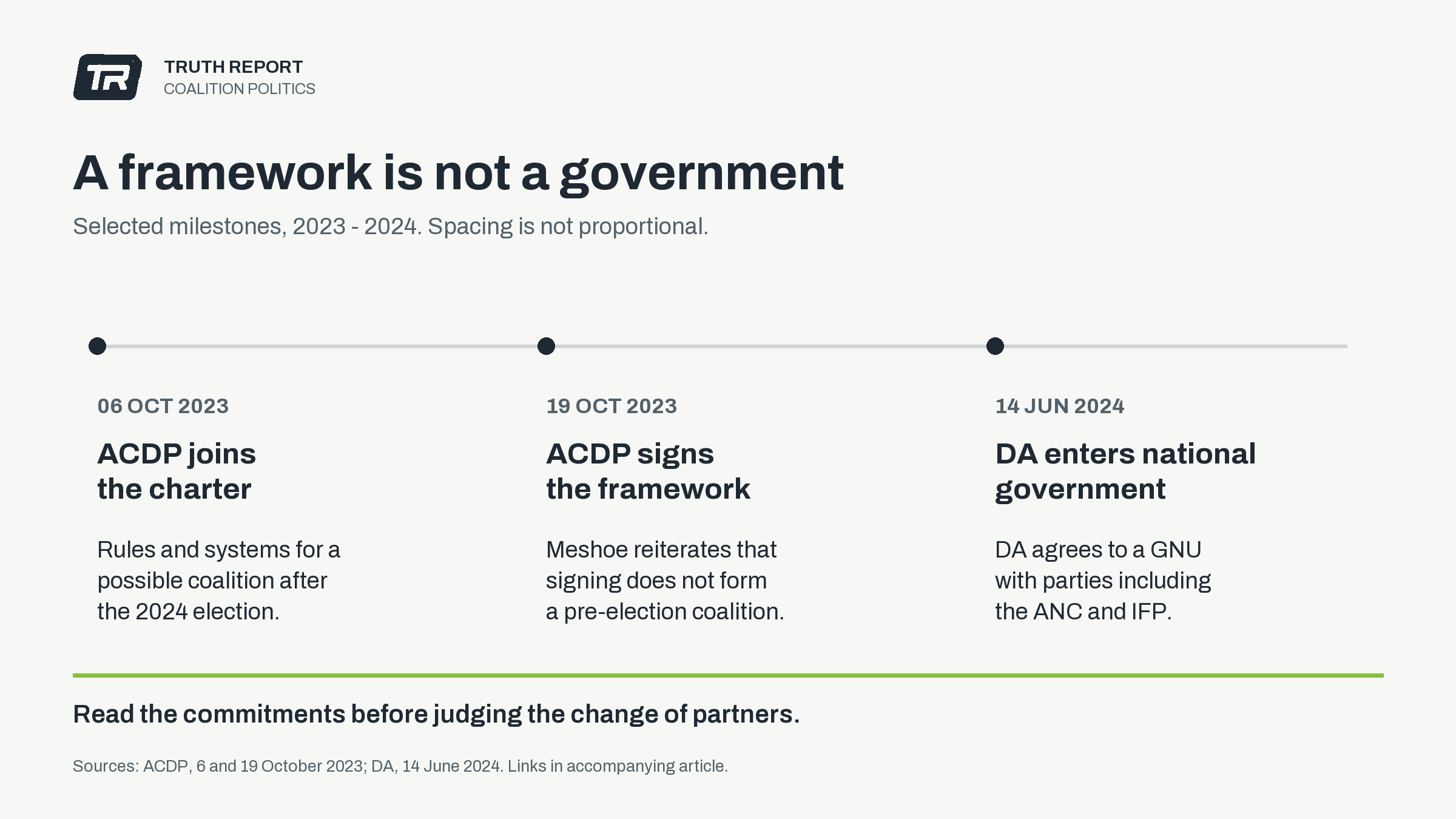
In an October 2023 statement issued in Thring’s name, the party said it opposed forming coalitions before an election. It joined the charter after receiving assurances that the initiative would develop the rules and machinery for possible cooperation afterwards.
Kenneth Meshoe repeated that distinction when the party signed the charter on 19 October 2023. Its purpose was to provide a framework for a possible coalition after the election; membership did not itself constitute one. His statement nevertheless placed the undertaking firmly within the effort to build an alternative to ANC government.
That creates two standards against which to judge what followed. The ACDP had explicitly preserved its freedom to decide after the election. It also had reason to expect that a project presented as an alternative to the ANC would carry political weight beyond polling day.
The DA’s strongest answer
On 14 June 2024, the DA announced its agreement to enter a government of national unity, alongside parties including the ANC and Inkatha Freedom Party. Its public justification was that the election required cooperation, that constitutional safeguards mattered, and that the party should influence decisions from inside government.
By 30 June, announcing its ministers and deputy ministers, the DA expressly argued that no party had won an outright majority and that the electorate wanted parties to work together. That is a substantive counterargument to Thring’s distrust: refusing office also has consequences, and an election can make a preferred governing combination unavailable.
The existence of that argument does not settle whether the DA treated its former partners fairly. Equally, the decision to join the ANC does not, by itself, establish dishonest conduct during earlier negotiations. A judgment about private assurances requires evidence of what was promised, to whom, and under which conditions.
The documented change of governing partners can be assessed without turning an allegation about motive into an established fact.

A smaller partner’s problem
Thring also objects to the way a larger party can describe a jointly governed municipality as its own achievement. His proposed remedy is a signed agreement that recognises the coalition and its members, rather than relying on verbal understandings.
Recognition has practical consequences. Residents need to know who agreed to a budget, who supported an appointment and who accepted a service-delivery compromise. If every success belongs to the largest party while responsibility for failure becomes collective, the public cannot easily judge each partner’s contribution.
Written rules are already part of South Africa’s national coalition architecture. The 2024 GNU statement of intent makes accountability and transparency explicit principles, provides for consultation and dispute resolution, and sets out how disagreements should be handled.
A municipal agreement could apply the same discipline through published priorities, clear responsibilities, agreed communications and a process for resolving disputes. Those are safeguards residents could inspect. A signature alone cannot establish that the undertakings will be honoured.
Principles have a price
Thring says policy differences helped keep the ACDP outside the GNU. Education is a concrete example: the party’s 2024 manifesto opposed specified provisions of the Basic Education Laws Amendment Bill, including changes affecting governing bodies and home-schooling. The objection was therefore part of its recorded platform, rather than simply an explanation offered after the fact.
He also presents remaining in opposition as preferable to joining a coalition that puts party advantage above residents. That position preserves a party’s freedom to reject an unacceptable bargain. It leaves another question open: what would its participation have secured for the people it represents?
Election administration requires similar care. The IEC’s declaration does not mean every individual complaint was groundless. Its 7 November explanation of objections said qualifying complaints could be upheld before or after results were declared, with remedies including an amended result. A specific error needs a specific evidentiary finding; it cannot responsibly become a general verdict on the election.
For residents, the useful test of Thring’s coalition position will be what appears in the agreement and what happens afterwards. Public commitments, identifiable responsibilities and measurable service priorities would make accountability possible. Another round of promises about trust would leave voters dependent on the parties’ competing versions of events.