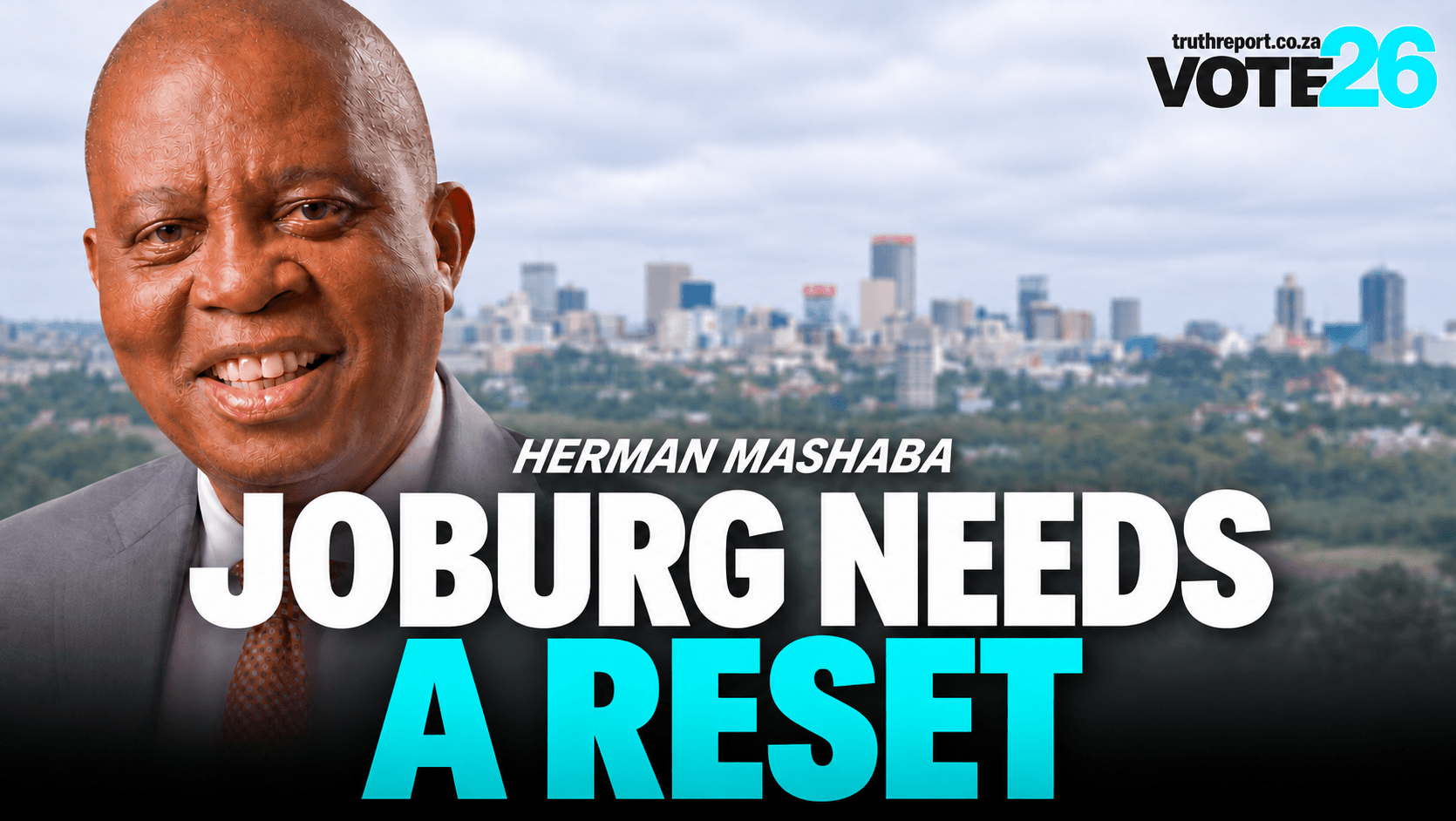
Prince Mashele sees the municipal election as a demand for a new national movement. The results expose the limits of existing parties, but they do not tell us who can unite the voters those parties have lost.
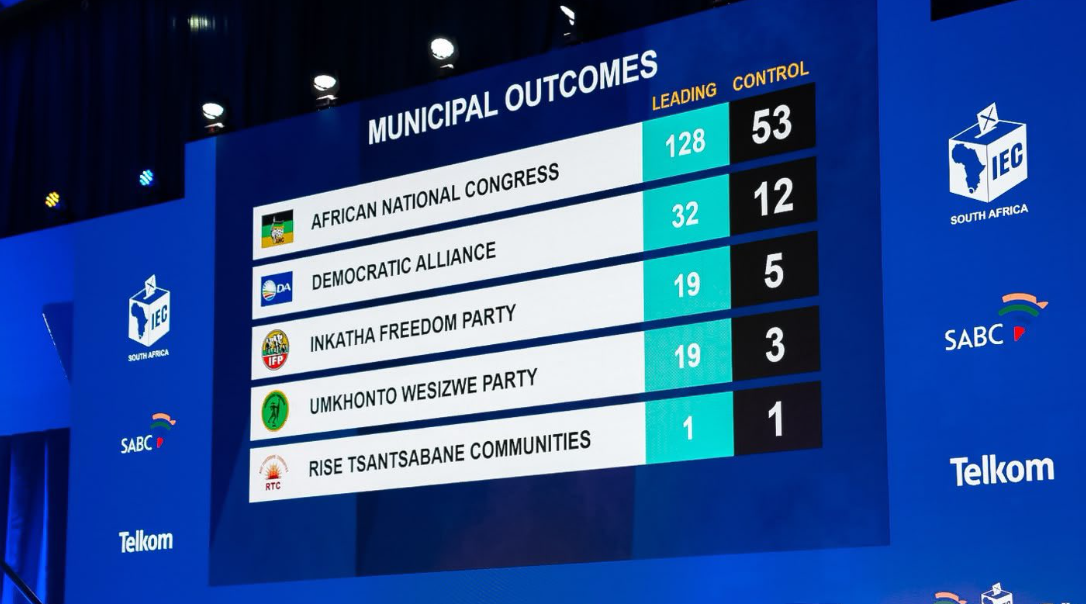
South Africa’s municipal election has left a gap between the ability to punish a governing party and the willingness to entrust its rivals with power. The ANC remains the largest party, with roughly 31% of the vote nationally; the DA has about 25%. Those are the broad proportions in SAnews’s account of the Electoral Commission’s declaration on 8 November. Neither comes close to a national majority.
That is the tension at the centre of Prince Mashele’s assessment of the election. He reads the ANC’s losses as a repudiation of its record, the DA’s result as evidence of a limited national appeal, and the fragmentation of support as an opening for a new political home. He also has a project to offer: a movement he calls Rescue South Africa, which he envisages bringing South Africans together across racial lines.
His argument identifies a real political opportunity. Its more sweeping conclusions require a distinction between what the election establishes and what an aspiring movement hopes it means.
What the numbers can establish
The ANC’s setback is also acknowledged in EWN’s reporting of the declaration. The immediate picture is fragmentation. SAnews reports the MK Party at roughly 10%, with the EFF and ActionSA each around 6%. These are national summaries of municipal voting, not a ballot electing a national government. They cannot, on their own, determine who will govern Johannesburg, Tshwane or Ekurhuleni.
There is also a warning against false precision. The published text of IEC chairperson Mosotho Moepya’s address gives the ANC 30.89% and the DA 24.60%, while the SAnews report gives 30.76% and 24.64%. Council-seat totals differ too. The broad ranking is consistent; exact coalition claims require the certified allocation for the particular council, rather than a national headline figure.
Mashele’s central observation survives those discrepancies: the largest party has failed to command anything approaching half the national municipal vote. But that does not establish that every voter who chose another party wanted the same alternative government. Opposition to the ANC can coexist with profound disagreement about who should replace it.
Nor does a vote for a smaller party necessarily mean its supporters want it confined to a supporting role. It may represent a first choice, a local judgement or a tactical decision. A ballot records a choice between available candidates and parties. It does not record the full explanation for that choice.
Political homelessness is measurable
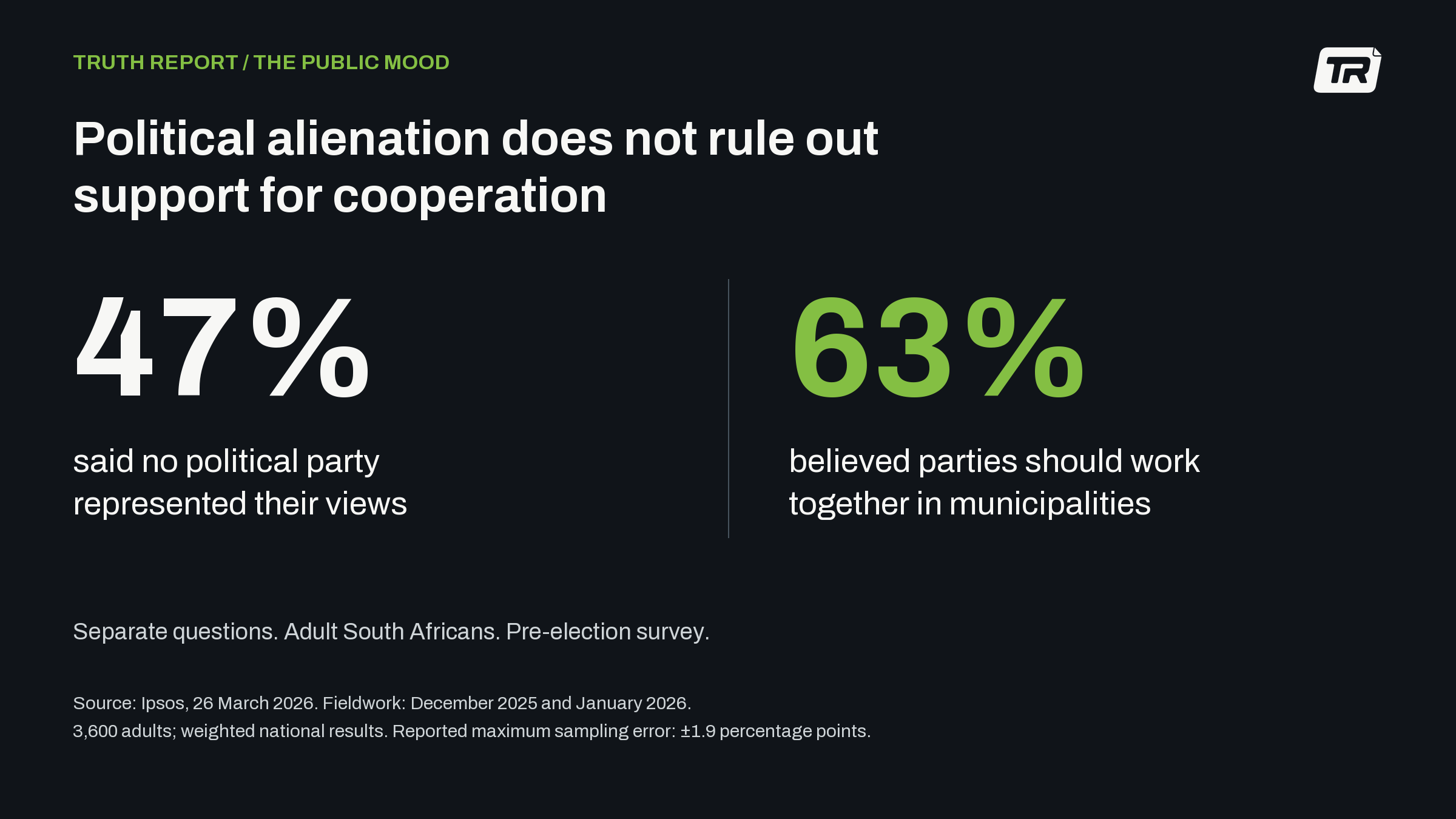
The strongest independent support for Mashele’s argument comes from evidence collected before the election. Ipsos reported in March that 47% of adult South Africans felt no political party represented their views. Its study used face-to-face interviews with 3,600 randomly selected adults, conducted in December 2025 and January 2026, with results weighted to represent the adult population.
This is evidence of a substantial constituency that feels unrepresented. It is not a post-election finding, and 47% is not a majority. Nor is it a forecast of support for Rescue South Africa, or for any other new entrant.
The same research complicates a simple story of rejection. Ipsos found that 63% believed political parties should work together in municipalities. Voters can feel poorly represented while still expecting the parties they have elected to cooperate. Fragmentation may create a market for a new movement; it also creates an obligation for existing parties to make government work.
Coalitions are a test of government
Mashele expects ActionSA eventually to cooperate with the DA in Gauteng’s major metros. That is a political prediction, not a completed coalition agreement. The question is both whether the local seat numbers permit an arrangement and whether the parties can sustain it.
South Africa’s system makes that distinction consequential. Municipal councils elect their executive leadership, and parties can combine their votes to support a government. A party without an outright majority can therefore exercise executive power through an agreement with others. A modest national share does not amount to exclusion from government.
The substance of an agreement matters as much as its composition. Residents need to know who takes responsibility for the budget, how appointments will be made, which repairs come first and how disputes will be settled. An arrangement that can elect a mayor still has to govern after the inaugural meeting.
There is a further limit to claims about the electorate’s instructions. Voters do not sign a single coalition contract. Parties must explain the bargains they make and accept public judgement on their consequences. Claiming exclusive knowledge of what all voters intended cannot substitute for that explanation.
A movement must earn the trust it seeks
Mashele’s proposed answer is a movement built around cooperation across racial boundaries. He presents that ambition as a response to what he hears in communities across the country. It is a political proposition with an evident appeal: shared citizenship expressed through practical local action.
Yet a desire for cooperation does not identify a preferred leader, organisation or policy programme. The distance between dissatisfaction and durable electoral support has to be crossed through organisation, credible candidates and a programme that survives scrutiny. A movement promising national renewal must explain how it will choose its leadership, account for its money and resolve disagreement within its own ranks.
The same caution applies to Mashele’s forecasts of ANC implosion and permanent limits on its rivals. Electoral setbacks can intensify internal conflict, but they do not establish a timetable for collapse. A disappointing result for an opposition party does not establish a permanent ceiling either. These are judgements about future behaviour, and future behaviour remains open to change.
The municipal election has made the contest for trust more urgent. Existing parties have a chance to earn it through the councils they now help to govern. A new movement has to demonstrate why it deserves it. For residents, the useful measure will be whether either route produces institutions capable of keeping their promises between elections.