


Mbulelo Mandlana argues that municipal failure should be answered by rebuilding the public sector. The test for the Communist Party is whether its new electoral independence can produce capable administrations and enforceable service commitments.
The South African Communist Party wants to change the question being asked about failing municipalities. Where others see an argument for bringing in private providers, its national spokesperson, Mbulelo Mandlana, sees a reason to restore the capacity and purpose of the public state.
That is a serious argument. It also places a demanding obligation on the party making it. Reclaiming public services must mean acquiring the ability to provide them: the staff, equipment, money and management that turn a political undertaking into water in a tap.
In his account of the party’s electoral intervention, Mandlana puts municipal government at the centre of a wider struggle over who directs development. The SACP, he argues, should negotiate around a public programme rather than rush towards the easiest coalition arrangement. Its ideological independence would then have a practical purpose: leverage over how councils operate.
There is independent evidence that this is the party’s declared direction. Its 2026 manifesto launch statement commits it to rebuilding municipal capacity, equipping workers and returning essential work to public provision where feasible. The qualification matters. Even the party’s programme leaves room for circumstances to determine what can actually be brought in-house.

A separate voice, a continuing alliance
Mandlana does not describe electoral competition with the African National Congress as the abandonment of every reason for their alliance. He presents it as an attempt to change the relationship, resisting what he regards as the ANC’s accommodation of capitalist interests while retaining the possibility of cooperation with it.
The tension is plain. A party seeking an independent mandate must show that it can disagree with its longstanding partner. A party seeking to influence government must also decide when agreement serves its programme. Independence has little practical content if support is automatic; it can become equally unproductive if refusing agreement becomes an end in itself.
The SACP leadership has publicly resisted the assumption of automatic support. SABC reported on 7 November that general secretary Solly Mapaila wanted discussions among left formations around a common agenda, with community services and direct budgeting among the priorities. That establishes a negotiating position. It does not establish that a particular coalition will deliver it.
Nor can a national total reveal the leverage available in every municipality. Bargaining strength depends on the seats and possible governing combinations in each council. A small caucus can matter greatly where its votes are needed, and much less where an administration can be formed without it.
Public responsibility already has a legal foundation
Mandlana’s strongest point is that public services carry obligations beyond a provider’s commercial return. South Africa’s constitutional framework already gives that principle institutional force. Sections 152 and 153 of the Constitution require municipalities to pursue sustainable services, accountable local government and budgets that give priority to communities’ basic needs, within their financial and administrative capacity.
This is an important boundary in the debate. Rebuilding public responsibility does not require inventing a new purpose for local government. It requires making an existing constitutional purpose effective.
But responsibility and the method of delivery are different questions. The Municipal Systems Act, sections 76 and 78 allows internal and external arrangements. When reviewing a delivery mechanism, a council must first assess internal provision, including costs, capacity and the potential to build that capacity. External options require further assessment. Under section 81, the municipality retains responsibility for the service even when an external provider delivers it.
The law therefore gives neither side a universal shortcut. A private contract does not remove public accountability. A decision to employ municipal workers directly does not remove the need to demonstrate resources and competence.
The strongest challenge comes from the audit record
The SACP’s argument encounters its hardest test in the institutions it proposes to strengthen. In its 2024/25 local government findings, the Auditor-General reported only 39 clean municipal audits. It also identified improvement in financial statement submissions and unqualified opinions. The picture includes progress as well as persistent weakness.
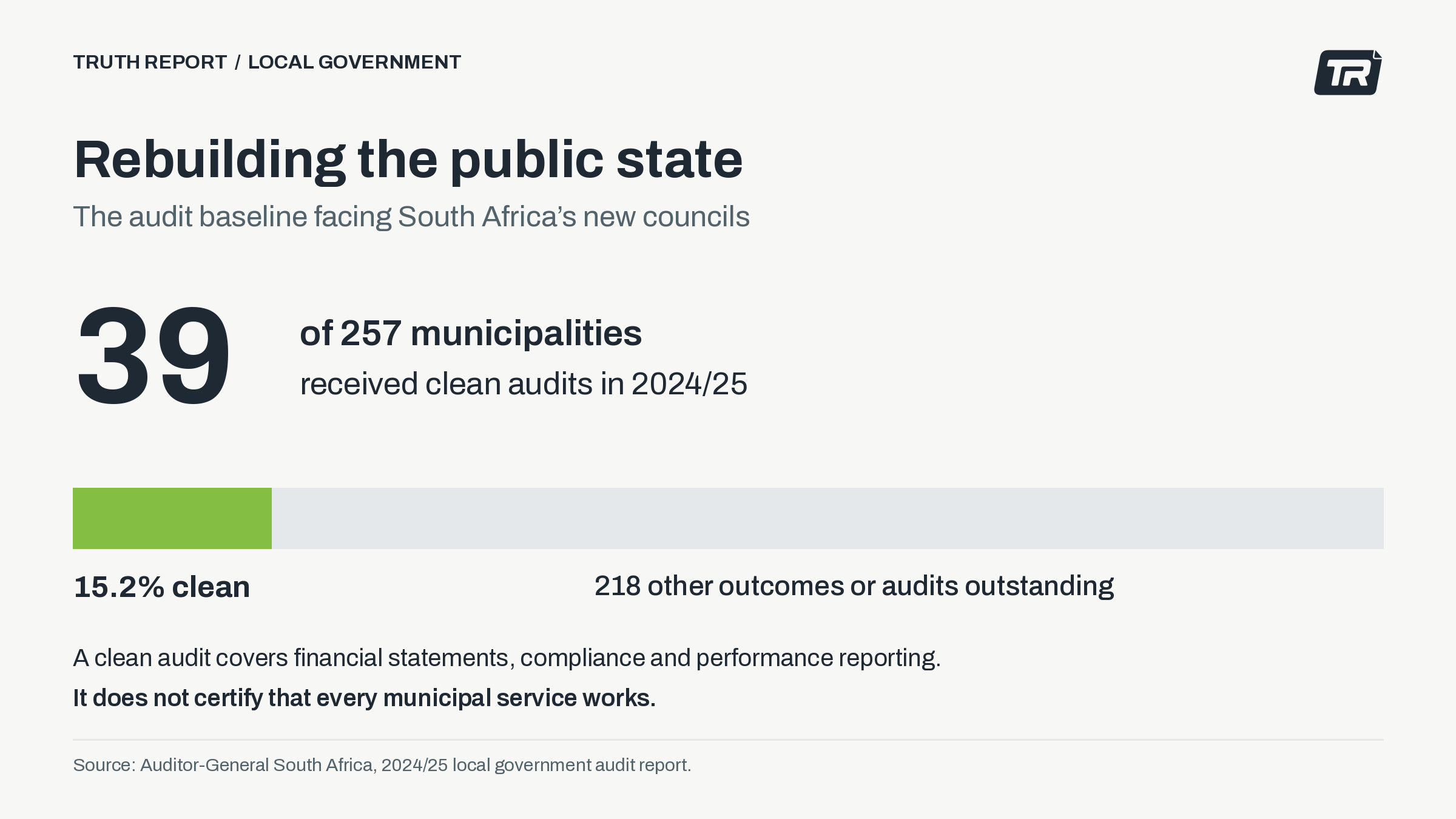
A clean audit concerns financial statements, compliance and performance reporting. It does not certify that every service works. Conversely, an audit finding alone cannot identify whether public or private delivery would perform better. The evidence challenges any assumption that changing the provider’s identity will resolve the administrative problem.
Mandlana’s broad criticism of public-private partnerships should be tested against that distinction. A council needs the ability to specify a service, assess its cost and hold people accountable whether it manages its own workforce or supervises a contractor. Moving work in-house can be defensible. So can a properly justified external arrangement. Each requires evidence about the service concerned.
The choice should survive questions that ideology alone cannot answer. Who will repair the infrastructure? What equipment is available? What will the whole service cost, including maintenance? How will residents know that performance has improved?
What a credible coalition undertaking would contain
The SACP could give its programme substance by making those questions part of public negotiations. A useful agreement would identify which services are being reviewed, the evidence for the proposed delivery model and the resources required. It would name responsible officials, establish measurable targets and provide a timetable for reporting results to residents.
A proposal to bring work in-house should therefore come with a transition plan. Ending dependence on a contractor is not enough if the municipality cannot sustain the service afterwards. Retaining a contractor should carry an equally clear explanation of performance standards, costs and enforcement.
These are tests of the party’s stated objectives, rather than demands that it abandon them. They would allow residents to judge whether stronger public provision is being built and whether a coalition bargain advances it.
Mandlana also resists importing a ready-made Chinese, Soviet or American model. That leaves the SACP with an obligation appropriate to its ambition: develop a programme suited to South African municipalities and expose it to public scrutiny.
The party’s electoral independence creates an opportunity to make its priorities visible. Whether that becomes a durable achievement will depend on what it secures in council decisions, budgets and administration. Residents will encounter the answer in the reliability, affordability and accountability of the services on which daily life depends.


