


Written, public agreements could make municipal coalitions more accountable. Their value will depend on whether parties can keep budgets, administrations and services working when political relationships sour.
The Democratic Alliance is promising to put its municipal coalition agreements in writing and make them public. That offers residents something more useful than another assurance that politicians will put service delivery first: a record against which their conduct can be measured. DA spokesperson Jan de Villiers has said the party will negotiate for stable governments and publish the agreements once talks conclude, according to Eyewitness News’s report of 9 November.
The question is what those documents will contain. An agreement that distributes offices can explain who gets power without explaining how that power will be used. For residents waiting for reliable services, the more consequential bargain concerns budgets, administrative competence and what happens when partners stop agreeing.
That is the test now facing the DA’s approach to coalition government. Its promise of transparency deserves to be taken seriously. It also deserves a standard more demanding than the survival of a mayor.

Different municipalities, a common obligation
The DA has resisted prescribing a single arrangement for every council. Geordin Hill-Lewis has said negotiations should reflect the circumstances of individual municipalities, with basic services taking priority over securing mayoral positions. His explanation at the results centre leaves room for different forms of cooperation.
There is a reasonable case for that flexibility. A council with several potential partners faces different choices from one where the arithmetic leaves few workable combinations. Insisting on an identical bargain everywhere could sacrifice a viable local arrangement to a national political message.
But flexibility needs a visible boundary. Residents should be able to establish which commitments apply everywhere and which concessions answer local circumstances. Otherwise, a case-by-case approach can become difficult to distinguish from bargaining without a consistent public standard.
The Constitution supplies a common starting point. Section 152 requires accountable local government, sustainable services and community involvement. Those obligations apply whatever combination of parties holds office. They provide a better measure of a coalition than the number of positions secured by each participant.
What the 14-day clock actually means
The urgency is real, but its legal meaning matters. In its 7 November account of the transition guidance, SAnews reports that section 29(2) of the Municipal Structures Act requires the first council meeting within 14 days after the council has been declared elected. District councils have a different trigger, linked to the appointment of their members by local councils.
This is a timetable for establishing councils and political leadership. It should not be read as proof that every municipality will have a comprehensive, durable power-sharing settlement within a fortnight. A first meeting and a settled governing programme are different achievements.
Nor should proposed reforms be mistaken for rules already in force. In August, Parliament described a Municipal Coalitions Bill that proposed mandatory written agreements, publication in provincial gazettes and an extension from 14 to 30 days. The committee’s statement explicitly said the Bill would not be finalised before the local elections. The current transition guidance continues to describe the 14-day requirement.
This distinction sharpens the DA’s promise. Publishing its agreements is a political commitment that voters can scrutinise now, without waiting for the proposed legislative framework.
A mayoral majority is only the beginning
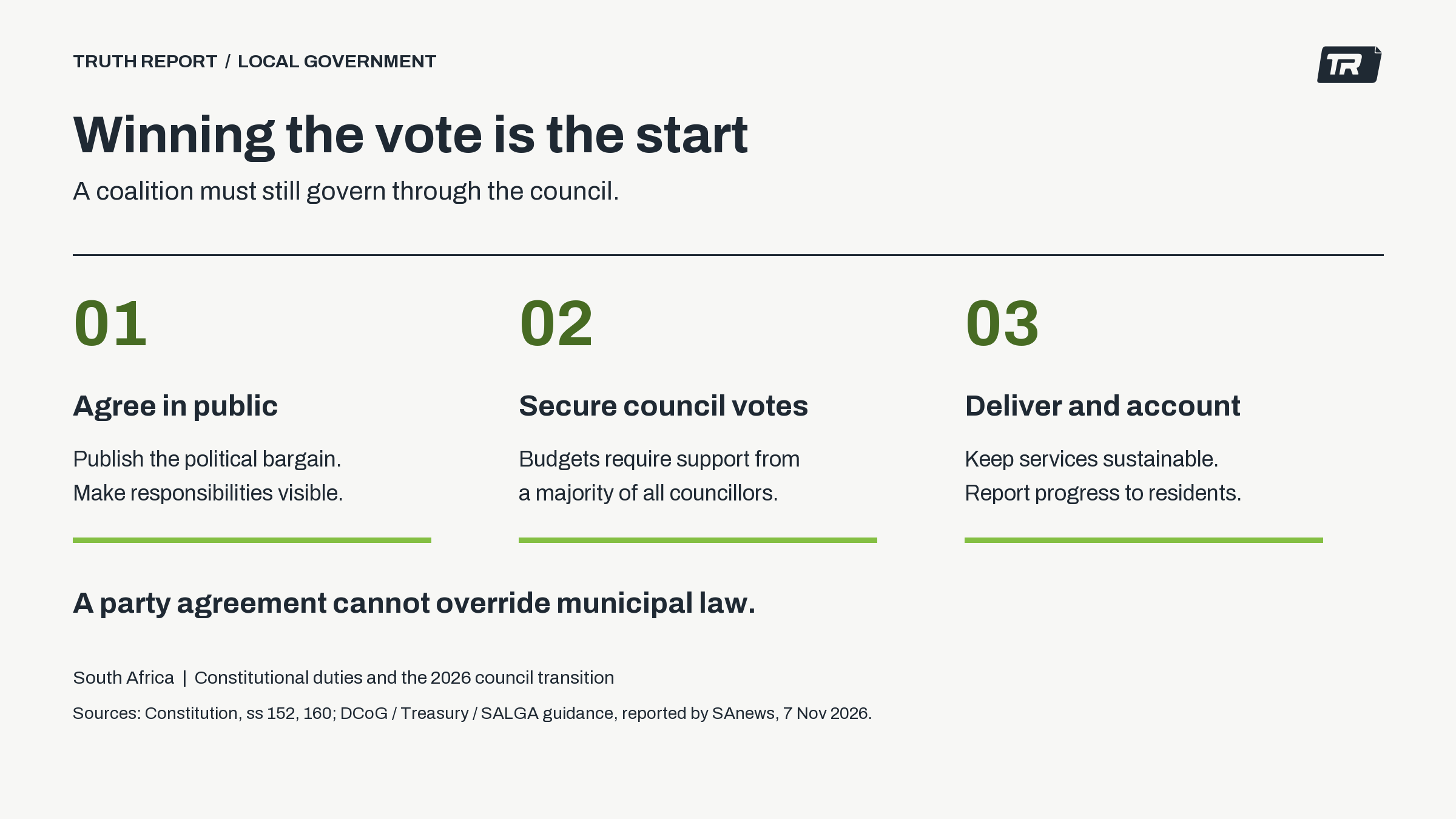
A coalition’s practical strength emerges when money must be authorised. Under section 160 of the Constitution, approving a budget requires the supporting votes of a majority of all council members. Budgets, rates and borrowing are among the powers the council cannot delegate.
The implication is straightforward: winning an office does not remove the need to assemble support for consequential decisions. Partners need a workable programme for revenue and spending, alongside a procedure for disputes. Otherwise, the agreement risks preserving the appearance of government while its essential decisions become bargaining opportunities.
A useful public agreement would therefore explain how partners intend to handle budget disagreements, monitor delivery and resolve conflict before it paralyses the council. These are tests residents should apply to the documents when published, rather than claims about provisions already agreed.
Stability has limits
The strongest argument for coalition discipline is continuity. A municipality cannot plan sensibly if every disagreement threatens a change of leadership. Yet continuity alone cannot establish that a government is serving residents well. An arrangement can remain politically intact while tolerating weak administration or avoiding difficult decisions.
The transition guidance also draws a firm institutional boundary: coalition agreements cannot supersede the Constitution or municipal legislation. A bargain among parties does not acquire authority over the council’s legal obligations simply because it helped elect its leadership.
Publication is therefore a beginning. Residents need to see the agreement, compare its promises with council decisions and ask which party is responsible when commitments are abandoned. The DA has offered a commitment that can be checked. Its credibility will turn on what the agreements require, and what its representatives do when honouring them becomes politically inconvenient.


