


The election has weakened the ANC and strengthened its rivals. The harder question is whether coalition bargaining will produce administrations capable of repairing municipal services.
The Democratic Alliance finished ahead of its rivals in Johannesburg, Tshwane and Ekurhuleni. Yet its reported vote share in each city remained below 35%. That is the central tension of South Africa’s municipal election: a clear first place can coexist with a fragmented mandate. The final metro figures reported by The Citizen put the DA at 34.79% in Johannesburg, 34.37% in Tshwane and 30.68% in Ekurhuleni.
For residents, the distinction matters. An election can weaken an incumbent without producing an obvious successor. The negotiations that follow must turn political competition into the capacity to take decisions, fund repairs and keep an administration working.

A weakened ANC is still a negotiating force
The African National Congress remains the largest party nationally in the IEC results reported by SAnews, with 30.76% of the vote against the DA’s 24.64%. ActionSA received 5.67%. These are aggregate election figures, not a national mandate to govern individual cities. Each council has its own distribution of seats and its own possible alliances. BusinessTech’s comparison with 2021 shows the ANC down from 45.59%, while the DA and ActionSA increased their aggregate shares.
The ANC’s internal reckoning is also real, although its outcome remains uncertain. Sunday Times reporting published on TimesLIVE says at least five senior members of the party’s national executive committee described Cyril Ramaphosa suggesting that he should step down. The same report records ANC spokesperson Mahlengi Bhengu saying she was unaware of such discussions by national officials. The account remains disputed and is not an announced resignation.
An electoral setback and a terminal decline are different propositions. The ANC can lose support while retaining enough councillors to influence the choice of a mayor or the survival of an administration. Its rivals face a corresponding difficulty: gaining votes does not remove the need to persuade other elected representatives to support them.
This creates an uncomfortable possibility for voters seeking a clean break. The party they wanted to punish may remain part of the government that follows. Whether that arrangement deserves support depends on what the parties agree to do, who takes responsibility and whether the agreement can sustain effective decisions.
First place carries weight, but no automatic mayoralty
The Municipal Structures Act, section 55, provides for the council to elect an executive mayor from among its members. It does not award that office automatically to the party with the largest vote share. A party’s claim to lead is therefore a political argument that must be translated into support inside the council.
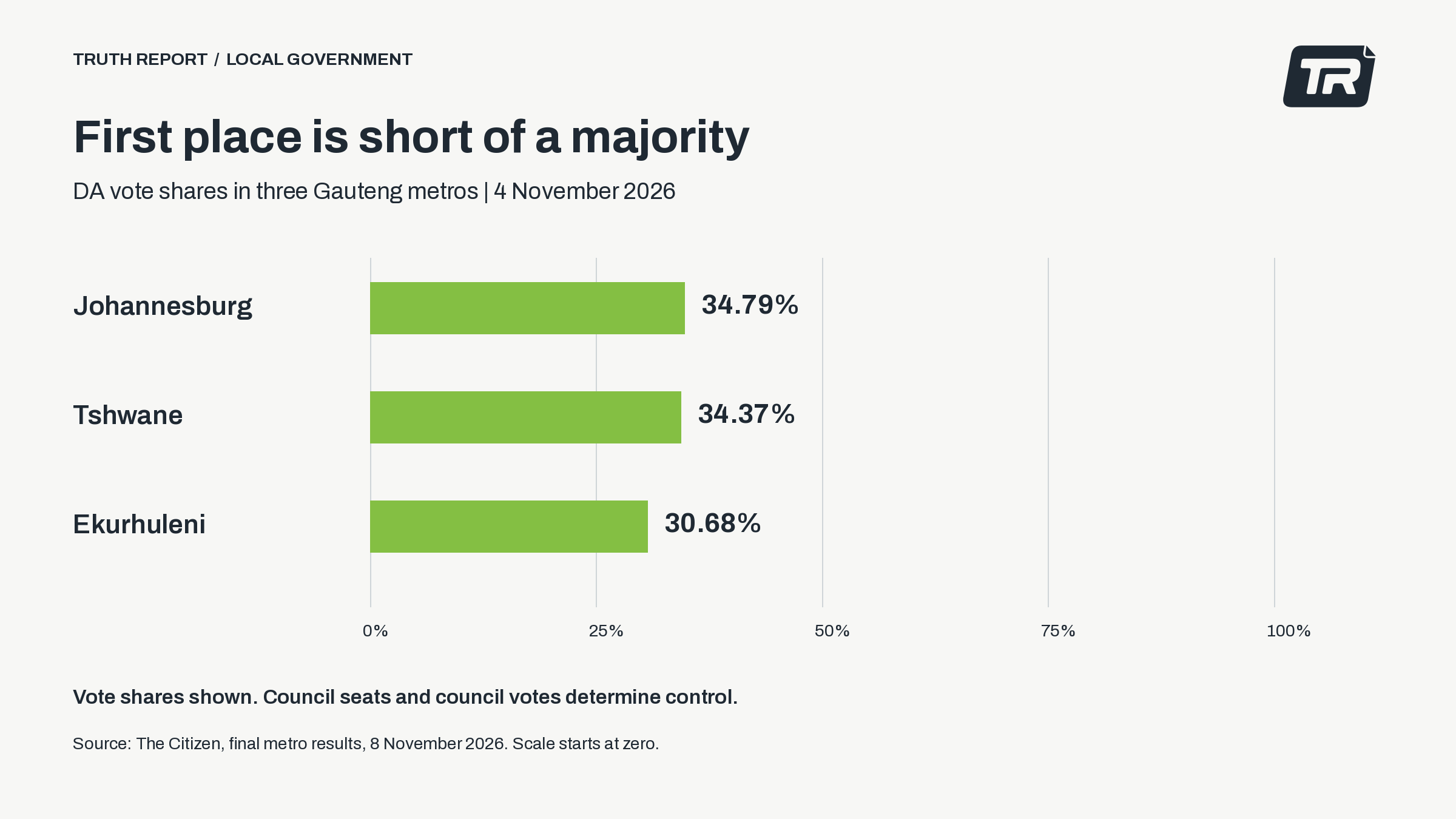
The largest party can reasonably argue that its result deserves substantial influence. Other parties can reasonably insist that their voters also chose representation. Neither argument answers the practical question of who can assemble sufficient support for a functioning administration.
A coalition excluding the largest party is not inherently a rejection of democracy. Nor does a coalition become a credible government simply because its partners can elect a mayor. The political bargain must carry the decisions that follow, especially when spending priorities and the distribution of responsibility become contentious.
Ramaphosa’s 8 November results address acknowledged this obligation, calling on parties in municipalities without an outright majority to work together. His warning against negotiations becoming contests over positions is a useful standard against which to judge every participant, including his own party.
The municipal inheritance is larger than the coalition deal
The strongest reason for caution comes from the institutions the new councils inherit. In its 2024/25 local government findings, released on 24 June 2026, the Auditor-General reported only 39 clean municipal audits, or 15%. It also found that 38 municipalities had regressed since 2020/21, including three metros.
Those findings should temper the idea that changing the mayor is itself a municipal turnaround. A different political leadership must still establish reliable financial controls, capable management and credible oversight. The audit office specifically recommends preserving administrative stability where performance has been relatively good, rather than allowing political transitions to disrupt it.
The difficulties reach into the basic relationship between a municipality and its residents. The Auditor-General’s financial reporting analysis found that revenue figures at 76 municipalities were materially misstated in 2024/25, reflecting problems including incomplete billing, inadequate evidence and incorrect recording. A council that cannot trust its revenue information has a weaker basis for deciding what it can afford.
There is evidence against fatalism, too. The Auditor-General’s overview records improvements in timely financial reporting and fewer repeat disclaimed audit opinions. A disclaimer means auditors could not obtain enough appropriate evidence to express an opinion. Improvement is possible; the question is whether it extends beyond reporting to the institutions and services residents rely on.
What residents should demand from the bargain
The useful test of a coalition agreement is its specificity. Residents should be able to see the service priorities, the money available, the officials responsible and the timetable for reporting progress. Partners should explain how they will handle disputes without abandoning those commitments.
That test applies equally to an ANC recovery strategy, a DA bid for leadership and an ActionSA claim to greater influence. Political humiliation is not a maintenance programme. A larger vote share is not a repaired water network. Both acquire civic value only when elected representatives turn them into sustained, accountable work.
The election has redistributed bargaining power. The next responsibility is to make that power legible to the people who supplied it: who will govern, what they will fix, and how residents can tell whether it is happening.


