


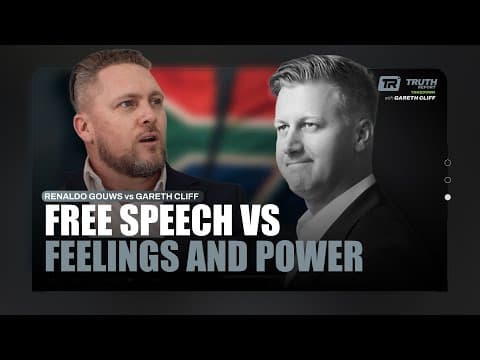
South Africa is often described as a free speech society, but this conversation asks whether that freedom still holds in practice.

In a candid exchange, Gareth Cliff and Renaldo Gouws unpack the growing tension between constitutional protections and real-world consequences. Gareth argues that by global standards, South Africa remains remarkably free. Citizens can openly criticise politicians, challenge state policy, and speak their minds without fear of prison or state violence, a reality that places the country far ahead of truly authoritarian systems.
Renaldo Gouws offers a sharp counterpoint. While the law protects speech, the public often does not. He explains how social media outrage, coordinated pile-ons, and calls for cancellation have become powerful tools of punishment. Careers can be destroyed, income can disappear, and reputations can be permanently damaged for expressing unpopular views. In that sense, freedom of speech exists on paper, but freedom after speech is increasingly uncertain.
The discussion highlights a deeper concern about modern debate. When people self-censor out of fear of backlash, open discourse begins to shrink. The conversation draws a clear line between legal freedom and social intimidation, asking whether speech can truly be called free if the cost of honesty is professional or personal ruin.
It is a thoughtful examination of cancel culture, hypocrisy, and the future of open debate in South Africa, and why defending free expression requires more than just a strong Constitution.


