His promises of a funded budget, stronger policing and municipal restructuring offer a testable programme. Deportations and a company-profit levy depend on decisions beyond Johannesburg’s council chamber.
Herman Mashaba’s proposed Johannesburg turnaround starts with a difficult bargain: put the city’s finances on a credible footing while finding money for more police officers and changing how essential services are managed. In a 4 November interview with Sunday World, the ActionSA leader promised a funded budget, an adjustment-budget provision for 500 additional officers and a council report proposing the dissolution of municipal entities.
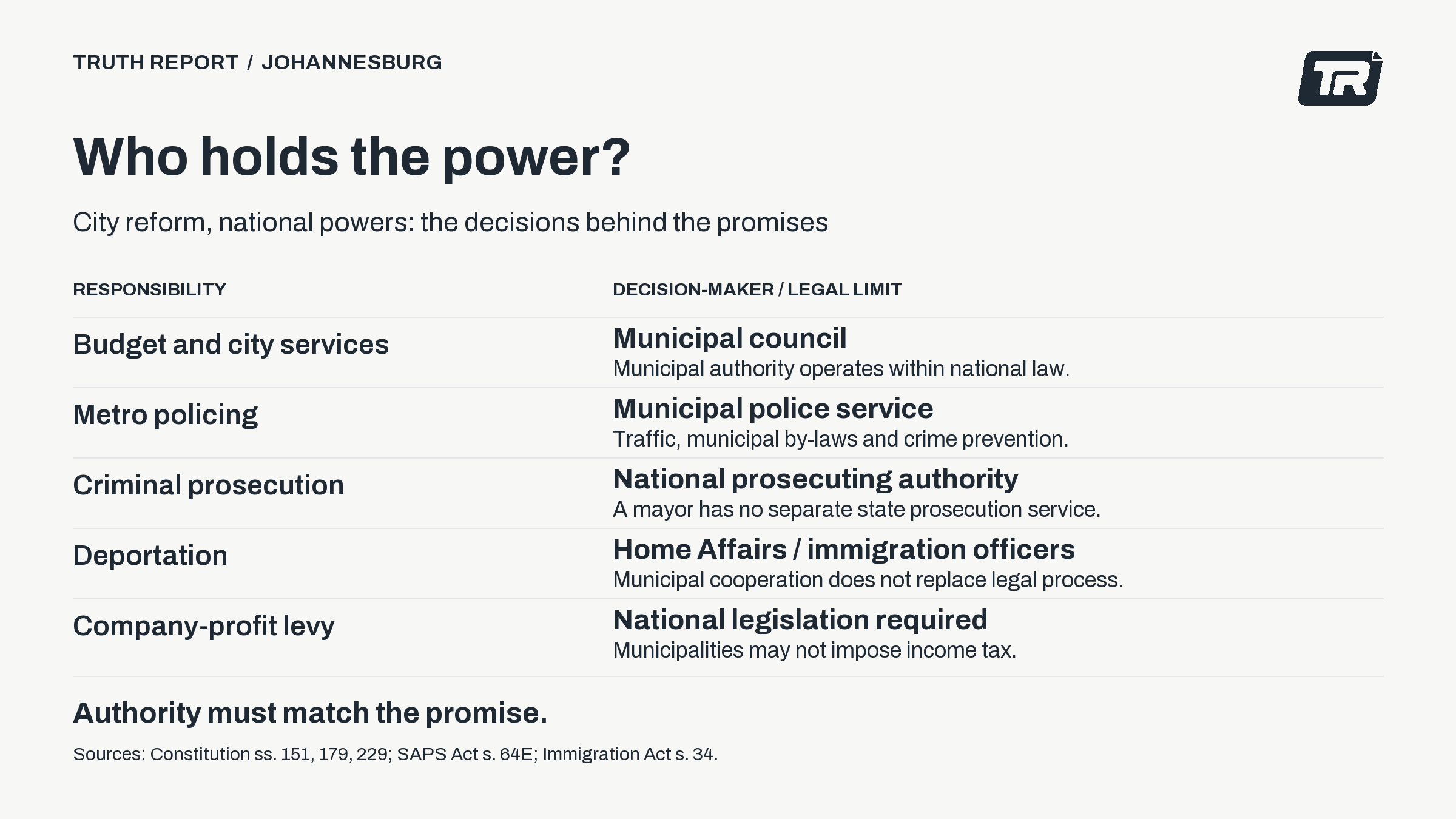
These are commitments against which an administration could be measured. But they sit alongside ambitions that a Johannesburg mayor cannot implement alone. The Constitution places municipal executive and legislative authority in the council. It separately establishes a single national prosecuting authority and prohibits municipalities from imposing income tax.
That division of power is central to assessing Mashaba’s programme. Residents need to know which promises can become council decisions, which require cooperation with national institutions, and which remain proposals for changing national policy.
Photograph: Universitätsarchiv St.Gallen, HSGN 028/01990, CC BY-SA 4.0. Unmodified.
The budget must survive contact with the bank account
Mashaba’s description of Johannesburg’s budget as unfunded needs qualification. He repeated that claim on 4 November, while acknowledging that his proposed administration would first need to establish the size of the shortfall. In July, however, Mayor Dada Morero said Treasury had confirmed that the 2026/27 budget was funded. That was the city’s stated position, rather than an independently established finding about its subsequent cash performance.
The distinction matters because approving a budget and collecting enough cash to carry it out are different tests. The Municipal Finance Management Act, section 18, requires realistic revenue projections, permits the use of uncommitted cash-backed surpluses and restricts borrowed funding to the capital budget. A spending plan cannot become credible simply because its columns balance.
The regulatory funding test, explained in KwaZulu-Natal Treasury guidance, considers financial performance, the balance sheet, cash flow, capital spending and working-capital needs together. That is a more demanding standard than announcing savings or assuming that arrears will be recovered.
For Mashaba, the first test would therefore be a published reconciliation of expected receipts and unavoidable commitments, with the police expansion and restructuring costs included. Residents should be able to see what can be paid for, what must be deferred and what improved collection would have to achieve. The rival political descriptions of the budget do not settle those questions.
Closing entities must improve services
Mashaba has advocated bringing functions performed by entities such as City Power and Johannesburg Water closer to the municipal administration. In March, he told 702 that he wanted these functions managed by senior officials reporting to the city manager.
His party’s written programme is more conditional than a blanket promise to dismantle the entities. The 2026 local-government manifesto, page 26, proposes reviewing their purpose and reforming, consolidating or closing those that duplicate functions or add bureaucracy without improving services, where legally and operationally appropriate.
The qualification is substantial. Under section 78 of the Municipal Systems Act, reviewing a service-delivery mechanism involves assessing costs, municipal capacity, employment effects and organised labour’s views. The law provides a process for choosing a mechanism; it does not establish that internal delivery will always outperform a separate entity.
The strongest case for Mashaba’s proposal is a clearer chain of accountability. Its strongest practical challenge is demonstrating that the new structure would improve maintenance, billing and repairs while protecting continuity during the change. A council report could begin that work. The announcement of a closure would not, by itself, repair a pipe or restore a substation.
More officers, with a defined job
In his 28 October interview with The Citizen, Mashaba proposed recruiting 500 Johannesburg Metropolitan Police Department officers annually for five years. That amounts to 2,500 recruits if the annual target is met. It is not a guaranteed net increase of 2,500 serving officers, because departures would also affect the final complement.
The expansion would need to fund training, supervision, equipment and deployment as well as salaries. Its purpose also needs precision. Section 64E of the South African Police Service Act gives municipal police responsibility for traffic policing, municipal by-laws and regulations, and crime prevention.
Those functions matter to daily safety. They do not give a mayor a separate criminal prosecution service. Section 179 of the Constitution locates criminal proceedings on behalf of the state within the national prosecuting authority and requires legislation to protect its independence.
For residents, a useful policing promise would identify where additional officers would work, what offences and hazards they would target, and how results would be reported. Headcount is a resource measure. The public benefit depends on what that resource achieves.
Immigration claims need evidence at the right scale
Mashaba’s coalition conditions combine services for all residents, opposition to corruption and an insistence on deporting people without lawful immigration status. He set out those conditions in The Citizen interview. Immigration enforcement is therefore central to his bargaining position, although its administration extends beyond municipal authority.
There is significant evidence against any suggestion that national deportation activity has simply stood still. In an April 2026 statement, Home Affairs reported 39,672 deportations in 2023/24, 51,560 in 2024/25 and 57,784 in 2025/26. The last figure is about 46% above the first. These are the department’s reported administrative totals, rather than an independent assessment of enforcement quality.
They also cannot establish how many undocumented people live in a particular township, whether residents’ safety has improved, or whether deportations have reduced pressure on services. National activity counts and neighbourhood conditions answer different questions. Neither should be used as a substitute for the other.
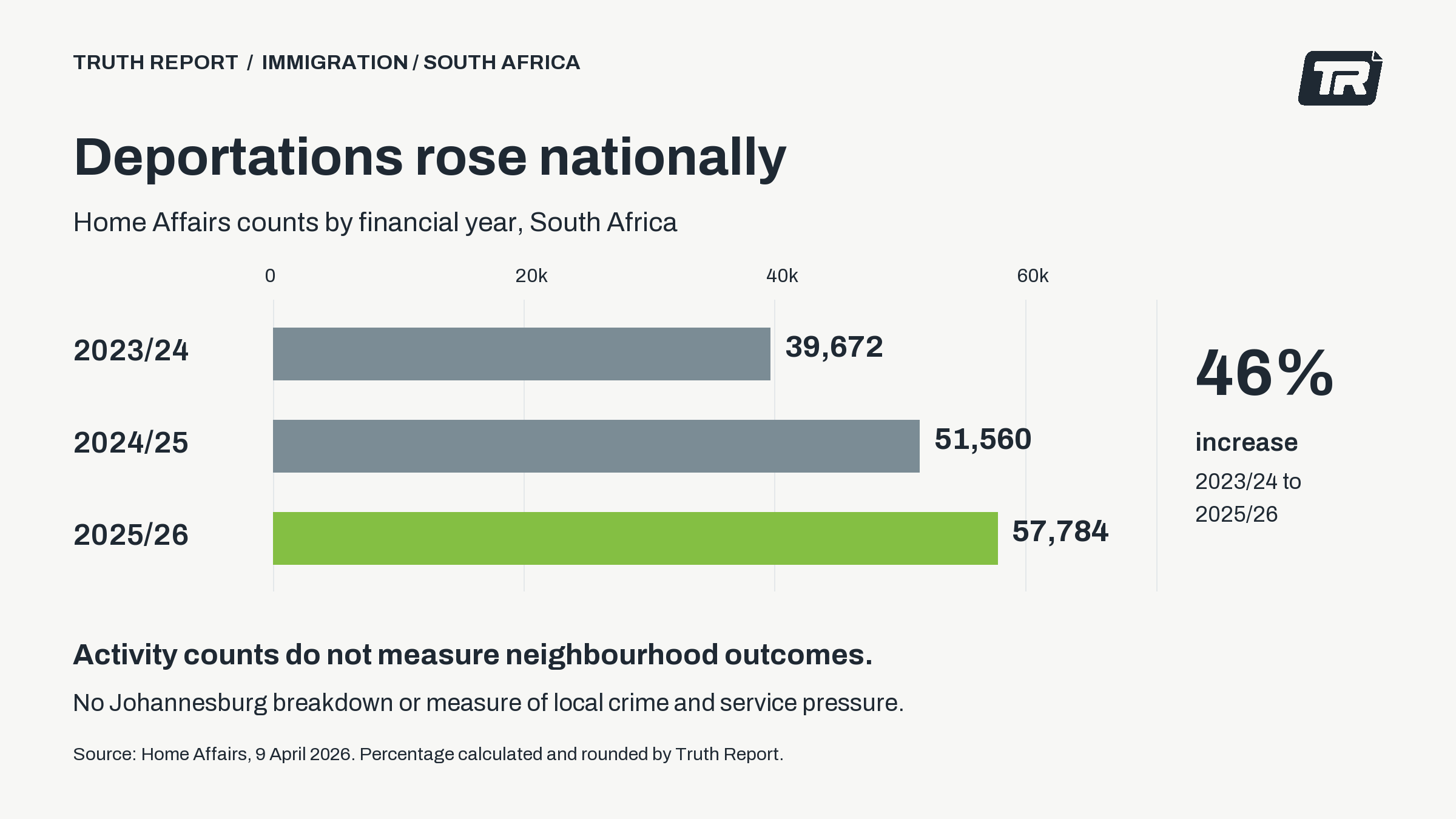
Increase from first to last year: 45.65%, rounded to 46%. These national activity counts do not measure Johannesburg population, crime or service outcomes.
The Immigration Act’s section 34 assigns deportation functions to immigration officers and provides procedural safeguards. A council can cooperate with the responsible authorities; a coalition agreement cannot replace the statutory process or determine someone’s immigration status by political declaration.
Redress requires more than a professionally managed fund
ActionSA’s proposed alternative to the existing empowerment framework also belongs in the national policy debate. The party’s published Opportunity Fund proposal envisages a 5% levy on company profits, an exemption for small, medium and micro enterprises, and a maximum duration of 30 years. It proposes investments in education, enterprise and infrastructure.
This is a proposal, not an existing source of municipal revenue. The constitutional restriction on municipal income taxation means Johannesburg cannot implement a company-profit tax on its own.
The proposal deserves assessment on its design: who would appoint and remove the board, how beneficiaries would be selected, what accounts would be published, and how conflicts of interest would be addressed. Professional management is desirable. It still needs enforceable oversight and a credible explanation of costs and benefits.
Mashaba’s most useful commitments are those that can be translated into budgets, lawful decisions, named responsibilities and public measures of performance. That would allow Johannesburg residents to judge an administration by money collected, repairs completed and services sustained. The city’s recovery would depend on making those ordinary obligations work, whichever parties eventually accept responsibility for them.