Linking political cooperation in Gauteng to partnerships in the Cape could make a municipal alliance harder to break. The real test is whether it produces accountable councils and functioning services.
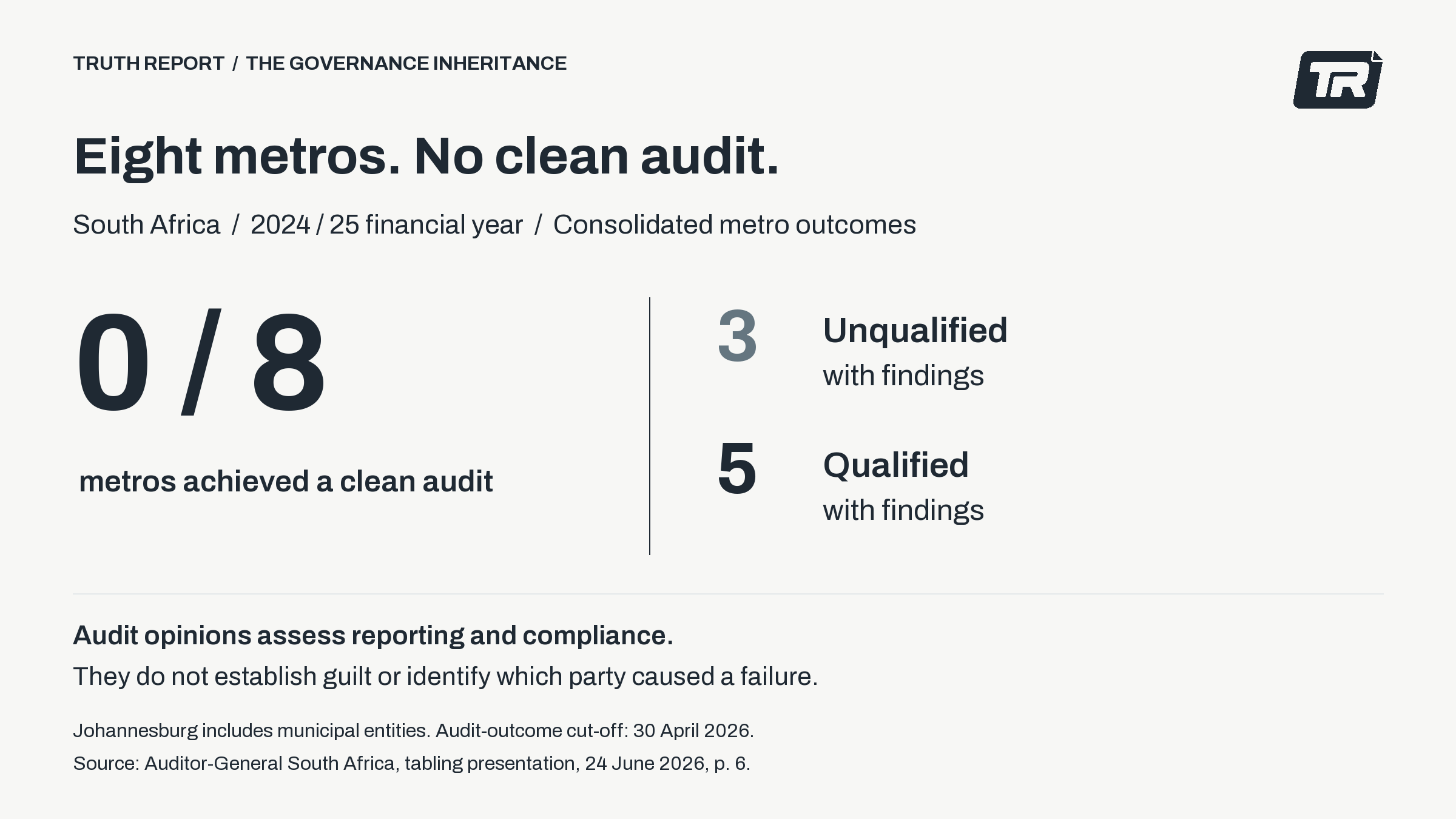
The parties bargaining for South Africa’s cities face an uncomfortable inheritance. In the Auditor-General’s 2024 / 25 assessment of the eight metropolitan municipalities, none achieved a clean audit. Whoever assembles the next governing majorities will have to repair institutions as well as negotiate political peace.
That is the measure against which an ambitious proposal aired in a Truth Report and Power Pod discussion should be judged: bring the Democratic Alliance, ActionSA, Freedom Front Plus and Patriotic Alliance into an agreement covering several municipalities, so that cooperation in one place helps secure cooperation elsewhere.
The proposal’s organising principle is called mutually assured destruction. Parties would have enough invested in the wider arrangement that bringing down a partner in one council could put their own positions in other councils at risk. Gauteng and the Cape would become parts of the same political bargain.
There is a serious argument here. It recognises that a coalition survives when its members continue to find cooperation worthwhile. But a political deterrent is a condition to be tested, not a guarantee. It cannot establish a majority where the seats do not provide one, and it cannot repair a water network by itself.

What the bargain would change
The attraction of a broader agreement is that it could change the calculation facing a small coalition partner. An offer of a better position in one municipality would have to be weighed against the possible loss of influence in several others.
In the proposed four-party arrangement, cooperation with ActionSA in Gauteng would be linked to cooperation involving the Patriotic Alliance in the Western and Eastern Cape. The DA and Freedom Front Plus would help connect those relationships. The suggested exchange concerns governing roles and political support; its viability would depend on the actual composition of each council and the parties accepting common terms.
This should be understood as a proposed negotiating strategy. In its 6 November statement, the DA said it had begun approaching parties and would publish concluded coalition agreements. That establishes the party’s stated approach to negotiations. It does not establish that this particular four-party pact has been agreed.
The wider model also has South African precedents. In their 2023 study of coalition practice, Susan Booysen and Jaap de Visser describe national and provincial agreements covering multiple councils. They found that such arrangements had been among the more stable coalitions, while warning that a breakdown between national or provincial partners could affect several municipalities at once.
The same connection that makes a bargain harder to abandon can therefore carry a dispute across municipal boundaries.
First establish the majority
South Africans voted on 4 November. As counting continued, election results remained provisional until formally declared. A promising combination of early percentages is a reason to examine a possible alliance, rather than proof that it can govern.
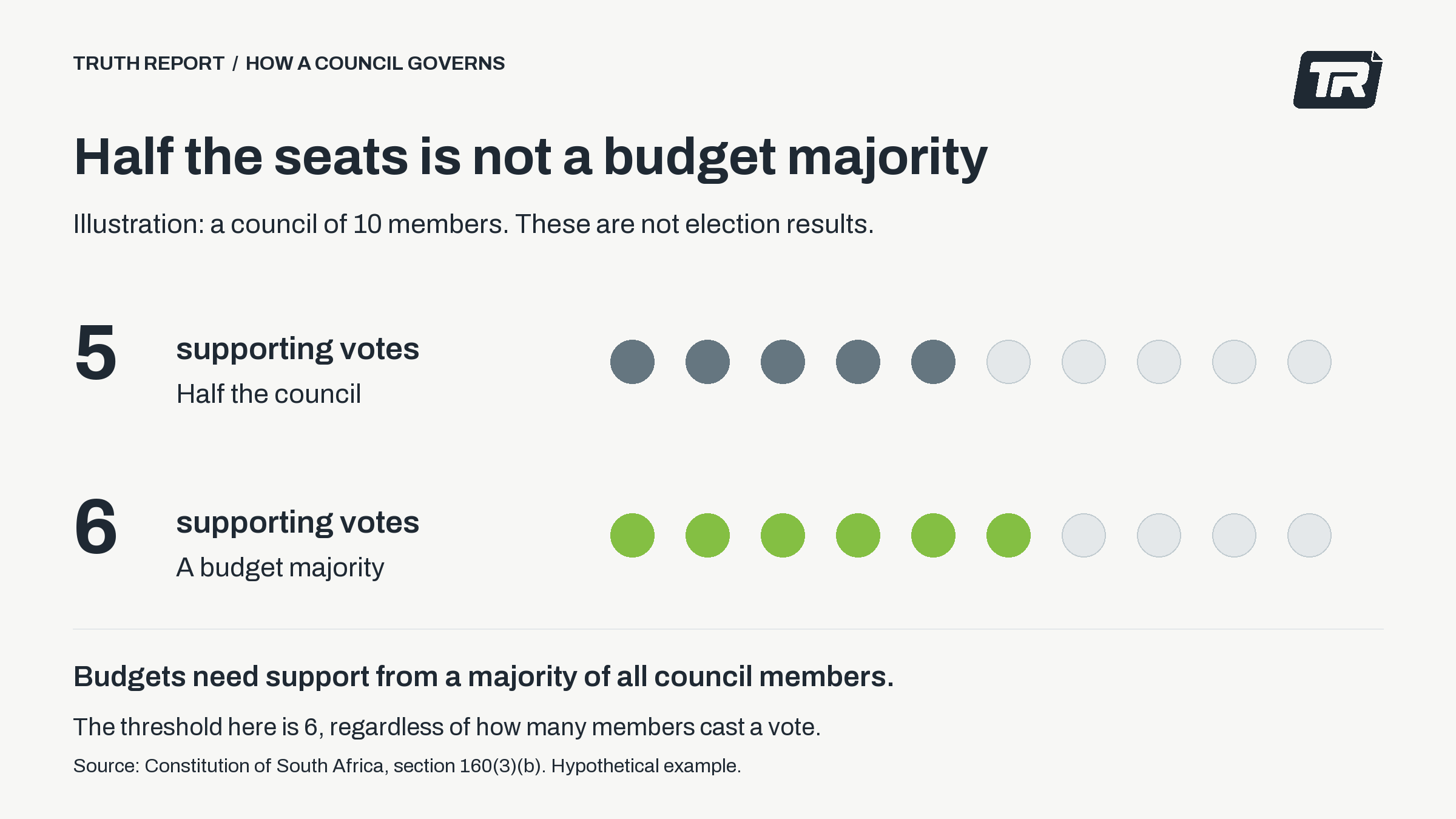
The relevant arithmetic belongs to each council. The Constitution provides for generally proportional representation and requires the support of a majority of all council members for budgets, by-laws, rates and borrowing. Most other questions are decided by a majority of votes cast, with a majority of members present before a vote can be taken.
That distinction matters. A coalition may win a particular division without possessing dependable support for its budget. In a hypothetical council of ten members, five supporters are half the council; six are needed to supply the majority required for a budget. Percentage rounding and incomplete seat allocations should never obscure that basic test.
The nuclear analogy has another limit. A party leaving a coalition does not automatically send everyone back to the electorate. The Dullah Omar Institute’s 2026 guidelines distinguish changes of political leadership from the continuing responsibilities of the municipal administration. A different grouping may emerge within the same council.
For the deterrent to work, a departing party would have to believe that its realistic alternatives are worse than remaining. A national agreement can raise the political cost of switching partners. It cannot make every alternative disappear.
The strongest objection is local accountability
A municipality is responsible to its own community. Under section 151 of the Constitution, its executive and legislative authority rests in its council. A national bargain cannot substitute for the decisions that council must take.
Suppose a partner objects to a questionable appointment or a failing project. If challenging that decision threatens its positions elsewhere, the pact could discourage necessary scrutiny. Conversely, if one party uses an unrelated dispute to destabilise several councils, residents far from the original disagreement could bear the cost.
These are risks inherent in the proposed mechanism, rather than allegations about an agreement already in place. A credible pact would need a way to distinguish opportunistic disruption from legitimate oversight, and a dispute process that resolves disagreements before essential decisions are paralysed.
Booysen and de Visser also warn against excessive centralisation and recommend allowing locally necessary alternatives in consultation with national leadership. A workable national framework needs room for the council that does not fit the national arithmetic.
An agreement between the DA and ANC deserves the same practical examination. A larger majority might provide a greater cushion against defections; it would also need an agreed programme and credible oversight. Excluding the ANC may be an electoral objective for its opponents, but exclusion alone does not demonstrate that another combination will govern competently.
The inheritance beneath the negotiations
The audit evidence makes that distinction unavoidable. The Auditor-General recorded three metros as unqualified with findings and five as qualified with findings. Cape Town, eThekwini and Johannesburg’s consolidated group were in the first category. Johannesburg’s separate city accounts received a qualified opinion.
An unqualified opinion with findings means that the financial statements passed the relevant test, while material findings remained elsewhere in the audit. It is different from a clean audit. These categories assess reporting and compliance; they do not establish that every official is corrupt, or explain which party caused each failure.
There is evidence of improvement that also deserves attention. Nationally, the number of municipalities with disclaimed opinions fell from 29 in 2020 / 21 to eight in 2024 / 25. The Auditor-General credited stronger support and oversight with gains in financial reporting. Institutional work can produce results, even while the broader picture remains troubling.
The practical task is to make that work durable. A coalition agreement should identify funded priorities, publish measurable service targets, protect competent appointments and explain how missed commitments will be addressed. Residents should be able to see what changed, what it cost and who is responsible.
A pact residents can judge
Some of these concerns are already before Parliament. Its August briefing on the Municipal Coalitions Bill described proposals for mandatory written agreements and their publication. Parliament said the Bill would not be finalised before the local elections. Those proposals should not be mistaken for safeguards already operating through that legislation.
Parties can nevertheless publish their agreements and build sensible dispute procedures now. The Dullah Omar Institute’s administrative-continuity guidance addresses practical measures such as clear delegations, institutional roles and senior appointments. Its central concern is that municipal functions continue through political change.
The four-party proposal offers a plausible way to make cooperation more valuable to the parties involved. Its strongest version would put that incentive behind a public programme, backed by lawful council decisions and an administration capable of carrying them out.
Residents need the resulting stability to mean something: an approved budget implemented properly, maintenance completed and services restored. If the pact can deliver that, it will have earned a life beyond election night.