Judging local politicians by the work they do is sensible. Lasting improvements also depend on who approves the budget, manages the staff and answers for failure.
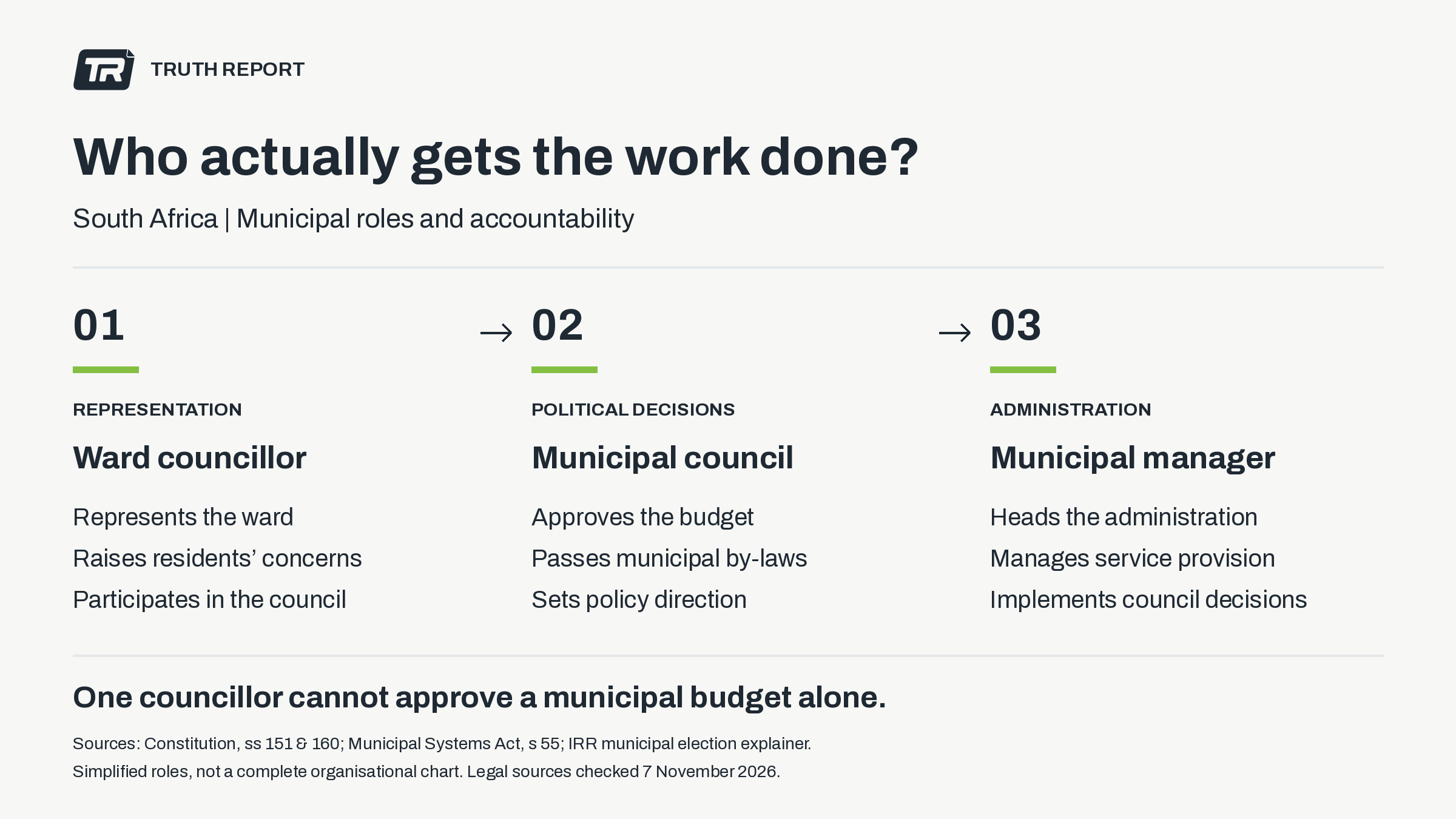
A councillor who answers the phone when a water pipe bursts offers something immediately valuable: a person residents can reach. But the power to approve a municipal budget belongs to the council collectively. The person chasing the repair and the institution financing it are connected, and neither can sensibly be judged in isolation. South Africa’s Constitution reserves budget approval to the municipal council.
That distinction matters when judging the councils chosen in the municipal election scheduled for 4 November 2026. A local representative’s availability is a reasonable starting point for accountability. It is an incomplete test of whether the municipality can keep water flowing, maintain infrastructure and spend public money properly.
The appeal of voting for the person who gets things done is easy to understand. It replaces inherited political loyalty with observable conduct. Residents can ask whether a representative follows up, explains delays and remains available after an election. Those are more useful questions than whether a campaign has produced an impressive slogan.
Yet a politics built entirely around the heroic councillor risks accepting permanent crisis management as success. The better question is whether that representative helps build a municipality in which an ordinary fault can be resolved through an ordinary reporting system.
The municipal electoral system makes room for both personal and party accountability. Ward elections allow voters to choose a local candidate, including an independent. Party representation also matters: the allocation of council seats takes account of party votes on ward and proportional-representation ballots. The Institute of Race Relations’ explanation of the system describes how list seats help align a party’s overall representation with its support.
This qualifies the argument that a small-party vote is inherently wasted. A candidate may have little prospect of winning a particular ward, while a party’s support can still contribute to representation in the council. The meaningful questions concern the local contest, the allocation of seats and how elected representatives will use them. Party size alone does not answer those questions.
Johannesburg’s earlier election provides useful perspective. In the Electoral Commission’s 2021 results announcement, the ANC had 33.60% of the city’s vote, the DA 26.47% and ActionSA 16.05%. These are historical results, not figures for the 2026 election. They show why being the largest party and commanding a majority must not be confused.
Representation is also different from administration. Under section 55 of the Municipal Systems Act, the municipal manager heads the administration, subject to the council’s policy direction. Responsibilities include managing service provision, staff and implementation of council decisions. Describing a ward councillor’s position as simply administrative obscures this division of responsibility.
A councillor can press a resident’s case and demand answers. That does not make the councillor the manager of a repair crew. If a complaint stalls, accountability requires identifying where it stalled: political priorities, management, funding or execution. Otherwise residents can end up blaming the most visible person while the actual failure remains untouched.
The Auditor-General’s 2023/24 municipal audit report supplies evidence of why the institutional test matters. It recorded 41 municipalities with clean audits and 113 operating with unfunded budgets. Those findings concern that financial year; they are not a description of every municipality’s position today. They nevertheless expose the limits of asking individual representatives to compensate for weak financial management.
The same report offers an important counterweight to blanket despair. Twenty-five municipalities had maintained clean audits every year since 2020/21. It describes sound controls as a foundation for better performance, while distinguishing its audit work from a comprehensive review of service delivery. A clean audit deserves attention, but residents still need to ask what happened to their water supply, roads and refuse collection.
There is a fair objection to placing so much emphasis on systems: people facing a sewage spill cannot wait for institutional reform. An energetic councillor may be the person who finally gets a response. Immediate help has real value. The test should therefore include both the emergency resolved and the recurring failure prevented.
Residents could reasonably ask their representatives for a small, verifiable record: which recurring faults were escalated, what the responsible department promised, whether the council funded the work and whether the repair lasted. Council attendance and voting records can add substance to that assessment. Public praise should follow evidence of results, with credit shared where officials and crews did the work.
The case for practical local politics is strongest when it reaches beyond personality. Choose representatives who are responsive, then judge how they exercise power alongside others. A functioning municipality should not require a personal connection to a councillor before it responds. The real achievement is a service that works for the resident whose number nobody at city hall recognises.