A possible DA, FF Plus, ACDP and PA coalition would have exactly enough votes to pass Nelson Mandela Bay’s budget. The bargain would also have to reconcile the promise of relief for ratepayers with the needs of residents who cannot afford to pay.
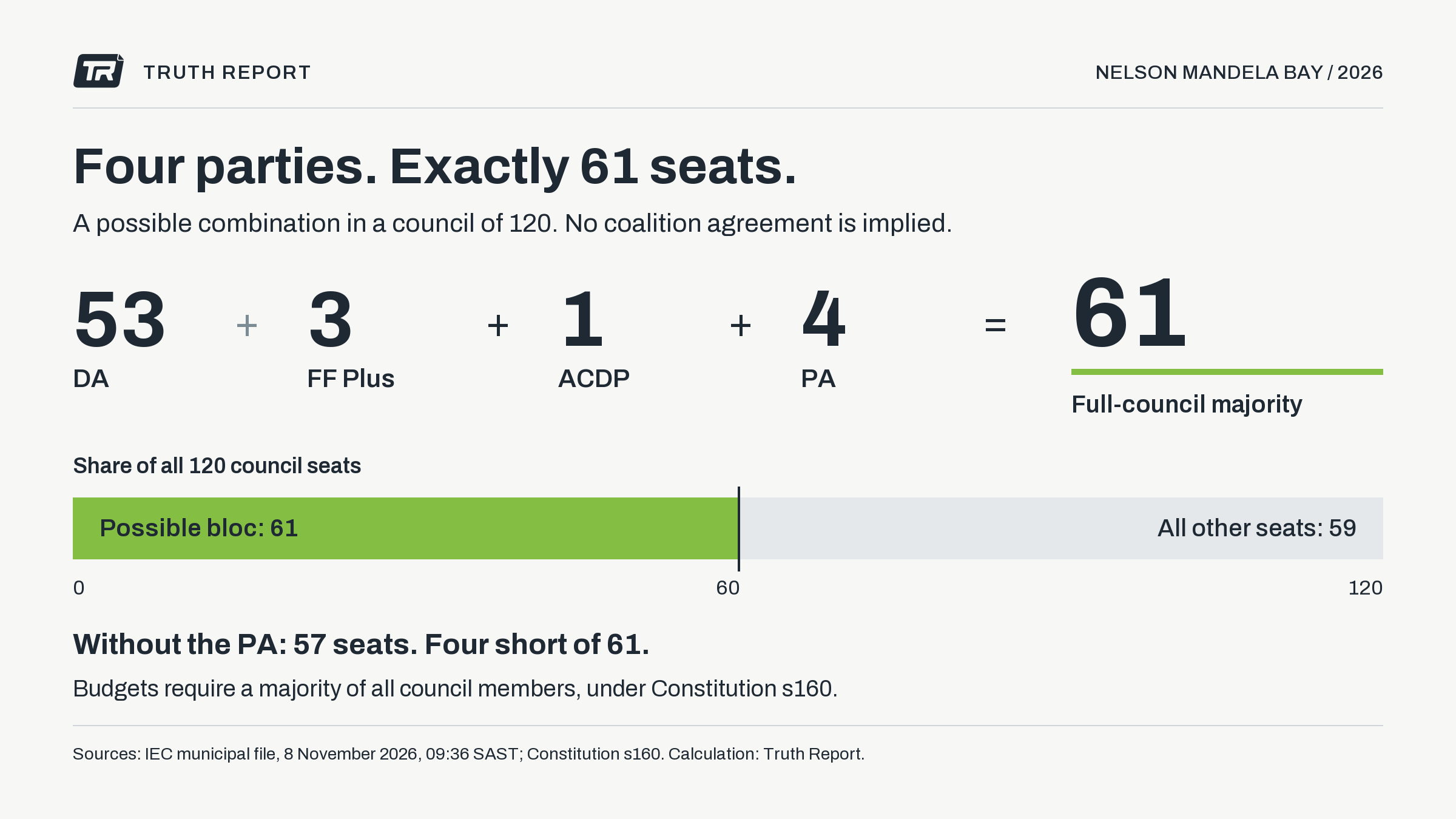
Nelson Mandela Bay has given the smaller parties an answer to anyone who calls their votes wasted. The Democratic Alliance’s 53 council seats, the Freedom Front Plus’s three, the African Christian Democratic Party’s one and the Patriotic Alliance’s four add up to 61. In a council of 120, that would be enough to pass a budget without outside support, provided every councillor in that combination voted for it. The IEC’s municipal results file dated 8 November 2026 accounts for all 120 seats.
Three parties would have 57 seats. Bringing in the PA would take them precisely to the full-council majority threshold. That is an available combination, not evidence that the four parties have agreed to govern together.
Renaldo Gouws’s argument for smaller parties deserves to be heard on those terms. On his own channel in February, Gouws urged voters to resist the argument that supporting a smaller party wastes their vote, presenting coalition politics as South Africa’s future. The Bay’s allocation gives that argument substance: a party with three councillors could help decide whether a particular government has the numbers to function.
That would also put the FF Plus’s name on the spending decisions its councillors support. Its voters are entitled to know what it secured, what it conceded and what their representatives voted to fund.
A budget needs all 61
The distinction between holding office and governing becomes concrete at the budget vote. Section 160 of the Constitution requires a supporting majority of the council’s members for budgets, by-laws, rates and other specified revenue decisions. Ordinary questions are decided by a majority of votes cast, once the quorum requirement is met.
For this four-party combination, an abstention or absence could leave only 60 supporting votes. It would then need help from elsewhere to approve the budget. The FF Plus would have bargaining power, but so would the PA and the ACDP. None could reasonably promise its supporters complete freedom from compromise.
There is good reason to welcome a credible agreement that can hold. The Auditor-General’s Eastern Cape assessment for 2024/25 says Nelson Mandela Bay had failed to investigate significant irregular and fruitless and wasteful expenditure stretching back several years. It identifies prolonged leadership instability, weak consequence management and ineffective financial discipline as obstacles in both of the province’s metros.
Those findings describe work awaiting any incoming administration. Replacing the names on office doors will achieve little if the officials managing contracts, accounts and infrastructure remain poorly supervised.
The municipality has acknowledged the weaknesses. In its January 2026 statement responding to the audit, it accepted the findings and described corrective measures covering procurement, billing, leadership and financial controls. It disputed the suggestion that the qualified opinion meant governance or service delivery had collapsed. Any successor should account publicly for what those measures achieved and what remains unfinished.
Where the rates money goes
The FF Plus offers a recognisable appeal to people who keep paying municipal bills and want their neighbourhoods maintained. Its 2026 municipal manifesto proposes returning a substantial portion of rates and levies to the wards where they were collected, cutting unnecessary expenditure and resisting tariff increases above inflation.
There is a legitimate demand here. A resident who pays faithfully should be able to find out why a streetlight remains broken, which contractor was paid and who is responsible for an overdue repair. Financial solidarity cannot become an excuse for municipal indifference.
But the party’s written policy also recognises redistribution and basic services for low-income households. It proposes using the equitable share, the municipality’s allocation from nationally raised revenue, to provide basic services to the poor. That qualification matters. It leaves room for a governing agreement that protects paying residents while accepting obligations across the metro.
The law requires that broader obligation. Section 73 of the Municipal Systems Act requires access to at least a minimum level of basic municipal services for all members of the community. Section 74 requires tariff policies to provide for poor households’ access to basic services, alongside equitable treatment and financial sustainability.
A coalition would therefore have to show how its ward spending promises fit a citywide budget. It should publish the proposed share retained locally, the cost of shared infrastructure and the provision for households unable to pay. Invoking the equitable share does not, by itself, demonstrate that all those costs are covered.
Nor should poverty and deliberate non-payment be treated as the same problem. A credible revenue policy must distinguish households needing assistance from customers able to pay, and must give residents a way to challenge an incorrect bill. Otherwise, the promise of financial discipline risks becoming another source of arbitrary treatment.
Put the agreement in public
The FF Plus’s smaller-party case has merit where it produces accountable influence. Its own manifesto commits it to stable coalitions, effective oversight and transparency. Residents should expect those commitments to survive negotiations over positions.
Any four-party agreement should identify who is responsible for resolving audit findings, maintaining infrastructure and protecting basic services. Its spending commitments should appear in the budget, with progress reported openly. Ratepayers should be able to trace their money; poorer households should be able to establish what assistance they are entitled to receive.
The Bay’s numbers allow a narrow majority of this kind. They cannot tell residents whether the parties will reach an agreement or honour it. That will be visible in their appointments, their spending and their willingness to hold their own representatives accountable.
Sixty-one seats would give these parties enough votes to make consequential decisions. The people living with those decisions would extend far beyond the wards that pay the most. A coalition asking to govern Nelson Mandela Bay must accept responsibility for the whole city.Truth Report