The city’s investment programme and recent reductions in murder deserve recognition. Neither settles whether residents in its most vulnerable neighbourhoods can reach work, use public services and live safely.
Cape Town’s administration has a substantial investment programme to defend. In June, the City announced that its adopted 2026/27 budget retained R40 billion in basic infrastructure investment over three years. That establishes the scale of its commitment. It does not establish what has changed on a particular street.
That distinction ran through Truth Report’s Cape Town governance debate at the Goal50 Educational Hub in Heideveld. The organiser’s event listing names the Democratic Alliance’s Xanthea Limberg, the Freedom Front Plus’s Emre Uygun, the ANC’s Jerimia Thuynsma and GOOD’s Brett Herron as the panel. Their competing arguments exposed a question that comparisons with other municipalities cannot answer alone: how should a city’s performance be judged when improvements and deprivation coexist?
Limberg’s case rested on investment, administrative competence and economic opportunity. Thuynsma challenged whether that account described the Cape Town experienced by residents without adequate roads or lighting. Herron proposed common service standards across neighbourhoods, while Uygun linked policing reform with a need for more social support. These are different tests of government, and each needs evidence appropriate to the claim.

Investment is a starting point
The City’s strongest response to a sweeping allegation of neglect is the content of its programme. Its June announcement included R16.7 billion for water and sanitation, R3.2 billion for the Cape Flats MyCiTi expansion, and R3.3 billion for informal settlement upgrading and state-subsidised housing, all over the three-year framework. Those are substantial allocations to functions that matter directly to poorer communities.
They are also allocations. Assessing delivery requires a further chain of evidence: what was spent, what was completed, whether the infrastructure works, and who can use it. A sewer upgrade may benefit households far beyond the site of construction. Conversely, a large metropolitan total can coexist with a long wait for a local repair. Neither observation excuses failure or proves discrimination.
The administration says 75% of infrastructure spending benefits lower-income households. That is the City’s assessment, rather than an independently established finding here. A meaningful test would publish the classification method, project locations, completion dates and resulting service improvements. Residents should be able to follow a claim about benefit through to something they can observe.
Herron’s proposal for shared standards offers one way to sharpen that test. A city could specify a minimum standard for a park, publish which facilities fall short, and fund a dated programme to close the gap. The same principle could apply to streetlight repairs and sanitation maintenance. This would turn an argument about two Cape Towns into a set of obligations that residents can check.
Safety figures require a date and a boundary
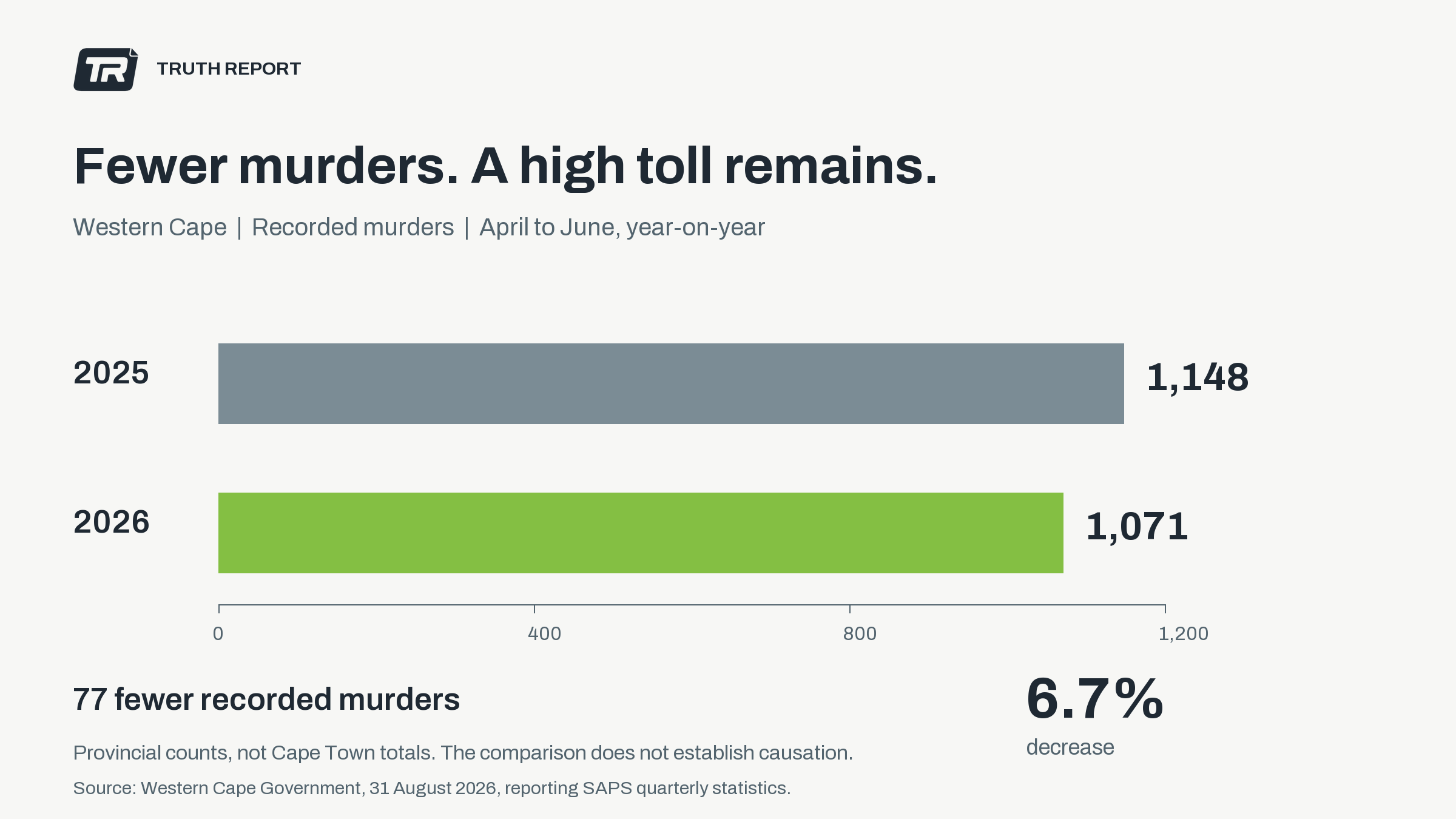
The debate’s sense of a continuing emergency is understandable. But an assertion that murders simply keep rising is too broad to describe every recent period. The Western Cape Government’s 31 August account of SAPS statistics recorded 1,071 murders across the province in April to June 2026, compared with 1,148 in the same months of 2025, a decline of 6.7%.
The province also reported a 17% reduction across six Law Enforcement Advancement Plan deployment areas. These figures are evidence of improvement in the specified period. They do not establish that the programme caused the reduction, and provincial totals must not be presented as Cape Town totals. Nor does a reduction make the remaining loss of life acceptable.
Local experience can also move differently from a combined total. In January to March 2026, the provincial government reported falling murders across the combined LEAP areas while reporting increases in Gugulethu and Khayelitsha. The subsequent quarter brought reported reductions in every LEAP area. That variation is precisely why neither a citywide boast nor a blanket verdict of failure is enough.
An honest safety account therefore needs both the trend and the geography. It must distinguish recorded murders from a population-adjusted murder rate, explain the period being compared, and show whether improvement reaches the places carrying the greatest burden.
Policing powers do not exhaust responsibility
Uygun’s support for devolving policing powers addresses a real institutional argument. The City has itself pressed for expanded investigation and forensic powers, arguing that arrests and firearm seizures need to lead to successful prosecutions. That is its stated policy case, rather than proof that devolution would deliver a particular reduction in violence.
The constitutional division of responsibility matters. Section 205 gives the national police service crime prevention and investigation responsibilities. Section 206 gives provinces oversight functions. Municipal government meanwhile administers local functions that include roads, street lighting and public places, under section 156 and Schedule 5B.
The practical connection between urban services and safety has a long documentary history. A 2025 parliamentary record discussing the Khayelitsha Commission’s recommendations describes dark pathways, access difficulties, inadequate wayfinding and risks associated with reaching communal toilets. It places these issues within an account of the commission’s work, rather than a current inspection of every settlement.
This supports Thuynsma’s underlying institutional point without proving every allegation about present conditions: a policing dispute cannot settle whether municipal infrastructure is adequate. It also challenges any suggestion that better local services could substitute for competent investigation. Residents need functioning institutions on both sides of that boundary.
Affordability and opportunity need their own evidence
Herron’s demand for a more affordable city also deserves a more exact test than campaign language provides. The City’s adopted-budget announcement sets out indigent relief and pensioner rebate provisions. Their existence qualifies an assertion that support is effectively absent. It does not establish how easily eligible households obtain it or how well it meets their needs.
The relevant questions are practical: how many qualifying households receive support, how many applications fail, how long decisions take, and what a household pays after assistance. Housing and transport proposals likewise need to identify beneficiaries, locations, costs and delivery dates. A promise to use public land or improve employability becomes assessable when those details are supplied.
Uygun’s attack on black economic empowerment raises a different policy dispute. William Gumede’s March 2026 opinion article published by Wits criticises concentrated benefits and political connections. That argument deserves engagement. It does not, on its own, establish which policy is the largest obstacle to employment in Cape Town. A ranking of causes requires evidence about this labour market, rather than a national argument treated as a local measurement.
The most useful consequence of the debate is a clearer standard of accountability. The administration should be judged on completed projects, accessible services and sustained improvements in safety, alongside its ability to finance them. Its challengers should be judged on costed commitments and an honest account of the powers they would control.
Cape Flats residents should not have to choose between recognising progress and demanding more. The governing test is whether public capacity produces a safer route home, a usable service and a credible route to opportunity in the neighbourhood where a person lives.