Rabbi David Wolpe describes a Jewish world whose confidence has been shaken. Evidence from Europe and Harvard supports his concern about exclusion, while pointing to a demanding obligation: protect Jewish belonging and preserve political disagreement.
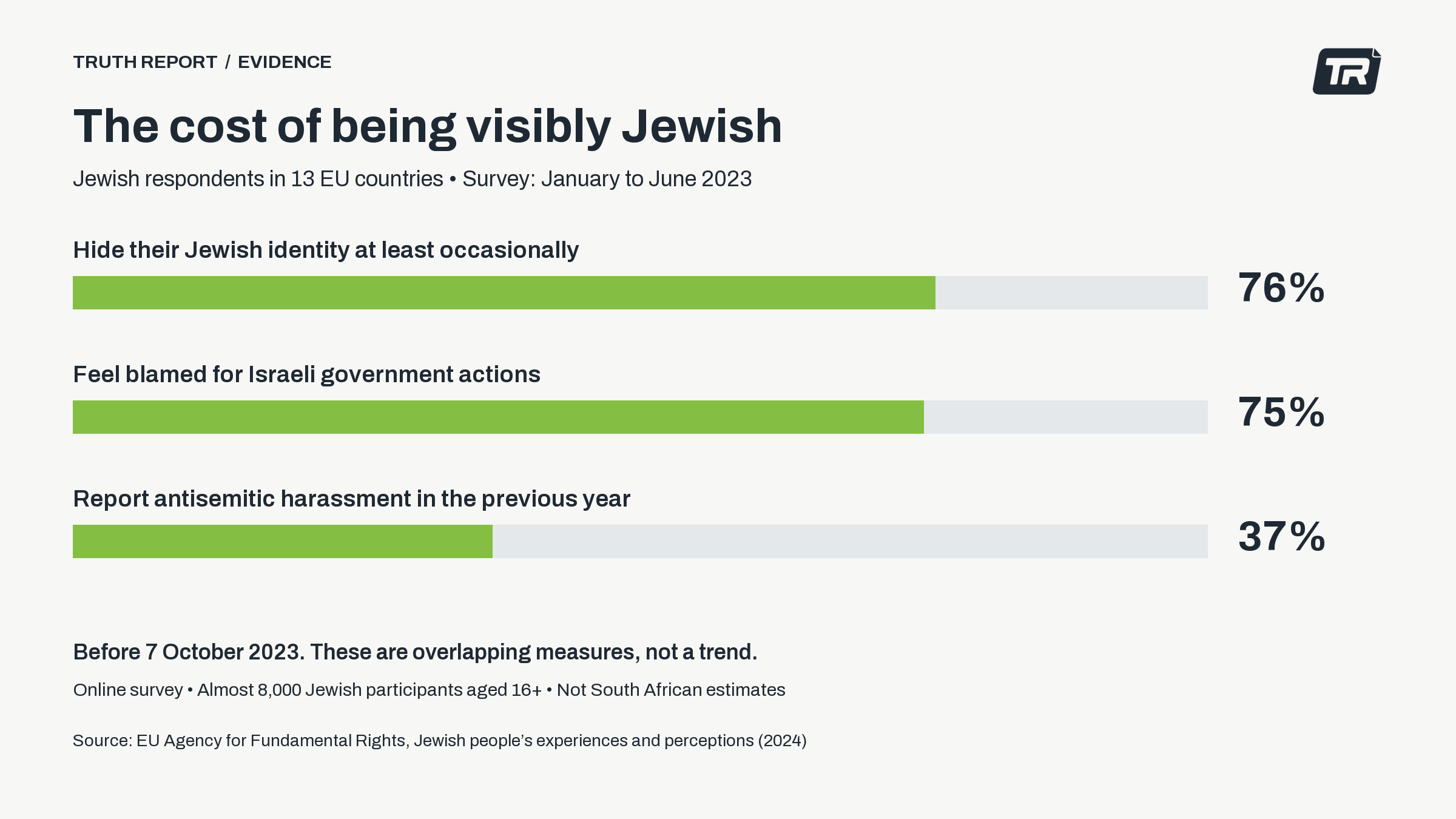
Long before the arguments over Gaza reached their present intensity, many European Jews were already making a private calculation about whether to be visibly Jewish. In a survey conducted in the first half of 2023, 76% of Jewish respondents said they hid their identity at least occasionally. The date matters. The insecurity preceded the Hamas attacks of 7 October and Israel’s ensuing military campaign.
In his conversation with Truth Report, Rabbi David Wolpe describes a similar change in personal confidence: wearing a kippah now prompts a degree of self-consciousness that he did not previously experience. His concern is about the ordinary freedom to move through public life without wondering whether an expression of religious identity might invite hostility.
That is the strongest thread running through his argument. A dispute about a government becomes something different when people who share a religion or ancestry are expected to answer for its decisions. The boundary matters in South Africa, where disagreement over Israel and Palestine must coexist with equal citizenship at home.
A warning with a longer history
The European Union Agency for Fundamental Rights survey gathered responses online from almost 8,000 Jews aged 16 and older in 13 EU countries between January and June 2023. Of respondents, 75% felt that others held them responsible for the Israeli government’s actions; 37% reported antisemitic harassment in the previous year.
These are respondents’ experiences and perceptions, not a police count or an estimate for South Africa. Nor can a survey conducted before October 2023 measure the change caused by what followed. It nevertheless establishes that collective blame and concealment were substantial concerns before the war.
Wolpe offers two explanations for the hostility he sees: older prejudice finding new permission, and social pressure drawing people into positions they have scarcely examined. The first is a historical interpretation; the second is a proposed explanation of behaviour. Neither should be mistaken for a demonstrated account of every protester’s motives.
His account is also more cautious than a simple prediction of permanent decline. He allows for the possibility that political passions will subside. That uncertainty is sensible. Institutions need to act on intimidation and discrimination without pretending to know the future course of an entire society.
What Harvard can establish
Harvard is central to Wolpe’s warning because he spent a year there as a visiting scholar. In his own published account of that year, he described fearful calls from students and parents, attempts at dialogue and an administration that he believed had struggled to confront hostility. He also acknowledged administrators of goodwill. His position was that their response had been inadequate, rather than that every person at Harvard shared the same hostility.

The university’s 2025 antisemitism and anti-Israeli bias report provides institutional evidence for parts of that account. Its listening sessions recorded Jewish students describing a hostile atmosphere, Israeli students experiencing social exclusion, and some Jews concealing their identity. Participants also described complaint procedures as unclear and slow. These were reported experiences gathered by a university task force, rather than judicial findings about each incident.
The report also complicates any picture of two uniform camps. It recorded exclusion affecting Jewish students with different positions on Zionism, including alienation within Jewish communal spaces. And it described constructive teaching and exchanges across the conflict’s divisions. The institution’s failures were serious; its community was more varied than the failures alone suggest.
Harvard’s published response deserves to be included. In April 2025, the university announced disciplinary review, expanded support for affected students, a research initiative on antisemitism and work to encourage viewpoint diversity. These commitments offer standards against which to judge institutional conduct. An announcement does not, by itself, demonstrate that a student’s experience has improved.
Where the distinction matters
Wolpe argues that anti-Zionism can overlap substantially with antisemitism, particularly where a proposed future would endanger the Jews living in Israel. That is a serious challenge to political programmes that treat Jewish safety as an inconvenience. Anyone proposing a constitutional future for Israelis and Palestinians owes an account of how both peoples would live safely and equally.
But it does not follow that Palestinian solidarity, opposition to Israeli policy and hostility towards Jews are interchangeable. The Jerusalem Declaration on Antisemitism, developed by scholars in relevant fields, explicitly treats support for Palestinian rights and proposals for constitutional arrangements ensuring full equality as positions that are not, on their face, antisemitic. It also identifies collective blame of Jews for Israel’s actions, and demands that Jews publicly condemn Israel because they are Jewish, as antisemitic.
The declaration is a framework for judgement, not a substitute for examining conduct. Its distinction is useful precisely because it protects people without granting any state exemption from scrutiny. A call for Palestinian equality and an attack on a Jewish neighbour do not become equivalent because both invoke Israel.
This also imposes a discipline on defenders of Israel. Evidence of anti-Jewish prejudice cannot settle every factual or legal question about a war. Equally, evidence of wrongdoing by Israeli authorities cannot diminish a Jewish person’s rights in Johannesburg, Cape Town or anywhere else.
The South African obligation
South Africa’s Constitution protects equality, religious freedom and expression. Section 16 also excludes specified categories from its protection, including advocacy of hatred based on race, ethnicity, gender or religion that constitutes incitement to cause harm. These provisions demand attention to the words, conduct and context of a particular case. Political offence alone is an inadequate guide.
For universities, employers and civic organisations, the practical question is whether people can participate on equal terms. Complaints need clear routes and consistent decisions. Threats require action. Debate must remain possible, including debate that a government or a community finds deeply uncomfortable.
Wolpe’s warning is most persuasive where it describes the erosion of ordinary belonging. A person deciding whether to hide a kippah is registering a failure that public declarations of tolerance cannot repair on their own. The test is whether Jews can live openly as Jews, and whether their neighbours can argue about Israel and Palestine without turning ancestry or faith into an accusation.