A confident prediction of a DA victory raises a harder question: does “winning Johannesburg” mean finishing first, governing alone or assembling enough support to run the city? The differences will shape what any mayor can deliver.
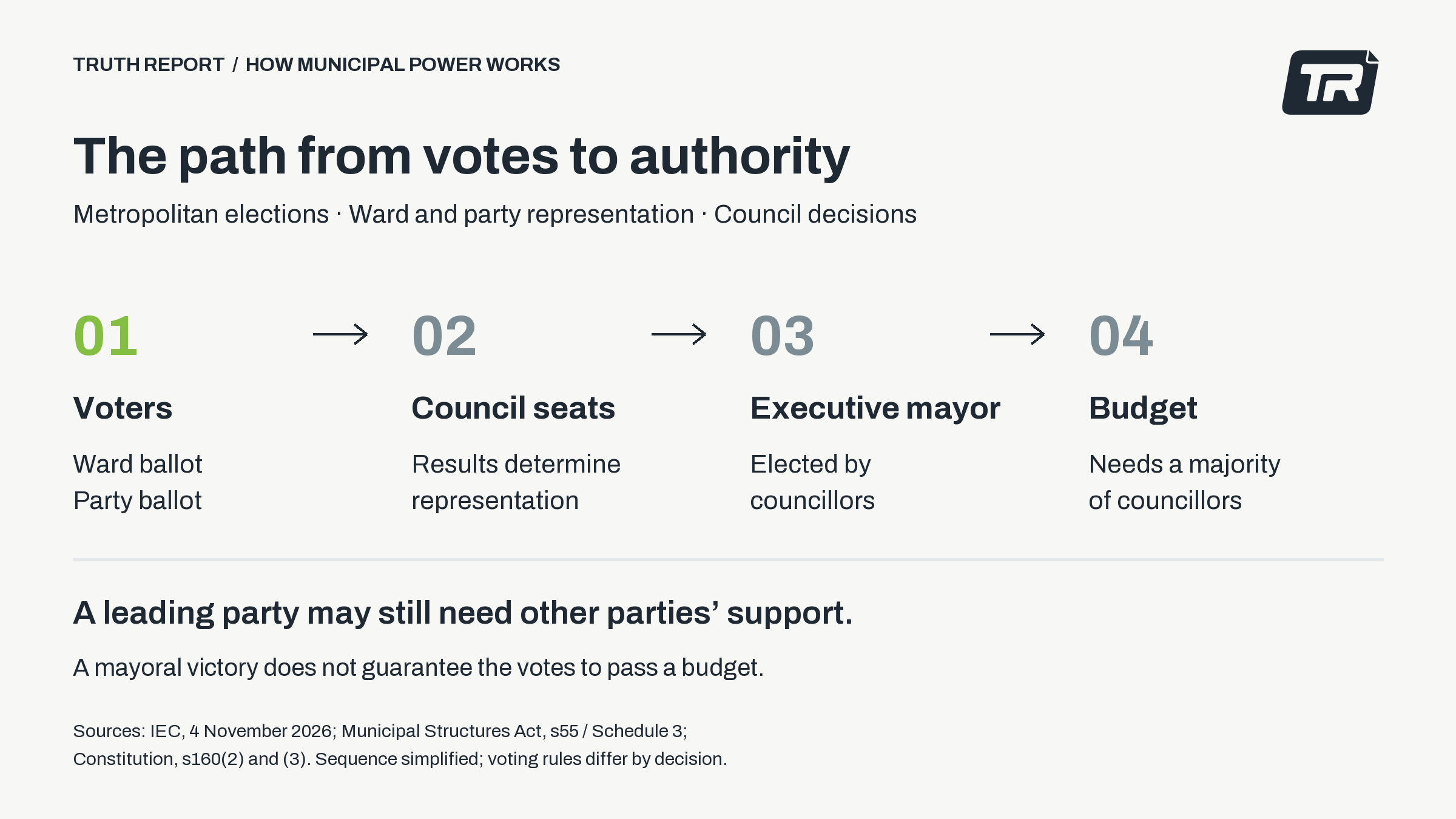
Helen Zille’s route to Johannesburg’s mayoral office runs through the council chamber. However prominent a candidate becomes during a campaign, voters do not directly elect the city’s executive mayor. Councillors choose that office-holder from among themselves under section 55 of the Municipal Structures Act.
That distinction is the essential test of a striking pre-election argument aired on Truth Report. The guest initially predicted an overwhelming Democratic Alliance victory and dismissed the need for a coalition. Later, the position became more qualified: a DA victory, or at least a DA-led coalition. Those are materially different forecasts, even if both could put the same person in the mayoral chair.
The 4 November 2026 election date has now passed. The argument should therefore be assessed as a pre-election forecast, not repeated as an established result. Its value lies in the question it exposes: how does a campaign built around a prominent individual become a durable governing arrangement?

Three meanings of victory
A party can finish ahead of every rival and still hold fewer than half the council seats. An outright majority means holding more than half. A coalition is an agreement between parties to govern together; it is not something a leading party automatically acquires by topping the results table.
Johannesburg’s previous election shows why precision matters. In 2021 the IEC allocated 91 of 270 seats to the ANC, 71 to the DA, 44 to ActionSA and 29 to the EFF. Other parties shared the remaining 35. No party reached the 136 seats needed for more than half of that council.
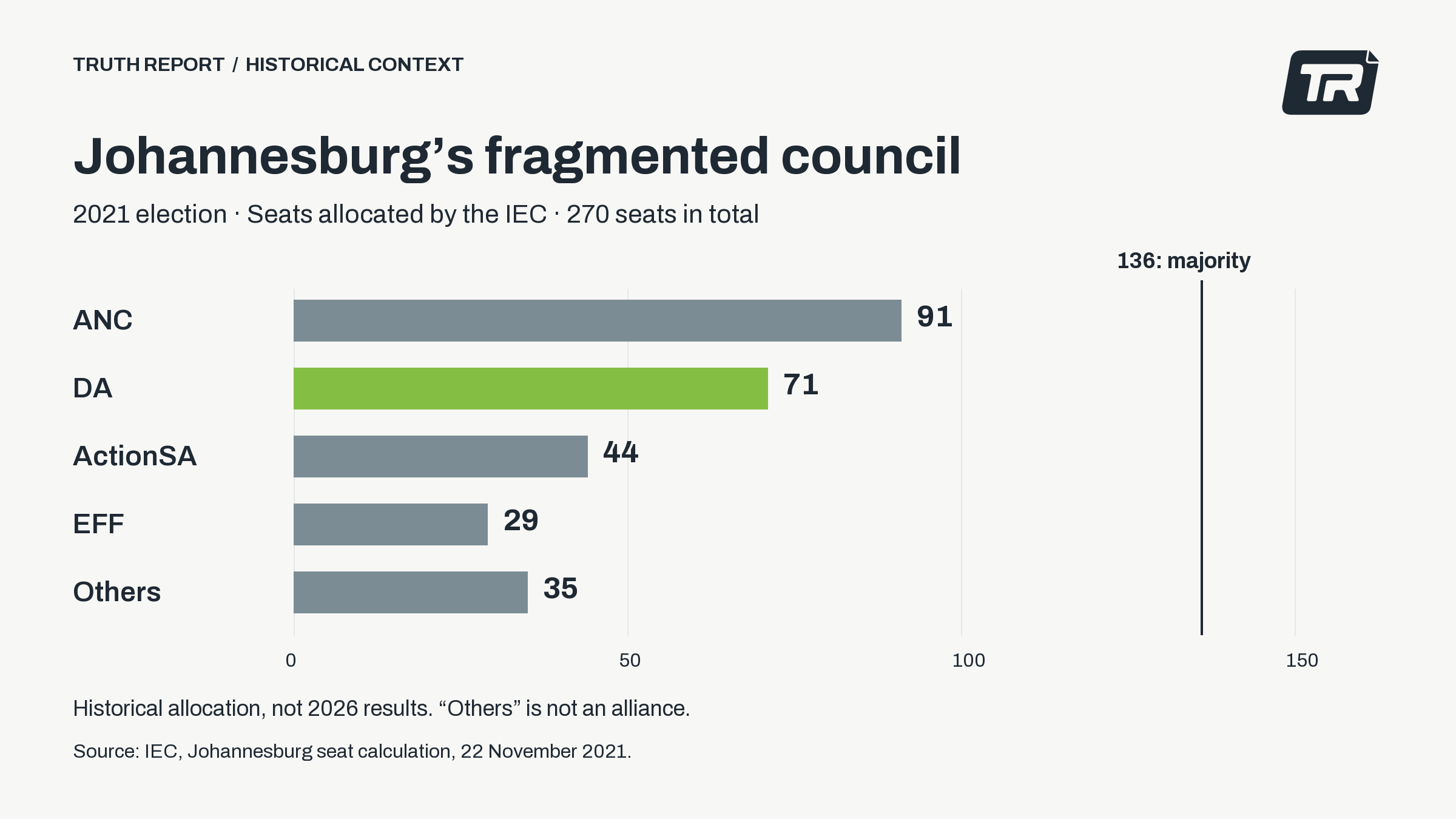
This history does not impose a ceiling on what the DA could achieve in a later election. It does show the scale of the difference between leading a fragmented field and winning enough seats to govern without another party’s votes. A forecast of a sweeping majority needs evidence of that larger change.
The council arithmetic also needs a legal qualification. The number constituting an absolute majority of seats is not a universal threshold for every council vote. Schedule 3 of the Structures Act sets the mayoral election procedure, including a secret ballot when more than one candidate is nominated. The Constitution separately requires the support of a majority of councillors for budgets and other specified decisions. Winning the mayoral vote and sustaining a budget are connected political tasks, not identical legal tests.
The case for a recognisable candidate
The guest’s strongest argument concerned Zille herself. In that account, her visibility and political reputation could overcome reservations about the DA and make her the focus of voters seeking change. The party formally announced her Johannesburg candidacy in September 2025.
There is a plausible political mechanism here. A recognisable candidate can give a campaign a clear identity, draw attention to local failures and make a promise of change easier to communicate. Voters need not approve of every national party position to prefer its municipal candidate. These are reasons to take the argument seriously, rather than dismiss it simply because it is enthusiastic.
But visibility is not a measurement of vote share. Controversy can mobilise opponents as well as supporters. Nor can the people taking part in one discussion establish which candidates an entire city recognises. ActionSA’s own campaign material names Herman Mashaba as its Johannesburg mayoral candidate. The contest cannot responsibly be analysed as if Zille were the only identifiable alternative.
A candidate-centred explanation becomes testable when it specifies what would count as success. More votes than last time? First place? An outright majority? Election as mayor with support from other parties? Moving between those outcomes makes a prediction easier to defend afterwards, but less useful beforehand.
Polls deserve scrutiny, not blanket dismissal
The discussion also challenged the authority of political statistics, invoking the 2024 election as an example of expectations going wrong. That criticism needs to identify the particular poll, its question and the outcome it was supposed to forecast.
One prominent published survey provides a concrete counterexample. Ipsos’s April 2024 release put ANC support at 40.2% and DA support at 21.9%. It did not place the DA ahead. The IEC’s national-ballot results subsequently recorded 40.18% for the ANC and 21.81% for the DA.
That comparison does not prove that polling is infallible, or that a national survey predicts a Johannesburg municipal election. Ipsos explicitly cautioned that its figures were not firm predictions and that turnout would affect the outcome. Its release described interviews with 2 545 registered voters, conducted from 9 March to 15 April 2024. The relevant lesson is to interrogate the evidence on its own terms.
A scenario model requires similar discipline. A list of plausible coalitions is not necessarily a poll, and ranking scenarios does not establish their probabilities unless the method explains how those probabilities were produced. Before giving a numerical forecast authority, readers should be able to see its date, geographic scope, turnout assumptions and treatment of undecided voters. Confidence in a candidate does not remove those questions; a polished model does not answer them automatically.
The work after the count
The institutional sequence is straightforward. Metropolitan voters receive a ward ballot and a party ballot. The resulting council composition provides the setting for the mayoral election and, where necessary, negotiations over political support. Governing then requires decisions that command the legally required votes.
A coalition can distribute responsibility, but it can also obscure it. A useful agreement would tell residents which priorities the parties share, how disputes will be resolved and who answers for missed commitments. Those are standards against which any arrangement should be judged, rather than assumptions that a particular combination of party names will succeed or fail.
The same test applies to an outright majority. Fewer negotiating partners would not, by itself, repair infrastructure, improve revenue collection or ensure competent administration. Electoral strength creates political opportunity; it does not demonstrate delivery.
Zille’s prominence gives the argument a compelling central character. The more consequential story is whether electoral support can become coherent authority and whether that authority can produce results residents can observe. Johannesburg’s verdict on its next administration will ultimately be written in the quality of the services it receives.