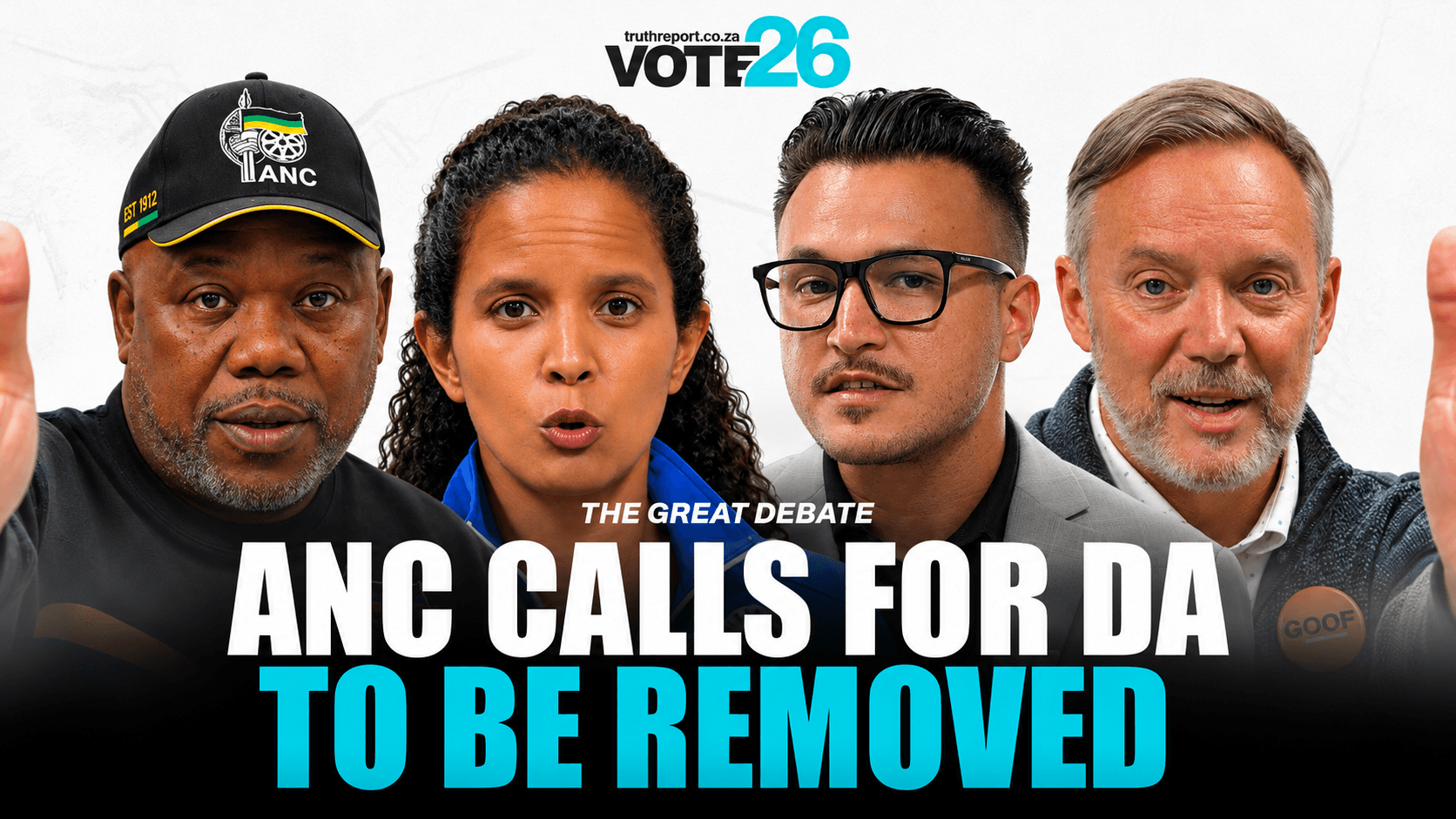
Sean McLaughlin’s municipal scenarios point to a contest that continues after the ballots are counted. Electing a mayor, passing a budget and keeping an administration together require different kinds of support.
In June, Ekurhuleni supplied a practical lesson in the politics now facing South Africa’s cities. Its ANC-led administration secured approval for an amended municipal budget after an agreement with the Democratic Alliance. The vote was 176 in favour and 31 against. Opposition councillors had helped an administration they opposed perform one of its essential duties.
That agreement did not establish a permanent alliance. It demonstrated something more limited, and immediately useful: parties can negotiate enough common ground to keep a city’s finances moving without settling every question about who should govern it.
As counting continued on 6 November after Wednesday’s municipal election, the Electoral Commission was still processing results and objections. Final city outcomes remained unsettled. Yet the distinction between electoral strength and governing power already matters. The largest party can find itself excluded from office; a smaller bloc can elect a mayor; neither outcome guarantees a dependable budget majority.
Political analyst Sean McLaughlin’s assessment of the contest turns on this separation. He envisages several possible arrangements, including ANC and DA co-operation, broader coalitions and administrations supported by parties that remain outside the executive. These are conditional political scenarios. Their value lies in showing where negotiations could lead, rather than supplying advance results.
A mayoral victory has a different threshold
Coalition discussion often revolves around a supposedly magical 51%. That is convenient shorthand for a secure majority in a 100-member council. The actual requirement depends on the decision being taken and the number of seats in that council.
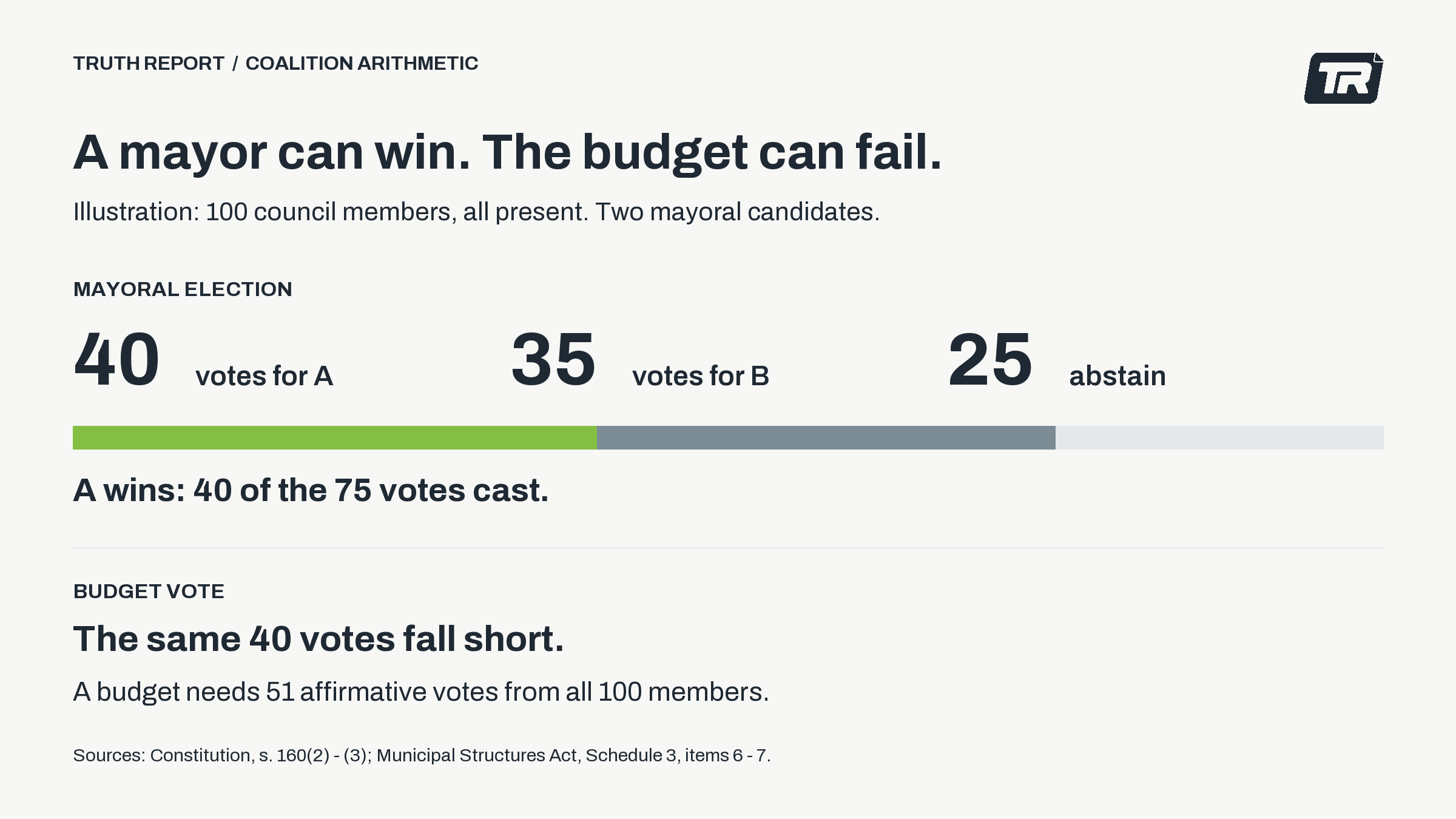
The Constitution requires a majority of council members to be present before voting can take place. For budgets, by-laws, rates and other specified financial decisions, a majority of the council’s entire membership must support the measure. Abstaining does not lower that threshold.
The procedure for a contested mayoral election is different. Under the Municipal Structures Act’s Schedule 3, councillors vote for candidates and the winner must receive a majority of the votes. If nobody achieves that, the lowest candidate is eliminated and voting continues. A party does not need an outright majority of council seats to secure the mayoralty.
Consider an illustrative council of 100 members, all present. Two mayoral candidates receive 40 and 35 votes, while 25 councillors abstain. The candidate with 40 wins a majority of the 75 votes cast. If the same division occurs on the budget, with 40 supporting it, the budget fails: 51 affirmative votes are needed.
That is why an agreement merely to abstain in a mayoral contest offers a weaker foundation than a commitment to support a credible budget. A party can help install a mayor without undertaking to fund that mayor’s programme.
The cities present different negotiations
In eThekwini, McLaughlin’s scenario is that uMkhonto weSizwe, the MK party, could emerge as the largest party while an alternative combination of the DA, ANC and Inkatha Freedom Party might still assemble sufficient support to govern. Whether those parties could reach an agreement is a separate question from whether their seats would add up.
His Johannesburg assessment raises the reverse problem for the DA: a strong performance could leave it short of control if other parties co-operate against it. For Tshwane, he sees a possible route through the DA and Freedom Front Plus, provided they secure sufficient representation. These possibilities describe bargaining positions, not declared coalitions.
Ekurhuleni offers a practical precedent for negotiated co-operation because the June budget agreement actually happened. But its scope should remain clear. Reporting on the deal records the DA’s claim that it secured changes on rates, infrastructure funding and oversight. It does not establish a five-year governing compact or prove that every promised change has been implemented.
For Mangaung and Nelson Mandela Bay, McLaughlin similarly identifies the difficulty of turning fragmented representation into durable support. Across these cities, the decisive information will be the final seat allocation, each party’s willingness to work with others and the terms on which councillors agree to support an administration.
There is a limit to reading local outcomes through national alliances. The Constitution vests municipal executive and legislative authority in the municipal council. Co-operation elsewhere may make a local agreement politically easier, but it cannot supply the councillors or the votes needed in a particular chamber.
Ward victories do not simply stack on top of party votes
Before coalition arithmetic can begin, votes must be translated into seats. South Africa’s municipal system combines ward representation with compensatory party-list representation. Treating those as two unrelated piles of seats can produce a misleading picture of a party’s strength.
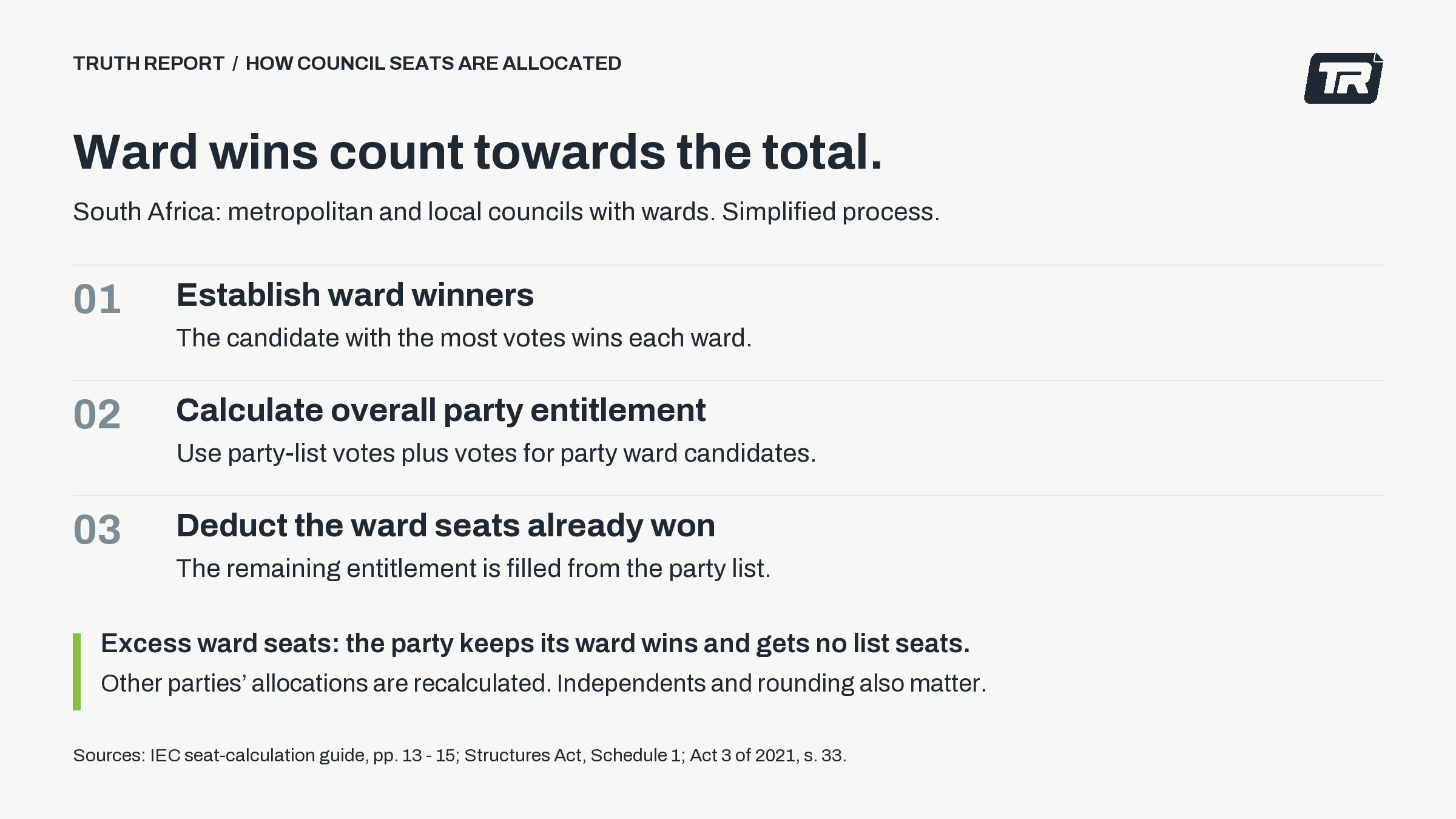
The Electoral Commission’s seat-calculation guide explains the sequence. Ward candidates win by obtaining the most votes in their ward. The commission then calculates each party’s overall entitlement using its party-list votes and votes for its party-nominated ward candidates. Ward seats already won are deducted to determine the party’s list seats. Independents and rounding also affect the calculation.
An exception arises when a party wins more wards than its proportional entitlement would ordinarily allow. The law provides for “excessive seats”, with further allocation rules added in 2021. The party keeps its ward victories, receives no list seats, and the allocation for other parties is recalculated over the remaining seats.
McLaughlin identifies this overhang risk as a reason to watch ward performance as well as headline percentages. It is a real mechanism, but its size cannot be read from a national poll or a single municipal vote-share figure. A claim that a party will gain a particular seat advantage requires the actual ward results and the full allocation calculation.
Stability needs an agreement residents can examine
There is a reasonable case for co-operation between parties that disagree. Ekurhuleni’s budget vote shows that opposition influence can be exercised through amendments and negotiated support. Requiring every disagreement to bring down an administration would make routine government difficult.
The test is what the agreement delivers and how the public can hold its signatories to it. A useful compact would specify budget commitments, maintenance priorities, oversight arrangements and a process for resolving disputes. Residents should be able to distinguish a disagreement over expenditure from a dispute over positions.
Parliament has itself identified the transparency problem. The Municipal Structures Amendment Bill, B23 of 2026, proposes a framework for coalitions. Its committee has described proposals for written agreements lodged with municipal managers and the relevant provincial authorities and published in the Provincial Gazette. The committee also said the legislation would not be finalised before these elections. Proposed safeguards should therefore not be mistaken for rules already governing the new arrangements.
There is also a stronger challenge to the assumption that rearranging political parties will repair municipal government: the administrative problems run deeper. In its 2024/25 findings, the Auditor-General reported only 39 municipalities with clean audits. It also recorded improvements, including timely financial-statement submissions reaching 98% and unqualified financial opinions reaching 61%. Those gains show that progress is possible, even while serious weaknesses persist.
A clean audit assesses reporting and compliance; it does not certify that every tap works. Nor do those national findings isolate coalition government as the cause of municipal failure. They underline the need to judge the administration behind the political agreement: its financial controls, technical capacity and ability to carry decisions through.
The question after the count is therefore more demanding than who wears the mayoral chain. It is who will support a funded budget, oversee its execution and remain answerable when the promised work does not happen. Residents will experience the coalition through those decisions long after the council’s first vote.Truth Report · Independent reporting and analysis