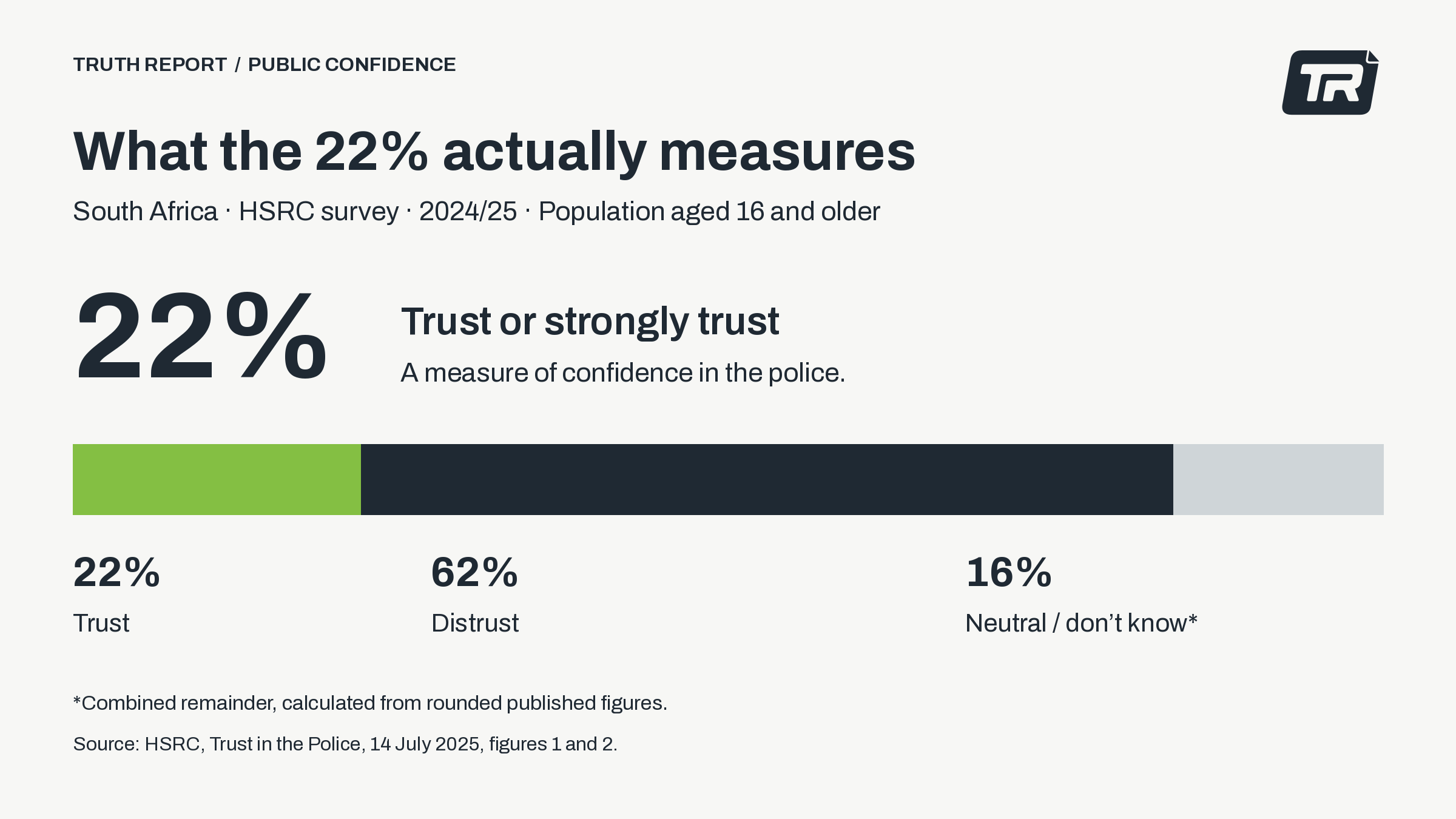
Only 22% expressed trust in the police in the HSRC’s 2024/25 survey. Recent reductions in recorded murder offer grounds for encouragement, but confidence requires a different kind of proof: a police service people can rely on when they need it.
South Africa can record fewer murders and still have a profound crisis of confidence in its police. Those two conditions are compatible. A national crime total measures one part of public safety; trust asks whether people believe the institution responsible for protecting them deserves their confidence.
The Human Sciences Research Council’s 2024/25 findings put trust in the police at 22%, against 62% expressing distrust. That is a severe institutional warning. It is also a finding that deserves precise treatment, because an inaccurate argument gives those responsible for police performance an easy way to avoid the difficult one.
The central question is how the South African Police Service, or SAPS, earns confidence through its work. A uniform establishes authority. It cannot, on its own, establish credibility.

What 22% means
The figure measures trust, rather than a general approval rating. The HSRC’s nationally representative survey programme uses face-to-face interviews with people aged 16 and older. Its published chart places trust at 22% in 2022, 2023 and 2024/25. These are dated observations, not a live reading of opinion in November 2026. The report sets out the method and trend.
Nor does 22% trust mean that 78% distrust the police. Neutral and uncertain answers also exist. The distinction matters: an honest account of institutional failure should not erase people whose views are mixed or unsettled.
The finding also cannot establish how many officers are corrupt. Public perceptions, disciplinary findings and criminal convictions answer different questions. Treating a confidence survey as proof of widespread individual criminality would turn a strong piece of evidence about legitimacy into an unsupported accusation.
The evidence against total failure
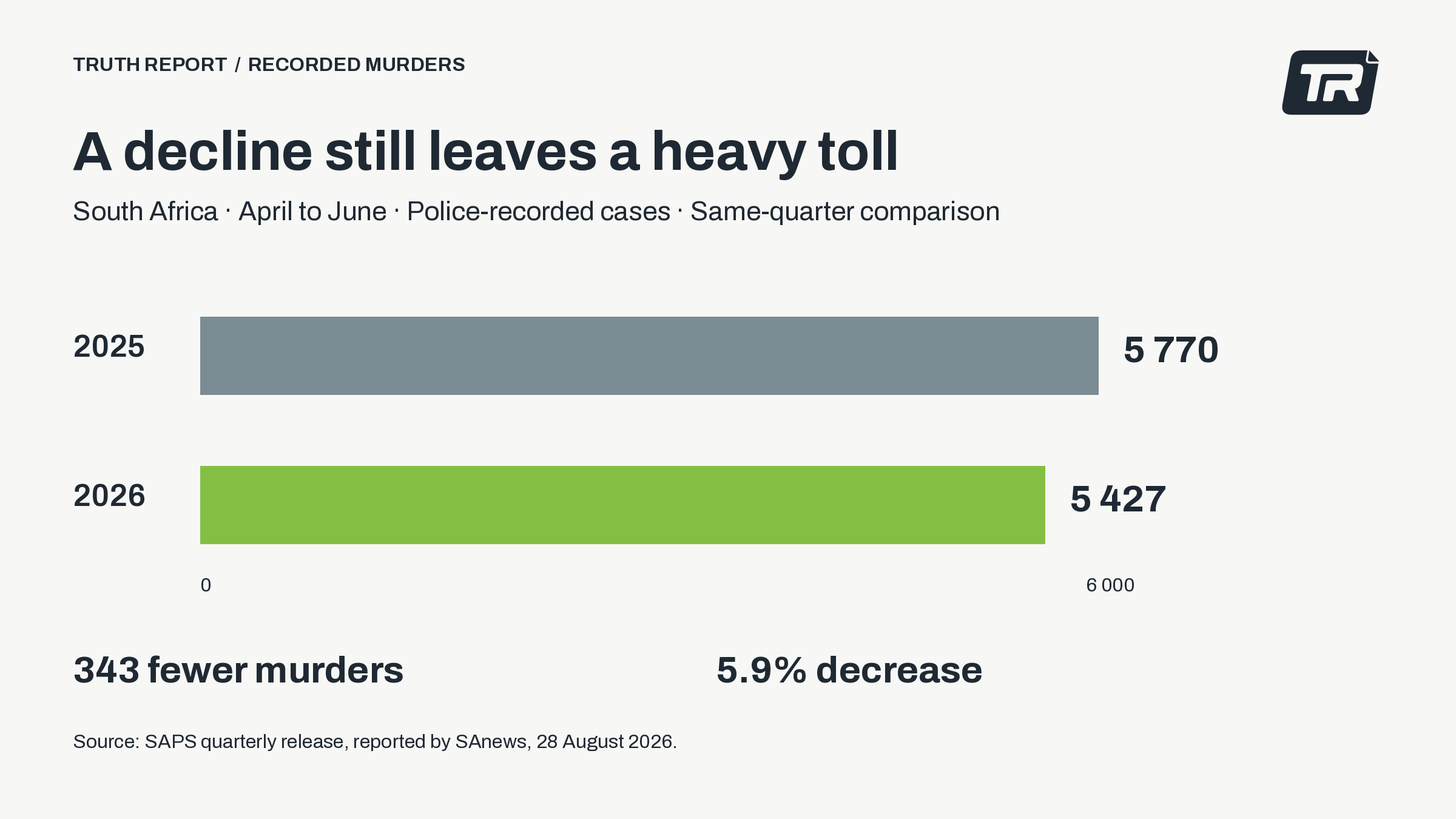
There is a substantial challenge to the claim that policing produces no positive results. At the August 2026 release of the first-quarter crime figures, police reported 5 427 murders during April to June, compared with 5 770 in the same period of 2025. That is 343 fewer recorded murders, a fall of 5.9%.
The same official account reported 780 hijacked and stolen vehicles recovered during the quarter. This is an institutional performance claim, not an independent assessment of each recovery. It nevertheless contradicts the absolute proposition that police never recover stolen property. SAnews reported the figures and the acting national commissioner’s account.
These improvements deserve recognition. Dismissing them would make criticism less credible and obscure the practical question of which interventions work well enough to repeat.
But the numbers cannot carry every conclusion officials might wish to draw from them. They do not isolate the contribution of policing from other influences on crime. They do not establish that every station improved, that victims received useful updates or that misconduct complaints were handled properly. A reduction in recorded crime is evidence of a change in recorded crime. The explanation needs further evidence.
Investigations remain a harder test
SAPS’s own 2024/25 annual report records a contact-crime detection rate of 47.55%, below its 48.75% target. The report attributes pressure on investigative work to detective losses and workloads. That explanation deserves scrutiny as a management problem: recruitment, retention and the allocation of cases are part of institutional performance.
The same report gives a murder detection rate of 10.13%. Its table includes both newly reported complaints and incomplete complaints from earlier years. This is therefore not a simple statement that 10.13% of that year’s murders resulted in convictions. Detection and conviction are separately reported measures, with different bases.
For a complainant, these distinctions may seem remote. Yet they matter for accountability. An institution can appear more successful or less successful depending on which denominator it chooses. Public reporting should make it possible to follow the work: what entered the system, what remained unresolved and what reached a defensible outcome.
Lawful restraint is part of good policing
Demanding effectiveness also requires recognising limits on police power. The Constitution protects an arrested person’s right to release where the interests of justice permit, subject to reasonable conditions. Release before trial is not, by itself, proof of corruption or a declaration of innocence. A particular decision must be judged on its legal basis and the relevant facts.
Likewise, section 26(3) prohibits eviction from a home without a court order made after considering the circumstances. A refusal to carry out an immediate eviction cannot automatically be treated as evidence that police are siding with an occupier. Commercial premises raise different legal questions; a general complaint cannot settle an individual dispute.
None of this excuses indifference, intimidation or a failure to explain what help is available. It means that a trustworthy service must combine lawful conduct with competent assistance. Restoring confidence cannot depend on officers ignoring rights whenever a frustrated complainant demands immediate action.
What would count as repair?
A useful reform agenda would make the ordinary case easier to scrutinise. Complainants should know who is responsible for an investigation, how to obtain an update and where to challenge neglect. Station-level reporting should distinguish an arrest from a prosecution, and a prosecution from a conviction. Oversight should examine what happened to complaints, rather than treating the number received as evidence of resolution.
These are tests proposed here for judging reform, not claims that such practices are uniformly absent. Their value is that they make performance observable. They also give diligent officers a way to demonstrate good work without asking the public to accept institutional reassurance on faith.
The choice is not between applauding every police announcement and assuming every officer is compromised. South Africans can recognise fewer recorded murders while demanding much better investigations and accountability. Confidence will become more defensible when the person who asks the police for help can see, understand and test what happens next.Truth Report · Sources linked in the article. Archival photograph credited above.