

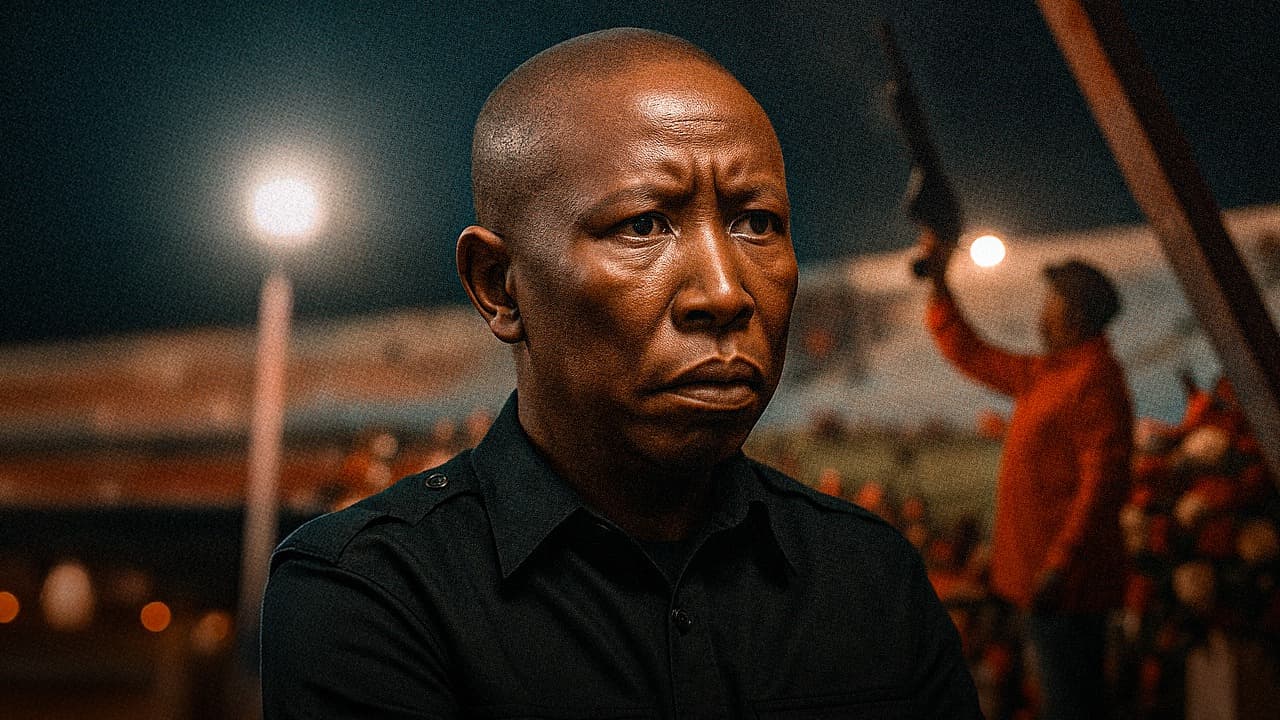
In a courtroom saga that dragged on longer than some of South Africa’s corruption inquiries, Julius Malema finally heard the words he had spent seven years dodging: guilty.
On Wednesday, East London Magistrate Twanet Olivier ruled that the Economic Freedom Fighters leader had fired a real firearm into the air during the party’s fifth anniversary celebrations at the Sisa Dukashe Stadium in Mdantsane in July 2018.

A Rally, a Gun, a Boomerang
The scene is etched into memory. Thousands of red-bereted supporters chanting revolutionary slogans as their commander-in-chief raised a gun and let rounds fly. What Malema framed as a show of power came back as a legal boomerang. The charges were clear: illegal possession of a firearm, contravention of the Firearms Control Act, unlawful possession of ammunition, and reckless endangerment.
Malema’s defence was that it was a toy gun. His former bodyguard, Adriaan Snyman, accused of handing him the weapon, was acquitted on all charges. Malema alone carries the weight of the verdict.
Sentencing arguments will be heard in January 2026. If the magistrate imposes the minimum custodial sentence, Malema could face more than a year behind bars. That would be long enough to remove him from Parliament. There will be no option of a fine. The political stakes are immense.
AfriForum’s Long Game
For AfriForum, which filed the charges in 2018, the ruling is vindication. Spokesman Jaques Broodryk wasted no time declaring victory, saying the judgment proves that even the politically connected cannot act as if they are above the law. He said the evidence overwhelmingly proved Malema committed serious offences under the Firearms Control Act. He added that this case shows that justice may be delayed, but it cannot be denied.
Seven years of legal delays, postponements, and procedural manoeuvres almost buried the case. AfriForum insists it kept the matter alive while prosecutors hesitated. Wednesday’s outcome was a symbolic win for the civil rights group and a stinging defeat for Malema’s carefully cultivated aura of untouchability.
Malema’s Counterattack
But if anyone thought Malema would take the blow quietly, they clearly have not been paying attention. The firebrand walked out of court to cheers from his supporters and launched straight into a familiar refrain: race, revolution, and persecution.
He labelled Olivier a racist judge, accused the justice system of being captured by white supremacists, and even invoked Donald Trump as part of the conspiracy against him. Malema declared that the case was never about justice. It was always about Julius Malema.
The EFF leader vowed to appeal all the way to the Constitutional Court. If prison comes, he said, it would be a badge of honour. He declared that he cannot be scared of prison and he is not scared to die.
In a move calculated to stir loyalty, he insisted he was ready to die on this hill and cast his conviction as proof that the system targets him, not his bodyguard, because of who he is.
Justice or Political Theatre?
Malema’s verdict lands in a South Africa where faith in institutions is already hanging by a thread. Courts may say justice has been served, but when a case takes seven years, what message does it send? To Malema’s critics, the ruling proves he is reckless, arrogant, and unfit for leadership. To his supporters, it cements his image as a revolutionary under siege.
The danger for South Africa is that both can be true. The rule of law flexed its muscles, but it did so at a snail’s pace. AfriForum gets its symbolic scalp while Malema uses the same judgment to energise his base. Both sides leave the courtroom claiming victory.
And that leaves the public asking whether this is accountability in action or just another episode of political theatre in a country drowning in it.


