


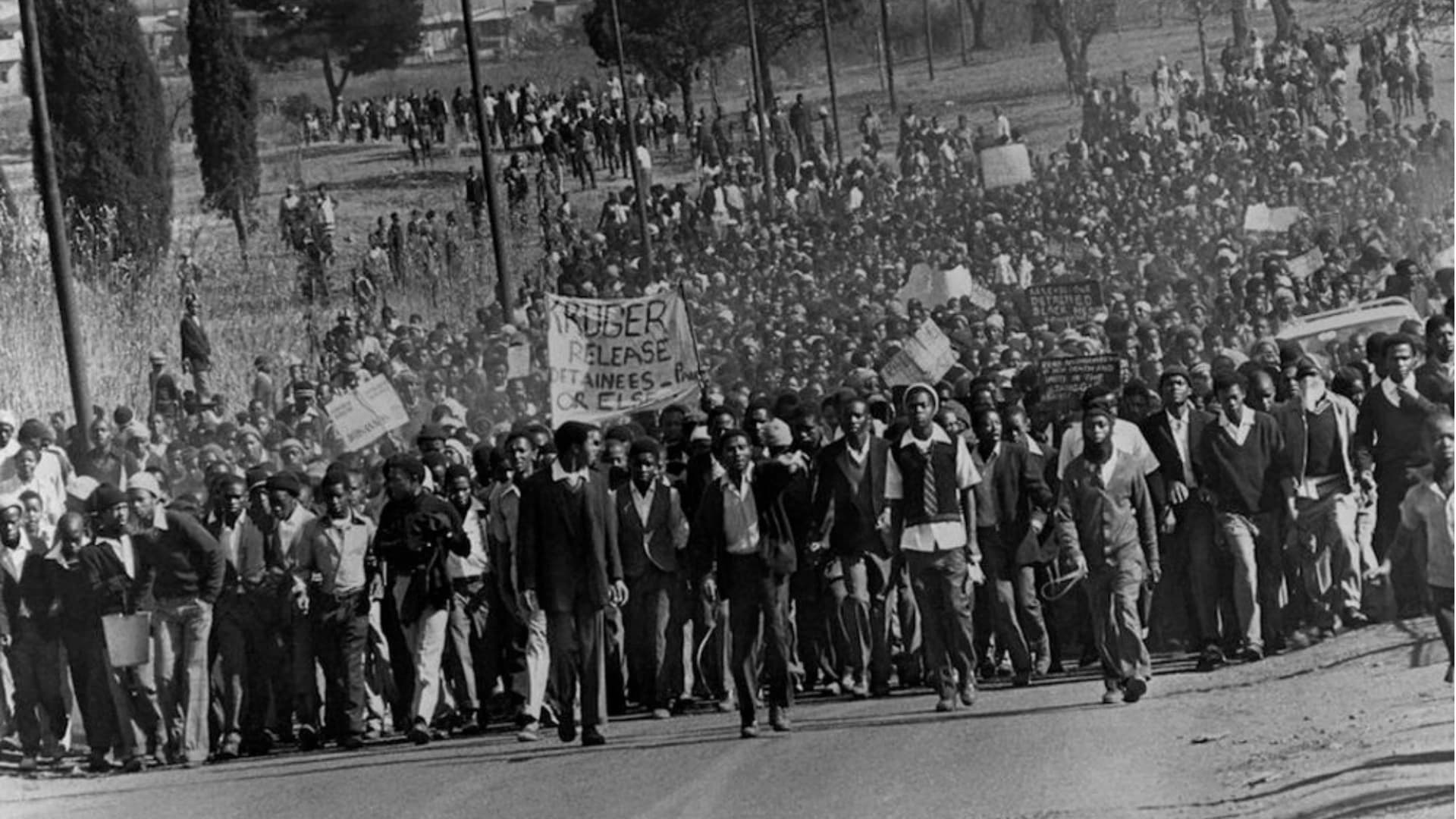
This Youth Month saw another orchestra of promises by politicians to the tune of improving education and job creation for the youth.
This year’s Youth Day was commemorated on Monday 16 June by officials, particularly with deputy president Paul Mashatile’s address in Potchefstroom and an Economic Freedom Fighters (EFF) rally in Umlazi, Durban.
Nearly 50 years after the ‘76 uprising of students, protest action again marked 16 June in Potchefstroom, North-West ahead of Mashatile’s address at a Youth Day event. The theme of the day was ‘Skills for the Changing World – Empowering Youth for Meaningful Economic Participation’.
“We must never forget,” said Mashatile, “those who joined the long list of matters and paid the ultimate price for our freedom. These are the young brave souls who fought for a dream that they never saw come to life.
Mashatile did, however, recognise “the reality that many young people in South Africa are not living the future they hoped for. They are confronted by high levels of unemployment, inequality and lack access to opportunities, especially in the digital world”.
Protests persist since Soweto uprising
Earlier that day, community members were reported to have attacked police with rocks and glass bottles. This protest signalled the youth’s discontent with a failing economic environment not conducive to ultimately securing employment opportunities. [enca.co.za]
Unrest like these seems to echo past demonstrations as youth unemployment currently sits at 45.5%.
Mashatile continued that the government must fix the structural challenges in the economy to address inequality and skills mismatch between education and what the job market needs.
“We need to encourage young people to look into starting their own businesses instead of waiting to be employed. In this day and age, entrepreneurship is one of the keys to building a better future.”
At King Zwelithini Stadium, Malema’s signature calls to pick up spears and continue the struggle did not fail to deliver.
“Today, we do not gather to celebrate. We gather to remember, to honour, to reflect and to revive the spirit of 1976. We are here today to say to the youth of 1976, you did not die in vain. Comrades, we must know, that as the youth of today, we have a responsibility to fight the legacy of Hendrik Verwoerd,” he said.
It’s funny how Malema brings up the name of a former prime minister who has been buried for almost 60 years a decade before the Soweto uprising even occurred.
So, 12 year old Hector Pieterson did not die in vain?
The state of SA education
The 2021 Progress in International Reading Literacy Study (PIRLS) report for South Africa revealed alarmingly low reading comprehension levels among Grade 4 learners. Scoring significantly below the international average, SA has 81% of Grade 4 learners unable to read for meaning in any language, including their mother tongue.
This means that only 19% of South African Grade 4 learners could comprehend what they were reading. The study also showcased a decline in reading comprehension since the previous PIRLS assessment in 2016.
The Organisation for Economic Co-operation and Development (OECD) outlined some of the main reasons behind South Africa’s high unemployment rate. South Africa’s labour market faces persistent mismatches between worker qualifications, fields of study, and job availability. [dailyinvestor.com]
This highlights a shortage of skilled and semi-skilled workers, which constrains long-term economic growth. Despite significant progress in recent decades, skills shortages persist due to a lack of quality education.
Whose fault is that? Former government officials that ruled over 60 years ago?
Language remains a battleground
To make matters worse, the language of education instruction remains a battleground — this time, the players have changed. Then, it was an oppressive apartheid government; today, it is a democratic government wielding a different kind of central power.
The 1976 youth uprising was triggered by the apartheid government’s attempt to force black schools to adopt Afrikaans as the medium of instruction in key subjects — seen as cultural oppression.
Today — nearly half a century later — government is advancing the BELA Bill. The BELA Bill aimed to revise the admission and language policies of schools, transferring decision-making authority from School Governing Bodies (SGBs) to the Head of Department (HOD).
Critics argue it could lead to the government forcing schools to abandon Afrikaans (or other mother tongues) in favour of English.
After 30 years of ANC rule, with literacy falling and youth unemployment skyrocketing — is this really still the legacy of apartheid? Or is it time for the current leadership to take responsibility?
For the youth of today — it’s not about the ghosts of 1976. It’s about the real failures of 2025.


