

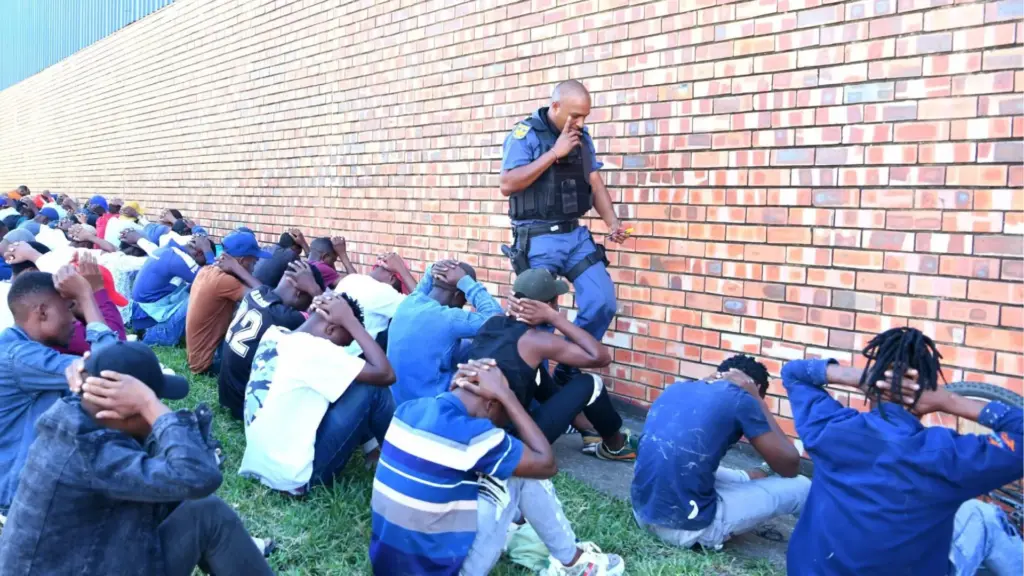
South Africans woke up this week to yet another jarring but unsurprising headline: SAPS raided a factory in Stanger, KwaZulu-Natal, uncovering over 300 undocumented foreign nationals being employed illegally. The owner of the facility was arrested, but the real question isn’t just “how did this happen?” — it’s how many more factories, farms, and businesses are operating just like this one, right under the government’s nose?
This isn’t a one-off. It’s not a fluke. It’s a symptom of systemic collapse — where immigration laws are ignored, labor regulations are flouted, and the state turns a blind eye until it’s politically convenient to act tough.
The Great Pretend: “We Didn’t Know”
A single factory. Over 300 illegal workers. Do the math — that’s not a hidden room or some back-alley operation. That’s a full-blown, humming, large-scale production site being run with zero regard for South African law. And yet, only now do we see a raid?
Where was the Department of Labour? Home Affairs? Local government inspectors? Were they asleep at the wheel — or complicit?
Because let’s be honest: you don’t get away with employing hundreds of undocumented foreigners unless someone’s looking the other way. Corruption? Incompetence? A toxic cocktail of both? You decide.
Economic Sabotage, Dressed as Business
South Africa’s youth unemployment is sky-high. Entire communities are desperate for work. But here we are, watching businesses line their pockets by exploiting vulnerable foreign nationals, paying them under the table, bypassing safety standards, and treating them as disposable labour.
And let’s not sugar-coat this: this isn’t just about illegal immigrants — it’s about economic sabotage.
This is the ANC government’s South Africa:
- Law-abiding citizens punished.
- Exploiters protected.
- Borders ignored.
If you’re running a legitimate business, complying with labour laws, paying taxes, and employing citizens — you’re being undercut by those who aren’t. That’s not capitalism. That’s state-enabled criminal enterprise.
Border Control? What Border Control?
This raid exposes a massive failure in border security and immigration enforcement. South Africa’s borders are so porous that hundreds of undocumented migrants can enter, settle, and get work en masse — often with fake papers or no documentation at all.
And when citizens raise alarm, they’re accused of xenophobia. But here’s the truth:
It’s not xenophobic to want law and order. It’s not xenophobic to demand that South Africa puts South Africans first.
The political class loves to posture about “unity” and “human rights,” while the working-class majority watches their communities rot from joblessness and illegal labour competition. There’s a difference between legal immigration and state-sanctioned lawlessness.
The Political Theater of Raids
Let’s not fall for the PR spin. Raids like this one in Stanger usually happen just before elections, when politicians need headlines. Suddenly, there’s a photo op. A press release. A Premier on site. But what happens a month from now?
Will the factory be shut down permanently? Will the owner be prosecuted? Will the undocumented workers be deported or just quietly released into society?
Or will it all fade, business as usual — until the next “crisis” reminds the public that their government only acts under pressure?
Time for Consequences
If this government was serious:
- Every undocumented worker would be processed and repatriated.
- The employer would face criminal charges, not a slap on the wrist.
- Inspectors would be dispatched nationwide — not just for show.
- A public list of offending businesses would be released.
But this isn’t about seriousness. It’s about optics. The Truth Report sees through it — and so do you.
Final Word
One raid doesn’t fix a broken system. South Africans deserve a country where the law applies to everyone — not just the soft targets.
We don’t need photo ops. We need order, enforcement, and leadership with a spine.
Until then, expect more factories, more illegal labour, and more empty press releases from a government that governs nothing.


