


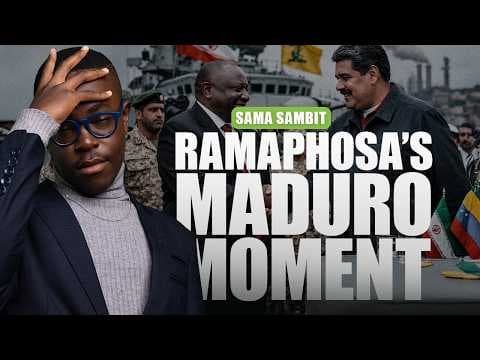
In this bold and unfiltered Truth Report interview, influencer THEE Sama Sambit breaks down why he believes Donald Trump’s recent move against Venezuela was not only justified, but necessary in the context of global security and geopolitical pressure.

Trump’s intervention, including military action that led to the capture or ousting of Nicolás Maduro amid accusations of narco-terrorism and corruption, has sparked intense debate internationally, with the U.S. signalling it may even oversee parts of Venezuela’s transitional governance and oil infrastructure to ensure a “safe transition.” While many governments, including South Africa’s, criticised the move as a violation of sovereignty, Sama argues that decisive action was required in the face of an illegitimate regime and regional instability.
But Sama goes further, drawing a controversial parallel between Venezuela and South Africa’s current leadership. He warns that Cyril Ramaphosa’s government could be headed toward its own “Maduro moment” if it continues cozying up to nations like Iran and refusing to confront internal decay. Sama suggests that failing states, whether in Latin America or Africa, become breeding grounds for corruption, criminality, and geopolitical manipulation, and that leaders who ignore these threats may one day find themselves facing external pressure, loss of credibility, and systemic breakdown. Critics of Trump’s move view it as overreach and “bullying” that violates international law, while supporters see it as confronting tyranny directly.
The conversation highlights a broader debate about sovereignty, intervention, and the responsibilities of global powers. Sama’s perspective is unapologetically pro-direct action, arguing that in some cases external pressure is needed to break cycles of corruption and decay that domestic politics cannot resolve. Whether one agrees with his analogy or not, the discussion reflects the intense polarization over how nations should respond to failing regimes, and whether countries like South Africa should heed lessons from Venezuela’s crisis before they reach a point of no return.
It’s a conversation that challenges viewers to rethink their assumptions about foreign policy, national sovereignty, and the price of inaction.


