


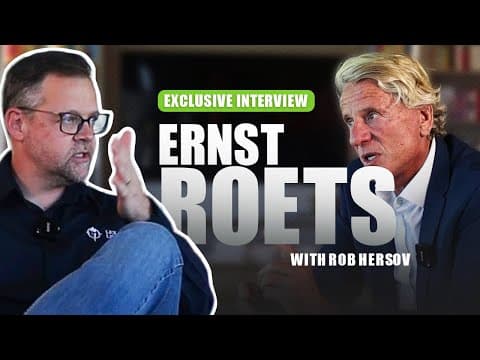
Rob Hersov sits down with Ernst Roets for a fierce, unfiltered conversation about the direction South Africa is heading in 2025, and what must be done to stop the freefall.

No polite politics. No academic diplomacy. Just two men tearing into the uncomfortable questions most analysts are too afraid to confront. Has the ANC lost any ideological purpose and morphed fully into a parasitic machine built on extraction, patronage, and control? Why do nearly half of South Africans now say they prefer military rule over the current version of “democracy”? And is the idea of a strong central state finally dead, after failing under the British Empire, the National Party, and now the ANC? For Roets, the evidence is overwhelming: centralised power collapses every time, and 2025 may be South Africa’s breaking point.
In this wide-ranging discussion, Ernst unveils his new initiative Lex Libertas, a think-tank and pressure group advocating for radical decentralisation, community sovereignty, and genuine autonomy for the country’s many cultural and linguistic communities. He draws on real-world models: Swiss cantons that govern themselves with precision, Scottish-style devolution that empowers local identities, and even blockchain-based DAOs that enable transparent decision-making without bureaucratic decay. The question he poses is simple: if the national state is imploding, why not build alternatives that actually work? The conversation dives into tax revolts, parallel service delivery, community security structures, and the power of organised civil disobedience to force the state to reform, or get out of the way.
This is not another doom-and-gloom interview. It’s a solutions-first confrontation with reality, packed with clear ideas for citizens who refuse to stand by while the country sinks. Whether you’re a policymaker, a frustrated taxpayer, a community leader, or simply a South African who still believes in a future worth fighting for, this discussion challenges you to rethink the entire structure of governance. Hersov and Roets make one thing clear: waiting for the state to save South Africa is over.
The future belongs to communities who take power back, intelligently, legally, and decisively.


