


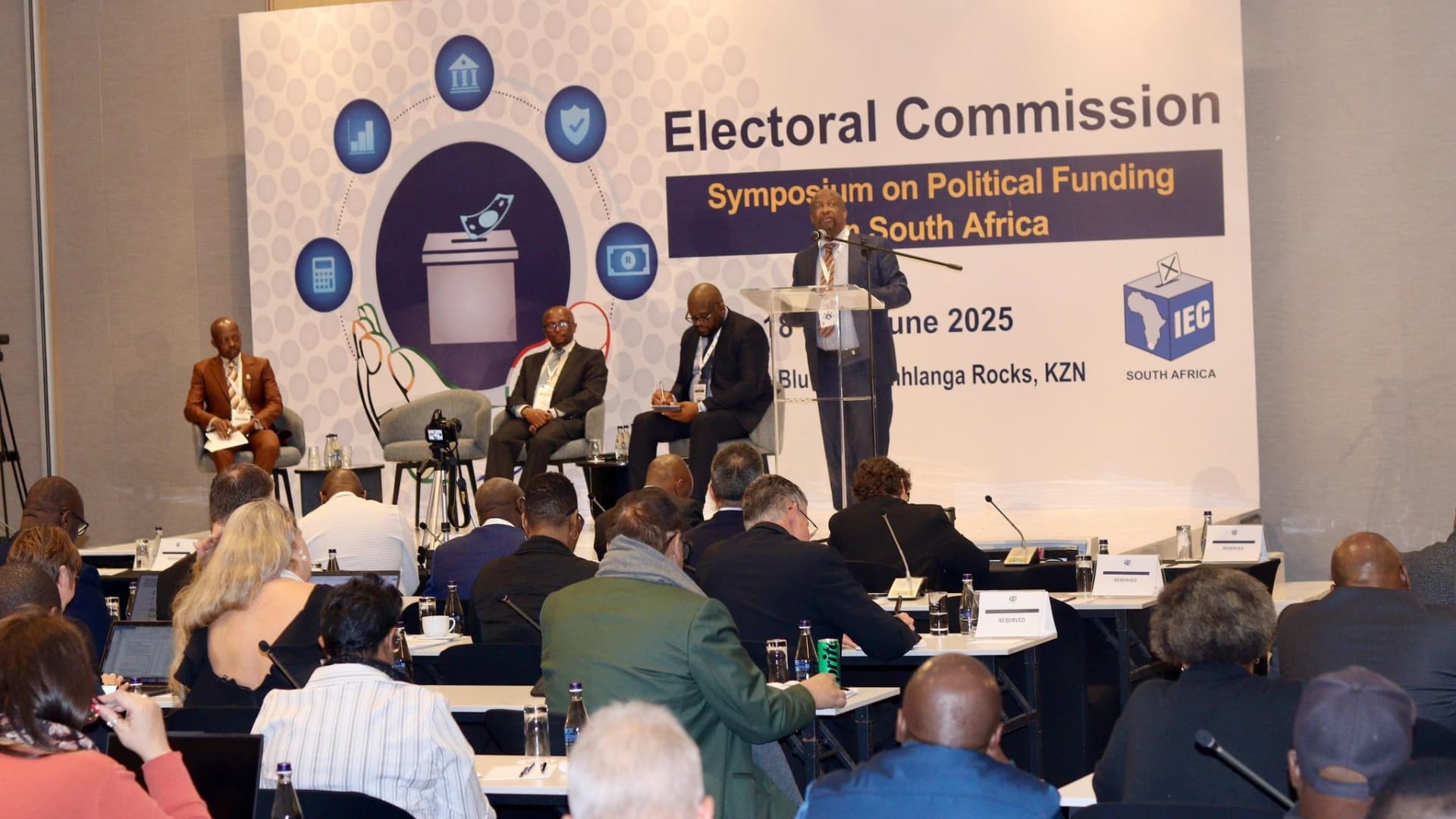
A recent study reveals widespread public concern over the lack of transparency in political party and candidate funding in South Africa, coupled with significant disengagement from political processes. This, according to a report released by the Human Sciences Research Council (HSRC) on behalf of the Electoral Commission of South Africa (IEC).
The findings were presented Wednesday 18 June by HSRC researcher Dr Ngqapheli Mchunu at the inaugural Electoral Commission Symposium on Political Funding in Umhlanga.
Two-day symposium held in Umhlanga
This symposium was a two-day event attended by approximately 200 politicians from parties including the African National Congress (ANC), Economic Freedom Fighters (EFF), United Democratic Movement (UDM), and Rise Mzansi, as well as representatives from non-governmental organisations.
The 215-page study, conducted between February and March this year, involved face-to-face interviews with 3 119 adults across SA’s nine provinces and 26 key informant interviews with experts from the IEC, political parties, civil society, academia, media and donors.
It examined public perceptions of the Political Funding Act (PFA) of 2018, which mandates disclosure of large donations, regulates public and private funding, and establishes mechanisms like the Multi-Party Democracy Fund (MPDF) to promote transparency and fairness in political financing.
SA losing trust in political institutions, study finds
The study found that 79% of South Africans believe the country is “headed in the wrong direction,” with only 58% expressing satisfaction with democracy. Trust in political institutions is notably low, with just 17% and 14% of respondents confident in political parties and politicians, respectively. Political disinterest is prevalent, with 40% reporting no interest in politics and 26% saying they are “hardly interested,” according to Mchunu.
Public awareness of the PFA remains limited, with 61% of respondents having heard “nothing” about the legislation and 20% possessing only “a little” knowledge. Awareness correlates with education and socio-economic status, with more educated and affluent individuals showing greater familiarity. “Awareness is strongly linked to education and socio-economic status with more educated and affluent individuals more aware. Those who had donated to political parties were more likely to be aware,” Mchunu said.
Public fears influence of wealthy donors
Concerns about the influence of wealthy donors on political decisions are significant, with 70% of respondents expressing worry—16% “extremely worried,” 21% “very worried,” and 33% “somewhat worried.” A majority, 57%, believe there is “too little information” about who funds political parties and candidates, while only 8% feel there is “too much information,” Mchunu noted.
The IEC is seen as the appropriate body to oversee political funding transparency, with 64% supporting its role in collecting donation data and 37% emphasizing the importance of tracking expenditure. However, public willingness to contribute to the MPDF, a voluntary fund managed by the IEC to support represented parties and candidates, is low. Three-quarters of respondents were either “not at all” (47%) or “not very” (27%) willing to donate, citing distrust in political processes, lack of awareness, and financial constraints.
“Many adults expressed reluctance to donate due to a lack of awareness, distrust in political processes in general and concerns about the misuse of funds. Financial constraints also play a significant role, some of the mass public felt unable to contribute beyond their basic needs,” the study stated. Even tax rebates failed to sway opinions, with two-thirds showing low willingness to donate despite such incentives.
Can the MPDF rebuild public confidence?
HSRC CEO Sarah Mosoetsa acknowledged the challenges in implementing the PFA but remained optimistic about addressing them. “The PFA regulatory mandate presents ongoing difficulties but they remain difficulties that are not insurmountable. Political finance is globally dynamic,” she said.
Mosoetsa also highlighted the broader implications of unequal funding access, noting, “South Africa, particularly with our historic and structural inequality, access to campaign funding is particularly consequential and equal access to political finance often reinforces unequal access to power.”
The study underscores the need for enhanced public education to boost awareness of the PFA and foster support for mechanisms like the MPDF, which some see as a tool to strengthen democracy and empower marginalized groups. Regular voters were more likely to support donation freedoms than non-voters, indicating that electoral participation shapes attitudes toward political funding.


