


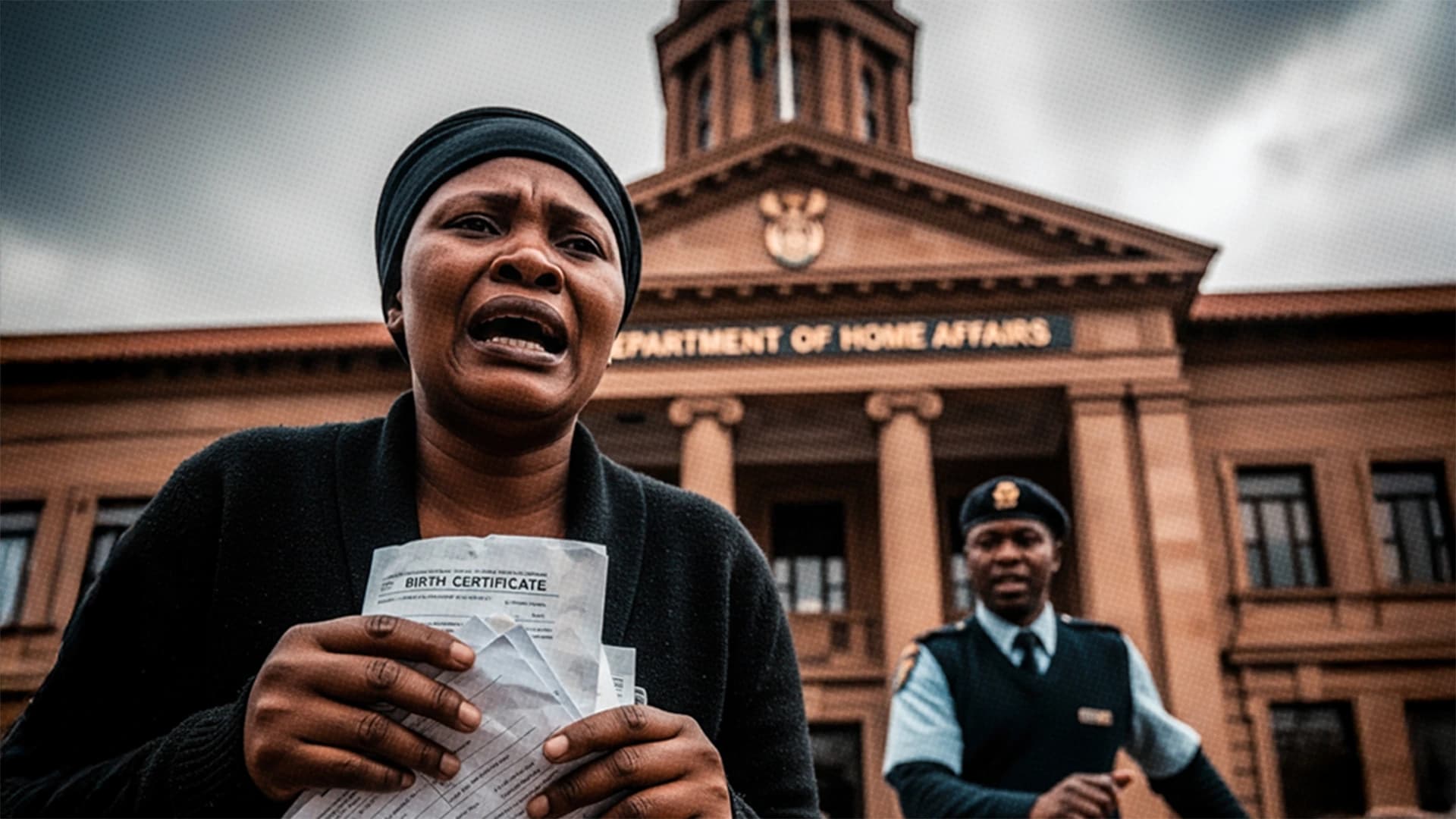
Primrose Modisane a 36-year-old mother of two, walked into the Department of Home Affairs in Germiston, accompanied by her grandmother and supporters, to collect her South African birth certificate on Tuesday 5 August.
This moment marked the end of a decades-long battle against bureaucratic obstruction and systemic failures that left her stateless in her own country. Her victory, secured only after a court order and the threat of public shaming, underscores a systemic crisis within the Department of Home Affairs (DHA), which has repeatedly failed to uphold the constitutional rights of countless citizens.
More than four months later, and despite submitting extensive documentation, DNA tests, school records, sworn affidavits, and even the support of Parliament’s Portfolio Committee on Home Affairs, Primrose remained undocumented. Her case reflects years of public humiliation, bureaucratic obstruction, and unlawful delays.

Modisane’s struggle began in childhood when she discovered she lacked a birth certificate, a document essential for accessing education, healthcare, and social services. Born in Zimbabwe – but entitled to South African citizenship through her grandmother, Barbara Modisane, a South African born in the 1940s in the then-Transvaal – she faced relentless obstacles from the DHA.
Zimbabwe-born SA citizen
Primrose and her mother were both born in Zimbabwe. Modisane came to South Africa when she was five years old. Her mother was eventually granted South African citizenship but the DHA demanded Modisane produce a birth certificate from Zimbabwe.
She argued in court papers that she also could not travel to Zimbabwe to access birth records because she had no ID or passport from either country. Her birth was also never registered in Zimbabwe.
Her case, supported by Lawyers for Human Rights (LHR), culminated in an April 2025 Gauteng High Court (Pretoria) ruling by Judge Mandla Mbongwe, ordering the DHA to issue her birth certificate and identity document within 30 days. The court ruling confirmed that Modisane is a South African citizen by descent, through her grandmother.
The Court ordered the Department of Home Affairs to:
- Recognise her citizenship under Section 2(1) of the Citizenship Act
- Register her birth and issue her with a birth certificate and ID within 30 days.
However, the department failed to comply until Modisane, LHR, and retired Constitutional Court Judge Johann Kriegler scheduled a media briefing to expose the delay.
“This should never have taken this long. It should not take a court order, and the threat of a media briefing for a South African citizen to be acknowledged in her own country,” Kriegler said in a statement.
In an interview with GroundUp, he added, “I have no doubt that the threat of public disclosure precipitated the sudden production of the birth certificate.” He noted that LHR had followed up with the DHA dozens of times after the ruling, receiving no response until the media threat loomed.
Broader pattern emerge
Modisane’s ordeal mirrors a broader pattern of DHA inefficiencies. Her mother, Phumulani Tshuma, received her own documentation only weeks before dying of untreated cancer in 2023, having been denied hospital access due to her undocumented status.
Modisane herself faced “hostile encounters” with officials who labelled her and her 80-year-old grandmother “border hoppers,” despite DNA tests proving their South African heritage, GroundUp reported.
She was trapped in legal limbo, unable to complete matric, vote, or open a bank account. Her children’s birth certificates omitted her name, requiring DNA tests to establish paternity.
“The first thing I am going to do when I get my ID is open my own bank account, get my name added to my children’s birth certificates, and register my youngest child for school. Then I will go to my mother’s grave and tell her that this suffering is over,” Modisane said.
This systemic failure extends beyond Modisane
A Section27 case study highlights Maria Matthews*, a 26-year-old undocumented South African who faced similar barriers when attempting to register her newborn’s birth in 2023.
Heidelberg Hospital refused to issue proof of birth due to her lack of an ID, charging her R8 000 as a “private patient” under the National Department of Health’s policy, despite a 2023 Gauteng High Court order prohibiting such practices. Only after Section27’s intervention did the hospital relent, allowing Matthews to register her child.
“Maria’s fight was not only about obtaining the required documentation to register her newborn’s birth, but exposed Heidelberg Hospital’s violation of a court order,” Section27 noted.
Former DHA Minister Aaron Motsoaledi acknowledged that there was a backlog of 258 000 late birth registration applications in 2023.
Legal action by the Children’s Institute and Legal Resources Centre (LRC) on behalf of 15 applicants, filed in December 2024, sought to address this, highlighting children denied healthcare, education, and social grants due to delays. According to the LRC the court action led to one-on-one engagements with the department that has resulted in 10 of the 15 applicants obtaining their documents.
Documentation for foreign births
Responding to Truth Report’s questions on what went wrong with Modisane’s application, the DHA spokesperson Thulani Mavuso said: “Registration of the birth of Ms Modisane was concluded after the period stipulated by the court because of legal consultations the Department had to undertake in light of the lack of documentation required for foreign births, as per Regulations on the South African Citizenship Act, 1995, as amended.
“Before the court judgment, the applicant submitted an application for foreign birth without the required full birth certificate, verified by the country of origin (Zimbabwe).”
He said to confront systemic issues the department had implemented Standard Operating Procedures and training through its Learning Academy. It has expanded access by establishing birth registration points at high-volume health facilities, alongside 348 offices and 220 mobile units for rural areas.
“These people-oriented efforts have enabled the department to register a total of 868 000 births during the 2024/25 financial year, of which 143 300 were late registrations,” Mavuso said.
He also reported significant progress on the late birth registration backlog.
“The Department’s records reflected only 33 000 late registration of birth cases as at June 2025. These are current applications,” Mavuso said.
*Name changed to protect privacy


