


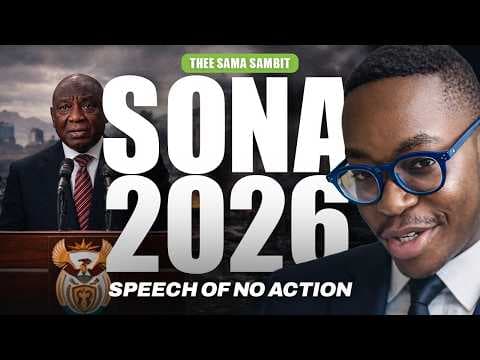
In this hard-hitting breakdown, THEE Sama Sambit examines what critics describe as a familiar pattern surrounding South Africa’s State of the Nation Address: ambitious promises, choreographed political confrontation, and limited measurable accountability.

Each year, the speech sets out bold commitments on jobs, growth, energy and anti-corruption — yet many South Africans continue to face deepening economic strain, including extremely high youth unemployment and persistent service delivery failures. The question raised is whether SONA has become more symbolic performance than substantive progress report.
The discussion confronts uncomfortable realities. Why do key pledges reappear year after year with little visible structural change? Who deserves credit for improvements in electricity supply, and how sustainable are those gains? Why do major corruption investigations often fade from public attention without clear resolution? And perhaps most importantly, what role do voters, media cycles and party loyalty play in allowing repetition to replace results? These are not abstract concerns — they go to the heart of governance, trust and democratic accountability.
This is not an argument for cynicism, but for scrutiny. A functioning democracy depends on citizens who evaluate performance rather than presentation. As the next election cycle approaches, the challenge is not simply whether leaders deliver compelling speeches, but whether they deliver outcomes.
For South Africans concerned about economic recovery, institutional integrity and credible leadership, the real measure of SONA lies not in applause lines, but in what changes once the cameras switch off.


