

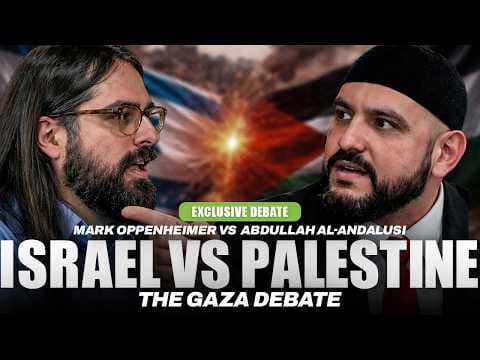
In this unfiltered public debate, Johannesburg advocate Mark Oppenheimer and British Muslim intellectual Abdullah al-Andalusi confront one of the most emotionally charged and politically volatile issues of our time: Gaza, October 7, and the global fallout that followed.

The exchange moves beyond social-media outrage and rehearsed talking points, diving head-first into international humanitarian law, competing claims of genocide, and the moral responsibilities of states, movements, and civilians. This is not a friendly panel, it is a direct clash of worldviews, tested live and without insulation.
The debate rigorously interrogates definitions that are often thrown around but rarely examined. What legally constitutes genocide? How is intent established under international law? Are comparisons between Israel and apartheid-era South Africa historically valid or dangerously misleading? Oppenheimer and al-Andalusi spar over Zionism, Hamas, civilian accountability, and whether moral outrage is being applied consistently, or selectively, depending on politics, identity, and media framing. Each argument is challenged in real time, forcing both speakers to defend their positions under pressure rather than hide behind slogans.
What makes this confrontation stand out is its refusal to simplify. There are no edits, no viral clips engineered for applause, and no easy villains offered to the audience. Instead, the discussion exposes how media narratives shape public morality, how free speech collides with hate-speech accusations, and why uncomfortable questions are increasingly pushed out of mainstream discourse.
Agree or disagree, this is what real debate looks like: arguments laid bare, logic stress-tested, and conclusions left to the listener rather than dictated from above.


