

Viral footage of a security guard assault has reignited a national debate about policing, private security, homelessness, violence, and the collapse of public trust.
A disturbing viral video has forced South Africans into an uncomfortable conversation.
The footage, filmed in Cape Town, appears to show private security officers detaining a man on the side of the road before one officer repeatedly kicks him in the face. The clip spread rapidly across social media, sparking outrage, debate, and renewed scrutiny of South Africa’s booming private security industry.
For many viewers, the video was proof that parts of the security sector have become dangerously aggressive. For others, it exposed something deeper. A country where private security companies are increasingly expected to do the work of a collapsing state.
The incident quickly drew a response from security company Zonewatch, which confirmed that officers involved had been suspended pending an internal investigation. But the public fallout went far beyond one company or one incident.
The video opened a national wound.
Why are private security guards now functioning as first responders in entire communities?
Why are residents calling armed response companies for problems that should belong to police, social workers, or law enforcement?
And what happens to a country when citizens lose faith in the institutions meant to protect them?
“We Are The Last Boy Scouts”
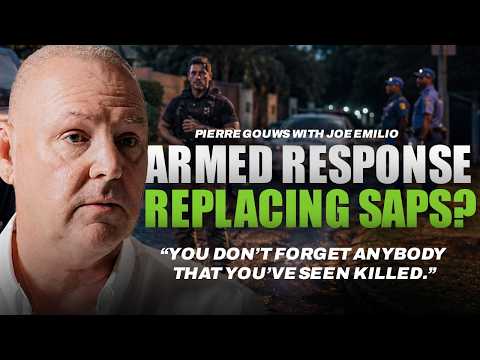
Pierre Gouws has spent more than three decades inside South Africa’s private security industry.
A former South African Air Force member who later built multiple security businesses, Gouws has operated through some of the country’s most volatile periods. From the post 1994 transition to the July 2021 riots, he says he has watched both the criminal landscape and state policing deteriorate dramatically.
“South Africa’s security companies are filling a void because nobody else is coming,” Gouws said during his interview with Truth Report.
He does not defend the violence seen in the viral video.
“Our job is to use minimum force, detain, and protect the person that you’ve caught because it affects his case. Anything you do with him affects the case that is heard.”
But he argues that the public often sees only the final moments of an incident while ignoring the environment security officers operate in daily.
“We deal with violence every single day.”
That environment has become increasingly unstable.
South Africa recorded more than 27,000 murders in the 2023 to 2024 financial year. That translates to roughly 75 murders every day. Violent crime remains among the highest in the world. Carjackings, armed robberies, kidnappings, and gang related violence continue to rise across major urban centres.
At the same time, the country’s private security industry has exploded.
South Africa now has one of the largest private security sectors on earth. Estimates place the industry at over R50 billion annually, with more than 580,000 registered security guards compared to roughly 150,000 police officers.
In many neighbourhoods, armed response vehicles arrive long before SAPS.
Sometimes, police do not arrive at all.
The Catch And Release Crisis
One of the most revealing moments in the interview came when Gouws described what many security companies face daily.
Guards are often expected to respond to noise complaints, public intoxication, aggressive vagrancy, domestic disturbances, theft, and violent altercations.
Yet legally, most private security companies have very limited authority.
“We’ve got no mandate to do it,” Gouws explained.
That creates a dangerous contradiction.
Communities expect security companies to solve every problem because they are visible, armed, and mobile. But legally, their powers are narrow, their liability is massive, and police backup is frequently delayed.
The result is frustration on all sides.
Gouws described incidents where guards waited hours for police to arrive after detaining suspects for theft or shoplifting.
“The longest we waited recently was six hours for SAPS.”
In many cases, suspects are simply released because businesses cannot afford to keep staff tied up indefinitely.
That revolving door has become a defining feature of South Africa’s crime crisis.
Residents see repeat offenders returning to the same areas days later.
Security officers become increasingly cynical.
And communities slowly stop believing that justice exists.
The Hidden Pressure On Security Guards
The public often sees private security guards as intimidating figures. Armed men in tactical gear racing through suburbs with flashing lights.
But behind the image lies an industry under enormous pressure.
Fuel prices, firearm regulations, training requirements, vehicle costs, insurance burdens, and regulatory compliance have all increased dramatically.
Meanwhile, security officers are increasingly exposed to trauma.
Gouws revealed that one of his own staff members recently died by suicide.
“I’d love to know how many of those things are happening in our industry,” he said.
The mental toll is severe.
Armed response officers are frequently first on scene at murders, home invasions, assaults, overdoses, and suicides.
“I remember going into a house with an elderly lady that had a dog collar around her neck and she was dragged through the house,” Gouws recalled.
“You don’t forget that.”
South Africa’s private security sector increasingly functions as a hybrid between police service, emergency response, trauma response, and community crisis management.
But unlike SAPS, there is little national discussion about the psychological cost on guards themselves.
The Vagrancy Debate Nobody Wants To Have
The interview also ventured into one of South Africa’s most explosive social issues.
Homelessness, addiction, and urban decay.
Gouws argued that many communities are trapped in a cycle where residents unintentionally enable destructive behaviour.
“The people left behind are either dealing with alcohol dependency or drug addiction,” he said.
Cape Town alone spends hundreds of millions of rand on homelessness interventions, shelters, rehabilitation programmes, and safe spaces.
Yet the problem continues to grow.
In cities across South Africa, residents increasingly complain about aggressive begging, drug use in public spaces, theft, and violent confrontations linked to chronic addiction.
The issue has become politically radioactive.
Activists argue that criminalising homelessness is inhumane.
Residents argue that communities are becoming unsafe.
Security companies are often stuck directly in the middle.
“We are prolonging the problem and making it bigger,” Gouws said, referring to residents giving money directly to street dwellers instead of directing them toward shelters and support systems.
It is a harsh conversation.
But it reflects a broader truth about South Africa’s urban crisis.
The country is increasingly trying to solve deep social collapse with armed response vehicles.
The July 2021 Riots Changed Everything
Perhaps the clearest example of the state’s weakening control came during the July 2021 unrest.
What began after the imprisonment of former President Jacob Zuma rapidly escalated into one of the worst outbreaks of violence in democratic South Africa.
More than 350 people died.
Shopping centres, factories, warehouses, and logistics hubs were looted and burned across KwaZulu Natal and Gauteng.
Economic losses were estimated at more than R50 billion.
Entire communities formed armed patrols.
Private security companies coordinated emergency operations.
Citizens stood guard outside shopping centres and neighbourhood entrances with privately owned firearms.
Gouws says the riots permanently changed the relationship between municipalities and private security firms.
“Private security and the City of Cape Town did not work very well together before,” he explained.
That changed when fears emerged that unrest could spread into the Western Cape.
Within 48 hours, security companies coordinated hundreds of armed personnel into emergency response structures.
The city began integrating private operators into broader communication systems and emergency planning.
For many South Africans, the riots shattered the illusion that the state alone could maintain order.
The lesson was brutal.
When crisis hits, communities increasingly rely on themselves.
The Firearms Debate Is About More Than Guns
One of the most contentious parts of the discussion centred around proposed firearm restrictions and tighter controls on the security industry.
Critics argue that South Africa already has too many guns.
Supporters of firearm ownership argue the opposite.
They believe disarming law abiding citizens and private security companies while violent crime rises would be catastrophic.
Gouws was blunt.
“There’s 150,000 police officers and over 500,000 security officers. We’ve got more technology, better systems, and more vehicles.”
Whether one agrees with him or not, the numbers highlight a reality many South Africans already understand instinctively.
The country’s safety infrastructure no longer rests primarily with the state.
It increasingly rests with private networks.
Neighbourhood watches.
Private security firms.
Community WhatsApp groups.
Armed citizens.
Volunteer responders.
That decentralised system may be imperfect, but for millions of South Africans, it is the only functioning safety net they still trust.
South Africa’s Trust Crisis
The viral security video triggered outrage because it exposed something deeper than misconduct.
It exposed exhaustion.
Exhausted communities.
Exhausted guards.
Exhausted police officers.
Exhausted citizens trying to navigate a society where institutional trust continues to erode.
Even Gouws acknowledged that many honest police officers remain trapped inside a collapsing system.
“You get so many good police people that actually feel sorry because they don’t have the tools or equipment or backup they need.”
That may be the most important point of all.
South Africa’s crisis is not simply about bad policing or aggressive security guards.
It is about institutional decay.
When systems weaken for long enough, unofficial systems rise to replace them.
Sometimes those systems work.
Sometimes they fail.
And sometimes, as the viral video showed, they explode into public controversy.
A Country Walking A Dangerous Line
South Africa’s private security industry now occupies a strange and uncomfortable position.
It is criticised for being too powerful.
Yet millions of citizens depend on it daily.
It is accused of overreach.
Yet communities constantly demand more intervention.
It is expected to uphold order.
Yet often operates without meaningful state support.
That contradiction sits at the centre of modern South Africa.
A nation where private institutions increasingly compensate for public collapse.
The viral video may eventually fade from public attention.
But the questions it raised will not.
Who protects the public when the state cannot?
Who protects the guards themselves?
And how long can a country survive when trust in its institutions continues to disappear?
As South Africa’s crime crisis deepens, those questions are becoming impossible to ignore.


