


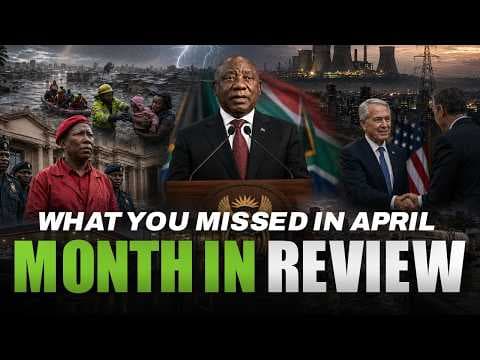
This month, South Africans watched the Constitutional Court reopen the Phala Phala scandal, heard warnings of a growing “Water Mafia” tightening its grip on collapsing infrastructure, and saw renewed debates around offshore wealth, Bitcoin, and the future of financial sovereignty. Across every story, one theme kept emerging: trust in institutions is breaking down. This is the Truth Report monthly recap.
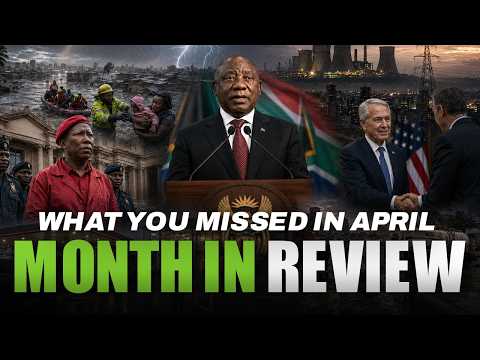
For many South Africans, this month felt less like ordinary politics and more like watching a pressure cooker finally begin to crack.
The headlines came fast.
The Constitutional Court delivered a politically explosive ruling on Phala Phala. Reports surfaced of organised syndicates allegedly targeting South Africa’s water infrastructure budgets. Discussions around offshore wealth protection and Bitcoin intensified as concerns around economic instability and state decline continued growing.
Different stories. Different sectors. Different people.
But underneath all of them sits the same question:
Who actually controls the future of South Africa?
That question has quietly defined much of Truth Report’s coverage this month.
The Constitutional Court Reopens the Phala Phala Firestorm
The biggest political story of the month arrived when the Constitutional Court ruled that Parliament acted unconstitutionally when it shut down impeachment proceedings linked to President Cyril Ramaphosa’s Phala Phala scandal back in 2022.
Almost immediately, social media exploded with misinformation.
Some claimed Ramaphosa had been impeached.
Others claimed the Constitutional Court had found him guilty of corruption.
Neither was true.
What the court actually ruled was arguably more important in constitutional terms.
The court found that Parliament could not simply use its political majority to bury a process after an independent Section 89 panel had already found prima facie evidence requiring further investigation.
That phrase became central to the entire debate.
Prima facie evidence does not mean guilt. It means there appears to be enough evidence at face value to justify deeper investigation.
The original Section 89 panel had already concluded there may have been constitutional violations linked to the handling of foreign currency stolen from Ramaphosa’s Phala Phala game farm.
Instead of allowing the impeachment process to continue, Parliament voted to terminate it in December 2022.
This month, the Constitutional Court effectively reversed that decision.
“The Constitutional Court has effectively ruled that Parliament unlawfully shielded the president from further scrutiny.”
That is the real significance of the ruling.
Not criminal conviction.
Not impeachment.
Constitutional accountability.
The ruling also landed at a politically dangerous moment for the ANC. Unlike in 2022, the governing party no longer holds the same level of parliamentary dominance following the 2024 election losses.
The result is that the Phala Phala saga, which many believed was politically dead, is now fully alive again.
The Water Mafia and the Rise of Infrastructure Cartels
If Phala Phala exposed questions around political accountability, the Water Mafia story exposed something arguably even more disturbing.
The slow emergence of organised criminal control over public infrastructure.
Truth Report spent much of the month covering allegations surrounding construction syndicates and so called “business forums” targeting South Africa’s water infrastructure projects.
The numbers involved are staggering.
At the centre of the controversy sits a reported R2.3 billion allocation for water and sanitation upgrades across vulnerable municipalities and metros.
According to multiple reports and security analysts, organised groups have allegedly been disrupting construction projects and demanding up to 30 percent cuts from contractors before allowing work to continue.
What makes the story especially alarming is the alleged feedback loop that follows.
Water projects stall.
Pipes remain broken.
Reservoirs stay empty.
Municipalities increasingly rely on emergency tanker contracts.
And in some cases, the same networks accused of sabotaging infrastructure are allegedly linked to the tanker economy profiting from the crisis.
It is a system where collapse itself becomes profitable.
“This is no longer just corruption. It is organised extraction.”
The consequences are visible everywhere.
Johannesburg residents have endured recurring water outages.
Large sections of Gauteng have experienced intermittent supply disruptions.
Businesses face rising operational uncertainty.
Factories require stable water access to operate.
Without reliable infrastructure, investment slows, businesses relocate, and local economies deteriorate further.
South Africa’s infrastructure crisis is no longer simply about incompetence.
Increasingly, it is about criminal capture.
The Offshore Escape Plan
Another major theme this month revolved around wealth flight, offshore structures, and growing distrust in the South African economy.
Truth Report featured extended discussions around the shrinking tax base, declining investor confidence, and why many wealthy South Africans continue moving assets offshore.
The concerns are not entirely new.
South Africa’s economic growth has remained weak for years. Mining employment has sharply declined from historical highs. Electricity instability continues damaging industrial output. Logistics bottlenecks at ports and rail networks remain major barriers to growth.
Against this backdrop, many investors are looking abroad.
One recurring argument featured heavily this month:
“If you think the world economy has issues, has problems, the dollar is going to devalue or the rand is going to rapidly devalue, where do you put your money? Bitcoin.”
That conversation eventually expanded into a broader discussion around Puerto Rico, Caribbean financial jurisdictions, tax incentives, and Bitcoin backed financial products designed for global investors.
The discussions reflected something deeper than crypto speculation.
They reflected declining faith in traditional systems.
Bitcoin, Financial Sovereignty, and the “Orange Pilled” Generation
Bitcoin coverage became one of the most talked about subjects featured on Truth Report this month.
Not simply because of price speculation.
But because of what Bitcoin represents psychologically.
For supporters, Bitcoin is increasingly viewed as an alternative financial system entirely outside government control.
One guest described Bitcoin as:
“The only investment that I’ve found that is uncorrelated to the world economy.”
The discussions explored the emergence of Puerto Rico as a growing crypto hub, alongside plans to build major Bitcoin reserves through offshore financial structures.
There was also a broader generational argument woven throughout the conversations.
Younger generations understand digital assets instinctively because they grew up alongside the technology.
Older institutions still control most of the world’s wealth.
That tension may define the next decade of finance.
Globally, institutional Bitcoin adoption has accelerated rapidly since the approval of spot Bitcoin ETFs in the United States in 2024. Major firms including BlackRock entered the market, helping push Bitcoin further into mainstream finance.
At the same time, concerns around inflation, sovereign debt, and fiat currency devaluation continue fuelling interest in decentralised alternatives.
For many South Africans facing a weakening rand, rising taxes, and low trust in institutions, those conversations are becoming harder to ignore.
The Bigger Pattern Behind Every Story
At first glance, Phala Phala, water syndicates, and Bitcoin offshore structures seem completely unrelated.
But they are all symptoms of the same larger reality.
A crisis of institutional trust.
People no longer trust Parliament to hold leaders accountable.
Communities no longer trust municipalities to deliver basic services.
Investors no longer trust the long term stability of local systems.
And increasingly, citizens are looking for alternatives outside traditional structures.
That is the real story underneath this month’s headlines.
Not simply corruption.
Not simply politics.
But the gradual erosion of confidence in the institutions meant to hold society together.
The Question South Africa Must Answer
This month forced South Africans to confront uncomfortable questions.
Can constitutional accountability still function in a deeply polarised political system?
Can the state still protect infrastructure projects from organised criminal capture?
Can economic confidence survive without functioning logistics, energy stability, and institutional trust?
And perhaps the biggest question of all:
What happens when citizens begin searching for financial, political, and social alternatives outside the system itself?
Because once trust disappears, rebuilding it becomes far harder than losing it.
And right now, South Africa appears to be entering an era where trust itself has become the country’s scarcest resource.


